A Modern Solution for Tooth Restoration
A dental crown is a custom‑fabricated cap that completely covers a damaged tooth, restoring its shape, strength, and appearance. In the United States crowns are one of the most frequently performed restorative procedures because they protect weakened teeth, seal out bacteria, and support bridges or implants while preserving the natural tooth structure. This article examines crowns from four essential angles: the health benefits of theing decay and improving bite function, the step‑by‑step clinical procedure from preparation to permanent placement, the range of costs and insurance coverage across the country, and the material choices—porcelain, zirconia, metal, or hybrid—allowing patients to balance durability, aesthetics, and budget.
Why Dental Crowns Matter for Oral Health
 Dental crowns act as a protective shield that covers the entire visible portion of a damaged or weakened tooth. By encasing the tooth, a crown prevents further decay, fracture, and sensitivity, especially after severe decay, large fillings, or root‑canal treatment. The sealed restoration blocks bacterial infiltration, reducing the risk of new caries and gum disease that can arise from gaps between the tooth and gingiva. Because the crown restores the tooth’s original shape, it re‑establishes proper chewing efficiency and speech clarity, allowing patients to bite, munch, and articulate without discomfort. Crowns also serve as stable abutments for dental bridges, keeping adjacent teeth from shifting and preserving correct bite alignment. Importantly, a crown preserves the remaining natural tooth structure; rather than extracting a compromised tooth, the crown reinforces it, extending its functional lifespan and often avoiding more invasive procedures. With diligent oral hygiene—brushing twice daily, flossing, and regular dental check‑ups—well‑placed crowns can last 10 to 15 years or longer, contributing to a healthier, more confident smile.
The Crown Placement Journey
 The crown placement journey begins with an initial examination and local anesthesia, which numbs the tooth and surrounding tissues before any work starts. The dental assistant prepares the operatory, gathers instruments, and confirms the patient’s consent and medical history. Once the dentist administers the anesthetic, the assistant hands the high‑speed handpiece and protects soft tissues with gauze and a saliva ejector.
Next, the dentist reduces the tooth, removing a thin layer of enamel (usually 1–2 mm) to create space for the crown. A retraction cord may be placed to expose the margins and keep the gingiva away from the preparation field. After shaping the tooth, an impression is taken—either a traditional putty‑wash or a digital scan—to capture the exact dimensions for the laboratory‑fabricated crown.
While the permanent crown is being made, a temporary crown is fabricated and seated to protect the prepared tooth and maintain occlusion. The assistant ensures the temporary crown fits comfortably, provides post‑operative instructions, and schedules the follow‑up visit.
During the final appointment, the temporary crown is removed and the dentist checks the fit, shade, and bite of the permanent crown using a try‑in. Any minor adjustments are made for comfort and proper alignment. Crown seating is the final step: a dental cement or bonding agent is applied to the interior of the crown, which is then positioned and pressed onto the tooth. Excess cement is cleaned away, and the bite is verified to feel natural. This completes the restoration, giving the tooth strength, protection, and a natural appearance.
Financial Aspects of Crowns in NYC
 Dental crowns in New York City vary widely by material, location, and practice type.
How much should a crown cost in NYC?
Typical porcelain or zirconia crowns run $1,200 – $2,500 per tooth, while basic metal‑based options can be as low as $800 – $1,200. Premium all‑ceramic or same‑day CEREC crowns may reach $3,000 – $4,000.
Dental crown cost with insurance
Most PPO plans (e.g., Delta Dental, Aetna, Cigna) cover 50 %–80 % of the “customary and reasonable” fee after deductibles, with annual maximums of $1,000‑$2,000. Out‑of‑pocket expenses therefore range from $200‑$800 for a standard crown, depending on coverage level.
How much does a crown cost with Delta Dental?
With a Delta Dental PPO‑Premium plan, expect to pay roughly $600 – $1,000 after the insurer’s 50 % contribution on a $1,100‑$2,000 crown. Basic PPO plans often do not cover crowns, leaving the full price to the patient.
Molar crown cost with insurance
A molar crown typically costs $700 – $1,400. After insurance (50 %‑80 % coverage) the patient’s share is about $150 – $400 when using an in‑network dentist.
Front tooth crown cost
Front‑tooth crowns range from $1,200 – $3,500, with all‑ceramic options at the higher end. Insurance usually pays 50 %‑80 % of the fee; the remainder can be financed.
Financing options at Empower Your Smile & other NYC offices
Empower Your Smile offers CareCredit, interest‑free monthly plans, and in‑office membership discounts. Many Manhattan practices provide similar flexible payment schedules to make high‑quality crowns affordable.
Comparing costs: dental schools, chain clinics, private offices
Dental schools (e.g., Columbia University) often charge 30 %‑50 % less than private practices but may have longer wait times. Large chain clinics provide mid‑range pricing with standardized fees, while boutique private offices in Tribeca or Upper East Side command premium rates due to higher overhead and advanced technology.
Choosing the Right Crown and Alternatives
 Material options and cost
Dental crowns are fabricated from gold or other metal‑alloy, porcelain‑fused‑to‑metal (PFM), all‑porcelain, zirconia, and E‑max (lithium disilicate). Gold/metal‑alloy crowns are the most durable, lasting decades, but are visible and usually cost $800‑$1,200 per tooth. PFM crowns blend a metal core with a porcelain overlay, priced around $1,000‑$1,800. All‑porcelain and zirconia crowns give the most natural translucency, ideal for front teeth, and range from $1,200‑$2,500. E‑max crowns fall in a similar price band. Traditional metal crowns without porcelain are the cheapest ($600‑$900) and are reserved for molars out of sight.
Material options and cost
Dental crowns are fabricated from gold or other metal‑alloy, porcelain‑fused‑to‑metal (PFM), all‑porcelain, zirconia, and E‑max (lithium disilicate). Gold/metal‑alloy crowns are the most durable, lasting decades, but are visible and usually cost $800‑$1,200 per tooth. PFM crowns blend a metal core with a porcelain overlay, priced around $1,000‑$1,800. All‑porcelain and zirconia crowns give the most natural translucency, ideal for front teeth, and range from $1,200‑$2,500. E‑max crowns fall in a similar price band. Traditional metal crowns without porcelain are the cheapest ($600‑$900) and are reserved for molars out of sight.
Balancing aesthetics, durability, and cost When aesthetics matter—especially on anterior teeth—porcelain, zirconia, or E‑max are preferred. For high‑force posterior sites, metal or PFM offers superior strength. Patients must weigh the higher upfront price of aesthetic ceramics against their longer‑term durability and confidence‑boosting appearance.
Crown vs. filling or onlay A crown encases the entire visible tooth, while a cap (onlay/inlay) covers only the biting surface. Crowns are chosen for severely weakened, cracked, or root‑canal‑treated teeth, or when a bridge/implant abutment is needed. Caps preserve more natural structure and are less invasive and expensive, suitable for moderate decay.
Cheaper alternatives
- Inlays/Onlays – Conservative, partial coverage restorations.
- Composite bonding – Quick, budget‑friendly cosmetic fix.
- Porcelain veneers – Cosmetic masking for front teeth.
- Dental implants – When the tooth cannot be saved at all.
Are crowns worth the money? Yes. Crowns restore strength, function, and appearance, often lasting 10‑15 years or more with proper care. The initial cost ($1,600‑$2,200 per crown) is offset by preventing future decay, fractures, and more extensive procedures, making crowns a cost‑effective investment in long‑term oral health.
Disadvantages Crowns require permanent enamel removal, can cause sensitivity, and may need replacement if cement fails or decay occurs. Metal crowns can trigger rare allergies; PFM crowns may show a dark gum‑line line. Ill‑fitted crowns can affect bite and wear on neighboring teeth.
Tooth cap vs. crown In everyday language the terms are used interchangeably, but technically a crown covers the entire visible tooth, whereas a cap (onlay/inlay) only restores part of the biting surface, preserving more natural tooth structure.
Practical Tips & Common Concerns
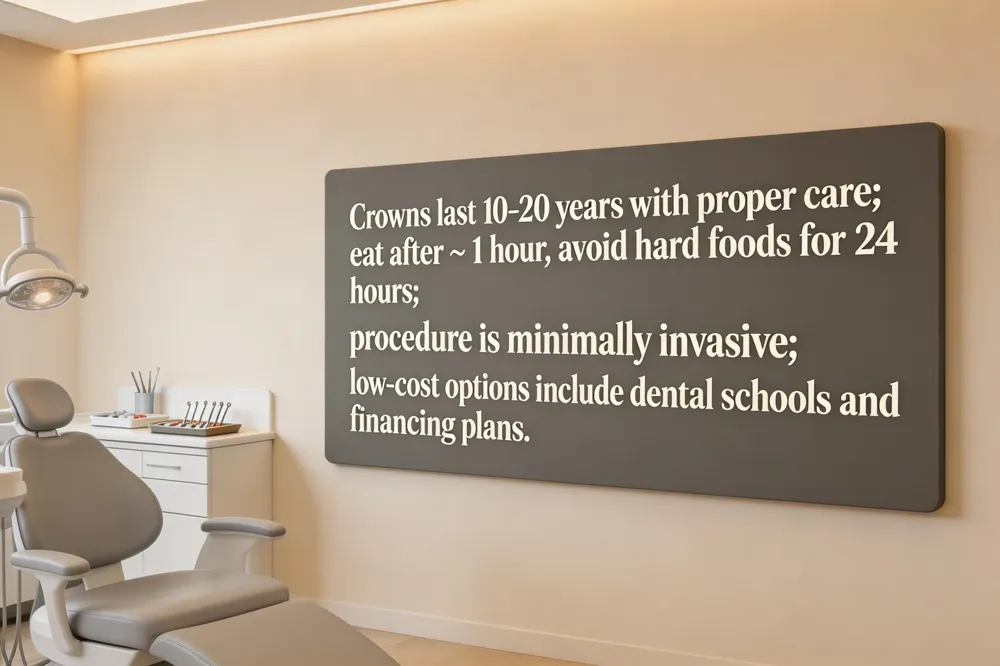 Dental crowns are a durable, minimally invasive solution, but patients often wonder about lifespan, eating, surgery, and cost.
Longevity & Maintenance – Crowns typically last 10‑20 years. Zirconia and metal caps can exceed 20 years, while porcelain or ceramic crowns average 10‑15 years. Proper oral hygiene, avoiding grinding, and regular check‑ups help crowns reach the upper end of their lifespan.
Eating After Cementation – Begin eating about one hour after the permanent crown is cemented, once the bonding material has set. Wait for numbness to wear off before biting. For the first 24 hours avoid hard, sticky, or very crunchy foods; after that, normal diet can resume with caution toward extremely hard items.
Is Crown Placement Major Surgery? – No. The procedure is office‑based, uses local anesthesia, reshapes the tooth, takes an impression, and places a custom cap. It is routine, not an extensive surgical operation.
Low‑Cost Options & Financing – The most affordable route is a dental‑school clinic, offering 50‑70 % lower fees. Membership or discount plans can cut costs 30‑50 %. Many offices provide interest‑free payment plans. Some practices, such as NYU College of Dentistry, use supervised students to lower prices while maintaining high quality.
Quick Answers to Common Queries –
- How long do crowns usually last? 10‑20 years, with proper care.
- How long after cementation can I eat? About one hour, avoiding hard foods for 24 hours.
- Is getting a crown major surgery? No, it’s minimally invasive.
- Cheapest way to get crowns? Dental school or discount plans.
- Aspen Dental crown cost? $800‑$2,000, average $1,250, with financing options.
- $500 dental crowns near me? Look for practices with in‑house labs, promotions, or CEREC same‑day crowns; check NYC offices like Empower Your Smile.
- NYU dental crown cost? $800‑$2,500, often reduced by student‑provider fees and insurance coverage.
Putting It All Together
Dental crowns protect weakened teeth, restore chewing strength, seal out bacteria, and help keep proper bite alignment, all of which support oral health. Crown placement is straightforward: after an exam, the tooth is shaped, an impression is taken (often digitally), a cap is placed, and crown is cemented in a second visit—or even in an appointment with CAD/CAM technology. Many insurers cover a sizable portion of the cost, and practices such as Empower Your Smile offer financing, options, and discounts for insurance holders. Talk with the Empower Your Smile team to explore material choices, aesthetic goals, and payment plans that suit your needs. Call or book online today to schedule a consultation and take the step toward a healthier smile.