Why Veneers Are More Than Just a Cosmetic Fix
Dental veneers are thin, custom‑made shells—usually porcelain or composite—that bond to the front of a tooth to mask chips, stains, gaps, or misalignment. While most patients think of veneers only as a smile‑enhancement, several misconceptions persist: many believe the procedure is highly invasive, that veneers weaken teeth, or that they require extensive upkeep. In reality, modern veneer techniques often involve no‑prep or minimal‑prep options that remove as little as 0.3‑0.5 mm of enamel, preserving natural tooth structure and causing only temporary sensitivity. Beyond aesthetics, veneers provide functional benefits. They act as a protective barrier for weakened or worn teeth, reduce plaque accumulation with their smooth surface, improve bite comfort by reshaping uneven edges, and can even lessen tooth sensitivity by covering exposed dentin. With proper oral hygiene, a porcelain veneer can last 10‑15 years or longer, delivering both lasting beauty and oral‑health advantages.
Cost, Care, and Longevity: The Practical Side of Porcelain Veneers
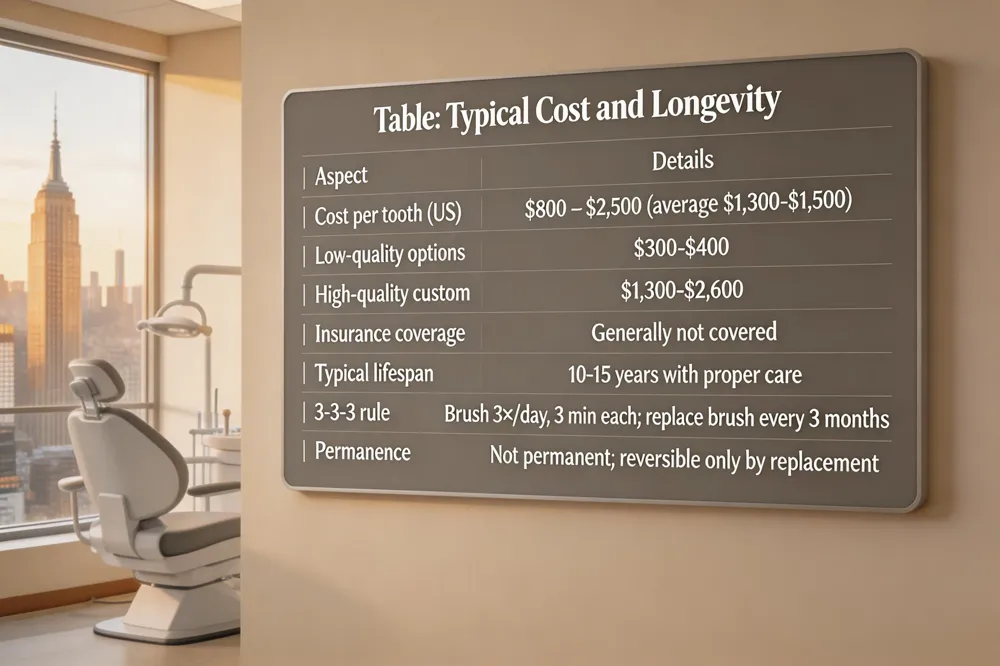
Table: Typical Cost and Longevity
| Aspect | Details |
|---|---|
| Cost per tooth (US) | $800 – $2,500 (average $1,300‑$1,500) |
| Low‑quality options | $300‑$400 |
| High‑quality custom | $1,300‑$2,600 |
| Insurance coverage | Generally not covered |
| Typical lifespan | 10‑15 years with proper care |
| 3‑3‑3 rule | Brush 3×/day, 3 min each; replace brush every 3 months |
| Permanence | Not permanent; reversible only by replacement |
 What is the typical cost of porcelain veneers in the United States?
Porcelain veneers in the United States typically cost between $800 and $2,500 per tooth, with most patients paying around $1,300 to $1,500 each. The price varies based on the dentist’s experience, the laboratory that fabricates the veneers, the number of teeth treated, and any additional procedures such as tooth preparation or gum contouring. While lower‑quality options may start near $300‑$400, high‑quality, custom‑crafted porcelain veneers usually fall in the $1,300‑$2,600 per‑tooth range. Cosmetic veneers are generally not covered by insurance, so many patients use financing or payment plans offered by the practice.
What is the typical cost of porcelain veneers in the United States?
Porcelain veneers in the United States typically cost between $800 and $2,500 per tooth, with most patients paying around $1,300 to $1,500 each. The price varies based on the dentist’s experience, the laboratory that fabricates the veneers, the number of teeth treated, and any additional procedures such as tooth preparation or gum contouring. While lower‑quality options may start near $300‑$400, high‑quality, custom‑crafted porcelain veneers usually fall in the $1,300‑$2,600 per‑tooth range. Cosmetic veneers are generally not covered by insurance, so many patients use financing or payment plans offered by the practice.
What is the 3‑3‑3 rule for teeth? The 3‑3‑3 rule is a simple oral‑hygiene mnemonic that recommends brushing three times daily—after breakfast, after lunch, and before bedtime—for a full three minutes each session. It also advises replacing your toothbrush (or electric‑brush head) every three months, or sooner if the bristles become frayed. This spacing interrupts bacterial growth, reduces plaque buildup, and helps protect enamel and gums when combined with daily flossing.
Are veneers permanent? Veneers are not permanent; they are a long‑term cosmetic restoration that typically lasts 10 to 15 years with proper care. Because a thin layer of enamel is removed to place the veneer, the original tooth structure cannot be fully restored once the veneer is removed. Over time, wear, staining, bite forces, bruxism, or inadequate hygiene can cause chips, cracks, or bond loss, requiring replacement. Regular dental check‑ups, diligent brushing and flossing, and avoiding hard foods or grinding help maximize their lifespan, and a new veneer can be fabricated when needed.
Balancing Benefits and Drawbacks: What Every Patient Should Know
Table: Benefits vs. Drawbacks
| Benefits | Drawbacks |
|---|---|
| Immediate aesthetic improvement | Irreversible enamel removal |
| Stain resistance | Cost (out‑of‑pocket) |
| Minimal invasiveness (0.3‑0.5 mm prep) | Potential sensitivity |
| Durability (10‑15 yr) | Need for diligent maintenance |
| Protects weakened teeth | Risk of chip, debond, replacement |
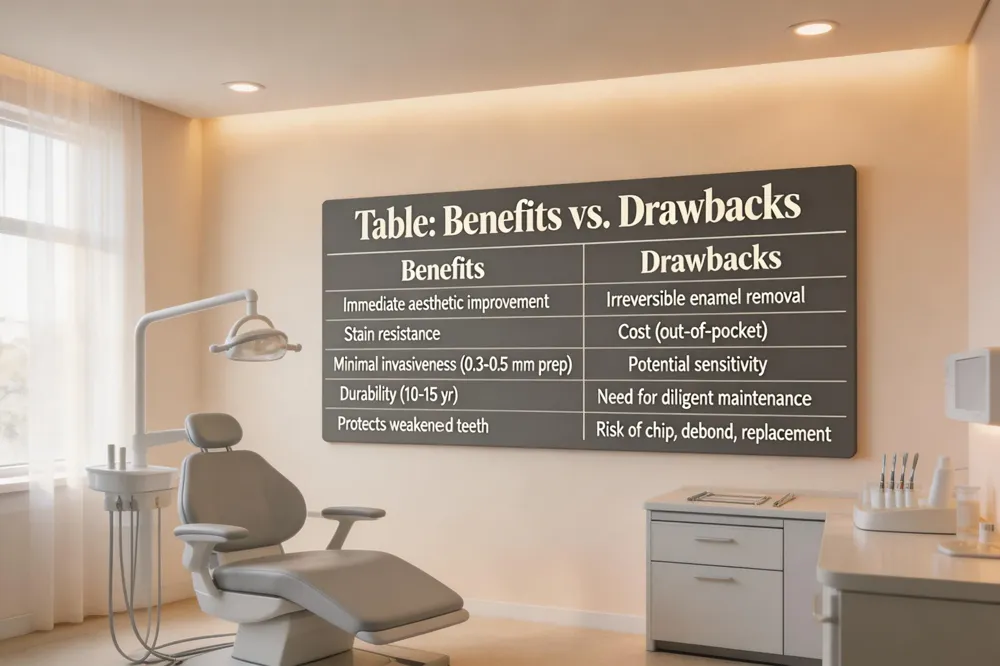 Veneers provide an instant, natural‑looking transformation by covering discoloration, chips, gaps and mild misalignment. They are stain‑resistant, can be placed with only 0.3–0.5 mm of enamel removal (or even no‑prep options), and typically last 10‑15 years when proper oral hygiene and regular dental check‑ups are maintained. The procedure is minimally invasive compared with crowns, and the thin, biocompatible porcelain or composite shells protect weakened teeth from further wear or decay.
However, the process is irreversible because any enamel removed does not regenerate, which can lead to temporary sensitivity to hot or cold foods. Veneers are a cosmetic treatment, so most dental insurance plans do not cover them; patients must consider out‑of‑pocket costs or financing options. They may also chip, debond, or require replacement after several years, especially in patients who grind their teeth or habitually bite hard objects. Severe gum disease, extensive decay, or major bite problems are contraindications that may necessitate alternative restorative options.
Patients should weigh these advantages ( immediate aesthetic improvement, durability, stain resistance, minimal invasiveness) against the disadvantages (permanent enamel loss, sensitivity, cost, and need for diligent maintenance) before deciding if veneers are the right choice.
From First Bite to Final Smile: Full‑Mouth Veneer Transformations
Table: Full‑Mouth Veneer Process
| Step | Description |
|---|---|
| Initial exam & imaging | Digital scans, impressions |
| Enamel removal | 0.3‑0.5 mm (conservative) |
| Temporary shells | Protect teeth while lab works |
| Lab fabrication | 1‑2 weeks for custom porcelain |
| Final bonding | Bond, polish, adjust |
| Typical number of front veneers | 4‑6 (central, lateral incisors, canines) |
| Outcome | Uniform bright smile, mild temporary sensitivity |
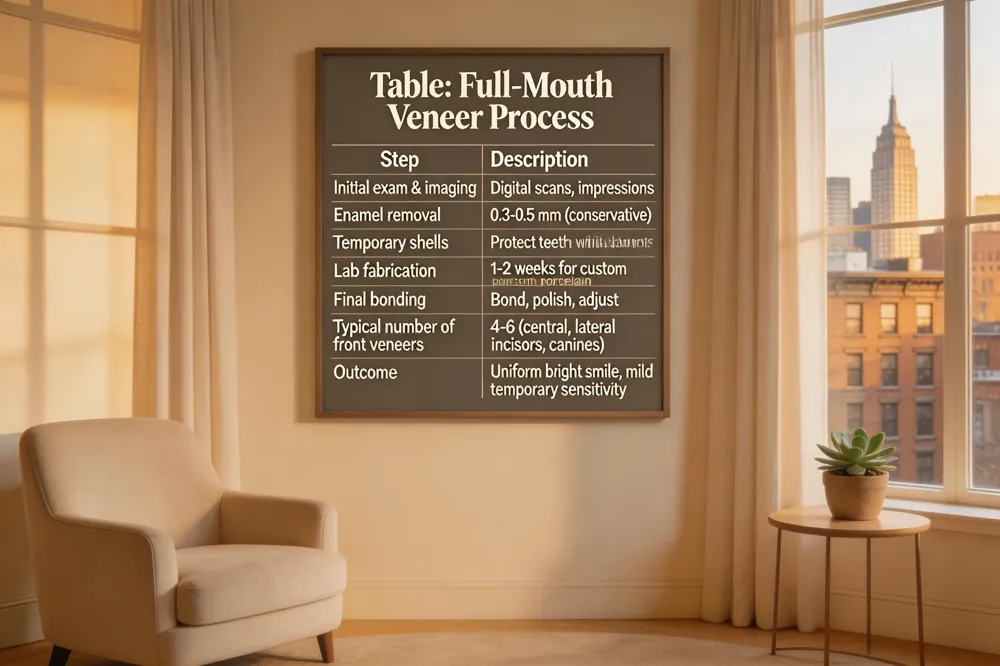 What can patients expect from full‑mouth porcelain veneers before and after treatment? Before treatment most people notice stained, uneven, or shortened front teeth, gaps and minor misalignments that make them self‑conscious. The process starts with a thorough oral exam, digital imaging and impressions, and a conservative removal of only 0.3–0.5 mm of enamel. Temporary shells protect the teeth while the laboratory crafts the final porcelain veneers—typically over one to two weeks. At the final visit the custom veneers are bonded, polished and adjusted. After the procedure the smile appears uniformly bright, straight and proportionate; patients report only mild, short‑term sensitivity and enjoy a durable, stain‑resistant result that boosts confidence for years.
How many veneers are typically placed on the front teeth and what results are seen? Most patients receive four to six porcelain veneers on the anterior segment—covering the two central incisors, the two lateral incisors and often the canines. These shells are color‑matched and shaped to mimic natural enamel and create a seamless transition to the posterior teeth. The outcome is a brighter, more uniform shade, balanced proportions and a natural‑looking front‑to‑back smile line.
What do porcelain veneers look like on front teeth before and after treatment? Before placement front teeth may be yellowed, stained, chipped, worn or have gaps and “black triangles.” After placement the veneers give a glossy, translucent surface that mirrors natural enamel, delivering consistent shape, length and color while resisting stains. The result is a confident, youthful smile that blends effortlessly with the rest of the dentition.
Beyond Aesthetics: Functional and Psychological Impacts
Table: Functional & Psychological Impacts
| Impact | Details |
|---|---|
| Bite function | Restores worn surfaces, improves comfort |
| Protection | Covers vulnerable surfaces, reduces decay risk |
| Self‑esteem | Boosts confidence, social comfort |
| Alignment | Corrects mild spacing/alignment without orthodontics |
| Risks after removal | Thinner enamel, translucency, sensitivity; may need bonding or new veneer |
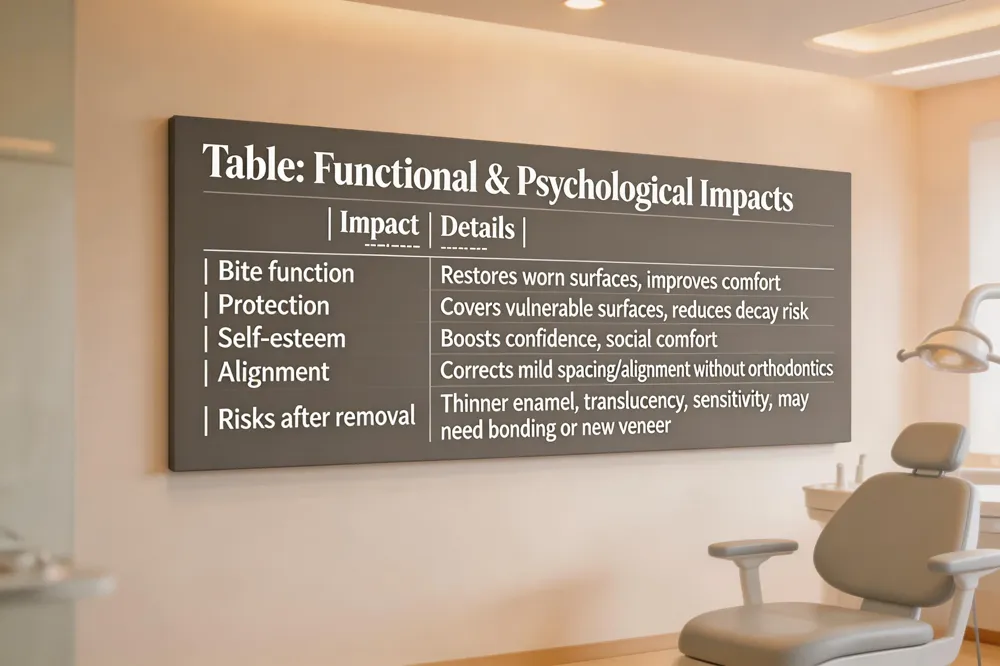 Dental veneers are thin shells of porcelain or composite resin bonded to the front of a tooth to improve appearance—they can subtly improve bite function and oral health.
Veneers can restore worn or uneven tooth surfaces, which may improve bite functionality and comfort while eating or speaking.
Veneers protect teeth from decay and damage by covering vulnerable surfaces.
[Veneers can boost self‑esteem and confidence, improving psychological well‑being through a more aesthetic smile].
Patients often experience increased confidence and social comfort after veneers.
For mild spacing or alignment problems, veneers provide an instant aesthetic correction without the need for orthodontic appliances. However, pronounced misalignment usually requires prior orthodontic correction to avoid excessive enamel removal.
When veneers are removed, the enamel that was thinned cannot regenerate. The tooth may appear thinner, more translucent, or feel rough, and may be temporarily sensitive. Restoration—such as bonding, a new veneer, or a crown—is typically needed to protect the tooth and restore appearance. Regular oral hygiene and routine dental check‑ups are essential to maintain the longevity and appearance of veneers.
The Science & Technology Behind Modern Veneers
Table: Materials & Workflow
| Aspect | Porcelain | Composite |
|---|---|---|
| Material | High‑grade ceramic | Tooth‑colored resin |
| Lifespan | 10‑20 yr | 5‑7 yr |
| Stain resistance | Superior | Lower |
| Cost | Higher | Lower |
| Placement | CAD/CAM, lab‑fabricated (1‑2 wk) | Single‑visit, chair‑side |
| Prep | 0.3‑0.5 mm (or no‑prep) | Similar or none |
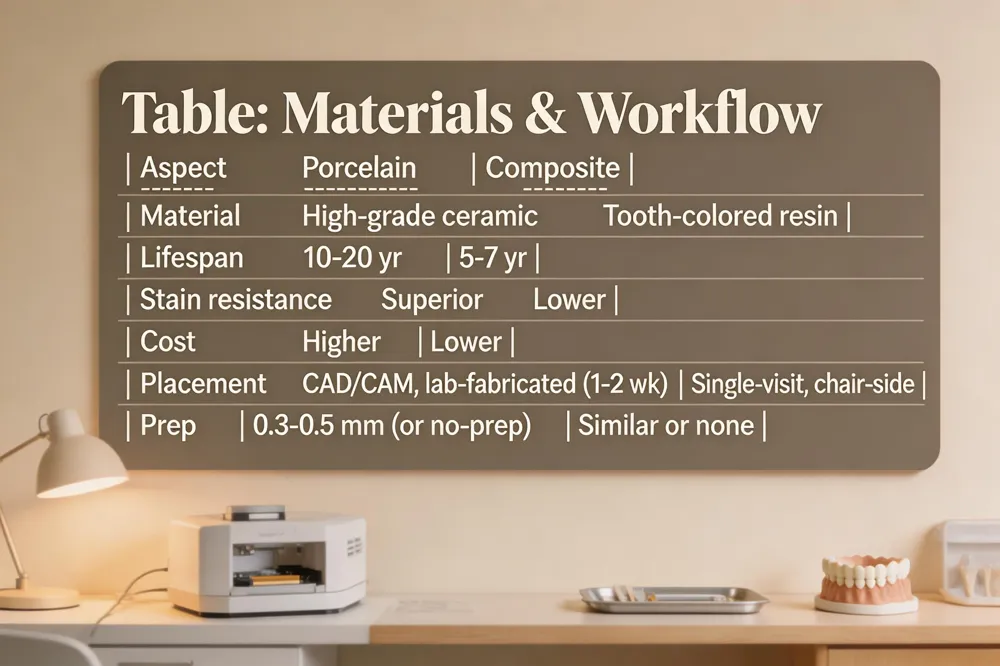 Modern dental veneers combine advanced materials science with digital workflow to deliver a natural‑looking, durable smile. Materials: porcelain vs. composite – Porcelain veneers are fabricated from high‑grade dental ceramics that mimic the translucency and light‑reflective qualities of natural enamel, offering superior stain resistance and a lifespan of 10‑20 years when cared for properly. Composite veneers, made from tooth‑colored resin, are less expensive and can be placed in a single visit, but they are more prone to staining and typically last 5‑7 years. Both materials are biocompatible, yet porcelain’s hardness and low porosity make it the preferred choice for long‑term aesthetics.
Digital impressions, CAD/CAM, and no‑prep options – Today most practices capture the patient’s dentition with intra‑oral scanners, creating a precise 3‑D model that eliminates traditional impression mess. Digital impressions, CAD/CAM technology enables precise, customized veneer fabrication. Some systems even mill ultra‑thin, no‑prep or minimal‑prep veneers in‑office, preserving as much natural enamel as possible while still achieving a seamless bond.
Maintenance tips for long‑term success – Longevity hinges on diligent oral hygiene: brush twice daily with a soft‑bristled brush and non‑abrasive fluoride toothpaste, floss daily, and attend biannual professional cleanings. Avoid hard foods, biting nails, or using teeth as tools, and limit exposure to staining agents like coffee, tea, red wine, and tobacco. For patients who grind, a custom night guard protects both the veneer and the underlying tooth. With these habits, porcelain veneers can remain vibrant and functional for decades.
Embrace a Healthier, More Confident Smile with Veneers
Dental veneers do more than perfect a smile; they protect weakened enamel, close small gaps without braces, and reduce plaque accumulation with their smooth, sealed surface. Modern no‑prep or minimal‑prep techniques keep enamel removal to a fraction of a millimeter, making the procedure minimally invasive while delivering long‑lasting stain resistance and durability. Patients also enjoy functional gains such as improved bite comfort and reduced sensitivity, plus the psychological boost of heightened self‑esteem that often leads to better oral‑hygiene habits.
Empower Your Smile embraces a patient‑centered philosophy, using digital smile design and CAD/CAM technology to preview results, tailoring each veneer to the individual’s facial anatomy, shade, and lifestyle. The team guides you through every step—from thorough oral health assessment to seamless bonding—ensuring comfort, safety, and predictable outcomes.
Ready to experience these hidden advantages? Schedule a personalized consultation today and let Empower Your Smile craft the confident, healthy smile you deserve.