Why the Frequency of Exams Matters
A comprehensive dental exam is more than a quick look‑over; it includes a detailed visual inspection, periodontal probing, bite analysis, and digital X‑rays that reveal hidden decay, bone loss, or early oral‑cancer lesions. By establishing a baseline of tooth, gum, and soft‑tissue health, the dentist can track subtle changes, catch small cavities before they need a root canal, and identify systemic disease signs such as diabetes‑related gum inflammation.
Guidelines vary by risk. The ADA and CDC generally recommend a routine check‑up and cleaning every six months for most patients. Low‑risk adults may extend to annual visits or a full comprehensive exam every 3–5 years, while high‑risk individuals—those with active periodontal disease, diabetes, smoking, or frequent cavities—often need exams every 3–4 months. Personalized recall intervals ensure timely prevention without unnecessary appointments.
Standard Recall Intervals and Personalization
 How often should a patient visit the dentist for routine check‑ups and cleanings?
Most patients are advised to see their dentist about every six months. This twice‑yearly schedule controls plaque, catches early decay or gum disease, and allows oral‑cancer screening. High‑risk individuals (cavities, gum disease, diabetes, tobacco use, pregnancy, weakened immunity) may need visits every three to four months, while low‑risk patients with excellent oral hygiene can often extend to once a year after a professional assessment.
What is the “2‑year rule” often referenced in dental care?
The informal “2‑year rule” suggests a maximum two‑year gap between dental visits. It serves as a safety net when regular appointments are difficult, but the American Dental Association and most clinicians recommend a six‑month interval for optimal early detection. Extending beyond two years can allow plaque, decay, or gum disease to progress unnoticed, increasing the need for invasive treatment.
Do patients need to visit the dentist every six months, or can the interval be longer?
Six‑month recalls are a long‑standing guideline, but they are not one‑size‑fits‑all. Risk‑based scheduling tailors intervals: low‑risk patients may safely see a dentist annually, while high‑risk patients benefit from quarterly or even monthly visits. Personalized risk assessment, often using digital imaging and periodontal probing, determines the appropriate schedule.
What are the American Dental Association’s recommendations for periodic exams?
The ADA recommends at least one comprehensive exam per year and a professional cleaning every six months for most patients. Higher‑risk individuals should have more frequent recalls (every three to four months). Low‑risk patients may extend intervals under dentist supervision. Recall intervals should reflect medical history, oral‑health status, and lifestyle factors.
How many dental cleanings are typically covered by insurance per year?
Most dental insurance plans cover two preventive cleanings annually at 100 % with little or no out‑of‑pocket cost. Additional cleanings may be covered partially, depending on the plan’s annual maximum and deductible.
Radiology Guidelines, Safety, and Costs
 Current X‑ray safety guidelines require that each radiograph be justified, that modern digital units with rectangular collimation be used, and that shielding such as thyroid collars be employed only when necessary. Dentists must retain previous images, position patients correctly, and adhere to federal, state, and local regulations. For asymptomatic adults, bite‑wing radiographs are typically taken every 1‑2 years for low‑risk patients, while full‑mouth series are spaced 3‑5 years unless clinical concerns arise.
Cost‑wise, a routine dental check‑up and cleaning without insurance averages $203, ranging from $100 to $250. Individual X‑rays cost $30‑$80 (often $50 for a bite‑wing set), and a cleaning $150‑$250. Combined, most patients pay $180‑$330 for an exam, cleaning, and necessary radiographs, though prices vary by region and practice.
Components, Benefits, and Costs of a Comprehensive Exam
 A comprehensive dental exam is a full‑mouth assessment that goes far beyond a quick visual check. It begins with a detailed health‑history review, followed by a thorough cleaning (scaling, polishing, and flossing) to remove plaque and tartar that home care cannot reach. The dentist then examines every tooth, gum, tongue, salivary glands, and jaw, measures periodontal pocket depths, and screens the neck and lymph nodes. Diagnostic tools such as digital X‑rays, intra‑oral cameras, and, when needed, 3‑D cone‑beam CT scans reveal hidden decay, bone loss, or impacted teeth while exposing patients to far less radiation than traditional film.
Early detection is a cornerstone of the exam. Small cavities, early‑stage gum disease, and oral cancer lesions can be caught before they become painful or costly. Because oral inflammation often mirrors systemic conditions—diabetes, cardiovascular disease, and even certain cancers—regular comprehensive exams provide a window into overall health.
Cost considerations vary. In the United States an annual check‑up with cleaning and basic X‑rays averages $200‑$300, while a full‑mouth cosmetic dentistry makeover in New York City typically runs $20,000‑$40,000 (up to $60,000 for extensive implant work). Dental X‑rays alone cost $30‑$80; a professional cleaning without insurance ranges $150‑$250, for a combined out‑of‑pocket expense of $180‑$330.
Answers to common questions:
- Standard dental check‑up steps – health‑history review, scaling, polishing, detailed visual exam, periodontal probing, X‑rays if indicated, and personalized preventive plan.
- Can a routine exam detect early lymphoma? – Yes. Dentists examine soft tissues and neck for abnormal swelling or lesions and refer suspicious findings for further evaluation.
- Typical cost of an annual check‑up in the U.S.? – Approximately $200‑$300, varying by region and insurance status.
- Typical cost of full‑mouth cosmetic dentistry in NYC? – Roughly $20,000‑$40,000, with premium cases reaching $50,000‑$60,000.
- Cost of X‑rays and a cleaning without insurance? – $180‑$330 combined, depending on the specific imaging and practice fees.
High‑Risk Groups, Orthodontics, and Implant Costs
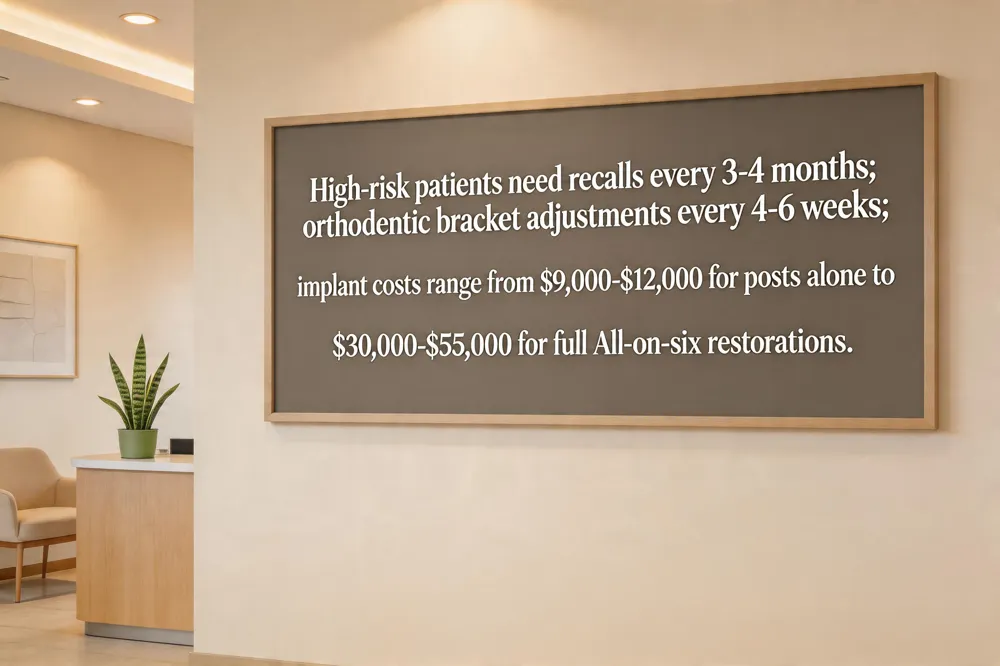 When deciding how often patients should see the dentist, risk profiles drive the schedule.
Orthodontic‑bracket patients need regular in‑person visits roughly every 4–6 weeks for adjustments and oral‑health checks; practices using newer, longer‑lasting wires may stretch this to 6–10 weeks when the treatment plan permits. Each appointment lets the orthodontist tighten or replace wires, repair brackets, and ensure teeth are moving as planned, while also reviewing hygiene habits and addressing discomfort early.
High‑risk individuals—those with active periodontal disease, rapid tartar buildup, diabetes, smoking, or systemic conditions—often require exams every 3–4 months. More frequent recalls help catch early signs of gum inflammation, cavities, or oral cancer, preventing costly, invasive procedures later.
Implant costs vary by region and case complexity. In New York City, a full All‑on‑six restoration typically ranges from $30,000 to $55,000 per arch, with most offices quoting $35,000–$45,000 when bone grafting, prosthetic material, and laboratory work are included. Nationwide, placing three dental implants usually costs $9,000–$12,000 for the posts alone and $10,000–$15,000 when abutments and crowns are added; the average 3‑on‑6™ price is $12,474, reflecting material choice, surgeon expertise, and any adjunctive procedures.
Cortisol and bruxism: Elevated cortisol keeps the nervous system in a heightened “fight‑or‑flight” state, causing jaw muscles to stay contracted. This muscle tension translates into daytime clenching and nighttime grinding, disrupting sleep architecture and increasing wear on teeth, jaw soreness, and morning headaches. Managing stress and, when needed, testing cortisol levels can mitigate bruxism and protect oral health.
Standard dental check‑up steps include a health‑history review, visual screening, professional cleaning (scaling, polishing, flossing), a detailed examination with probing, diagnostic X‑rays if indicated, and personalized preventive counseling. These components together form a comprehensive preventive strategy that supports long‑term oral and systemic health.
Practice Management, Patient Comfort, and the 80/20 Rule
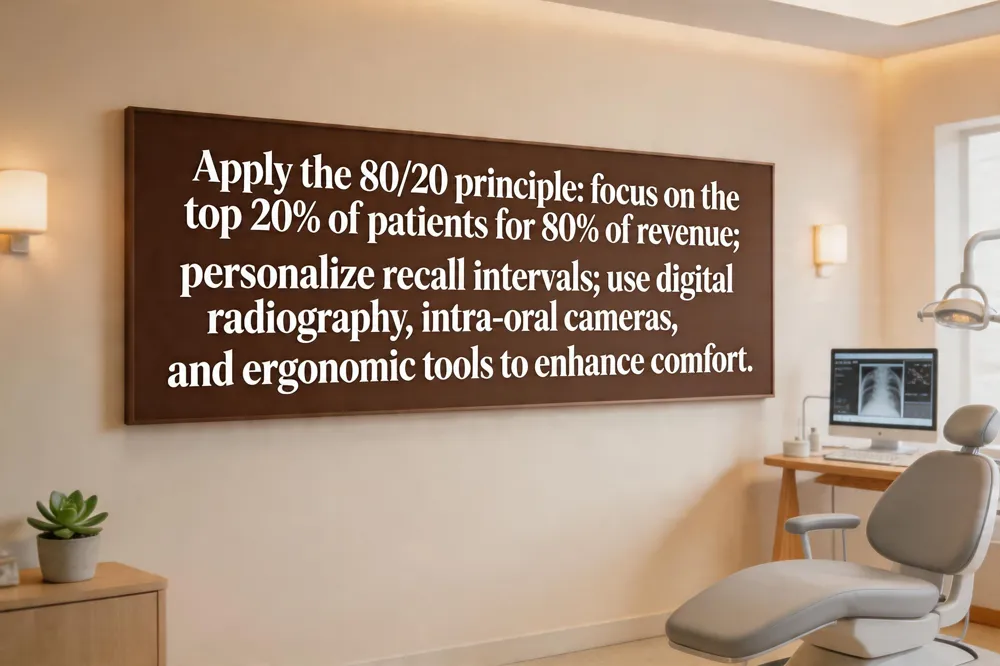 The 80/20 (Pareto) principle is a useful lens for dental practice managers. Roughly 80 % of revenue, referrals, and patient satisfaction stem from just 20 % of patients or core activities. By identifying that high‑impact segment—often long‑term, preventive‑care patients—a practice can allocate staff time, marketing resources, and appointment slots where they generate the greatest return, while still delivering quality care to every visitor.
Stress‑related bruxism is closely linked to elevated cortisol levels. Cortisol keeps the nervous system in a heightened fight‑or‑flight state, causing jaw muscles to stay contracted. This tension translates into daytime clenching and nighttime grinding, eroding enamel, causing jaw soreness, and triggering morning headaches. Managing stress, improving sleep hygiene, and, when needed, testing cortisol can break the cycle and protect the smile.
Empower Your Smile applies a patient‑centered scheduling model that personalizes recall intervals. After a comprehensive risk assessment—including medical history, oral‑hygiene habits, and systemic conditions such as diabetes—the team uses advanced digital radiography, intra‑oral cameras, and AI‑driven risk tools to set an optimal visit frequency. Low‑risk patients may safely extend recalls to once a year, while high‑risk individuals (active periodontal disease, frequent cavities, smokers) often receive visits every three to four months.
Advanced technology enhances comfort during each appointment. Digital X‑rays emit up to 90 % less radiation than traditional film, intra‑oral cameras allow real‑time visualization of problem areas, and ergonomic scaling instruments reduce treatment time. Together, these tools support the 80/20 goal of maximizing outcomes while keeping patients relaxed and confident in their oral‑health plan.
Takeaway: Balancing Frequency, Health, and Value
Regular dental examinations are essential for maintaining oral health and catching problems early. Most guidelines, including the American Dental Association and CDC, recommend a baseline of two visits per year—every six months—for cleanings, visual exams, and X‑rays. Evidence shows recall intervals should be tailored to each risk profile: low‑risk patients may extend to annual visits, while high‑risk groups (diabetes, smokers, periodontal disease, pregnancy) often need three‑to‑four‑month appointments. Early detection of cavities, gum inflammation, or oral cancer reduces treatment complexity and cost and protects systemic health, as oral infections can affect heart disease, diabetes, and stroke risk. Personalized recall schedules, based on oral‑health status, lifestyle, and medical conditions, ensure optimal prevention while respecting patient convenience and safety.