What is Crown Lengthening?
Crown lengthening is a periodontal surgical procedure that removes excess gum tissue, and when needed, a small amount of underlying bone to expose more of the natural tooth surface. The primary purpose is to create enough clinical crown height for a durable restoration (crown, bridge, veneer) and to improve smile aesthetics when excessive gingiva makes teeth appear short or "gummy.”
Functional vs. aesthetic indications – Functional crown lengthening is performed when sub‑gingival decay, fractures, or an inadequate ferrule threaten the longevity of a restoration, or when biologic width would be violated. Aesthetic crown lengthening addresses cosmetic concerns such as a gummy smile, uneven gingival contours, or altered passive eruption, reshaping the gum line to achieve a balanced tooth‑to‑gum ratio.
Typical clinical workflow – 1) Initial consultation with clinical exam and radiographic/3‑D imaging to assess gingival biotype, bone crest distance, and crown‑to‑root ratio. 2) Treatment planning determines whether a simple gingivectomy, an apically positioned flap with osseous reduction, or an alternative technique (laser, orthodontic extrusion) is required. 3) Under local anesthesia the periodontist removes tissue, reshapes bone, and repositions the flap, often placing sutures. 4) Post‑operative instructions (ice packs, soft diet, gentle hygiene, follow‑up) guide healing, which stabilizes in 4‑12 weeks before the final restoration is placed.
Understanding Crown Lengthening: Indications, Procedure, and Codes
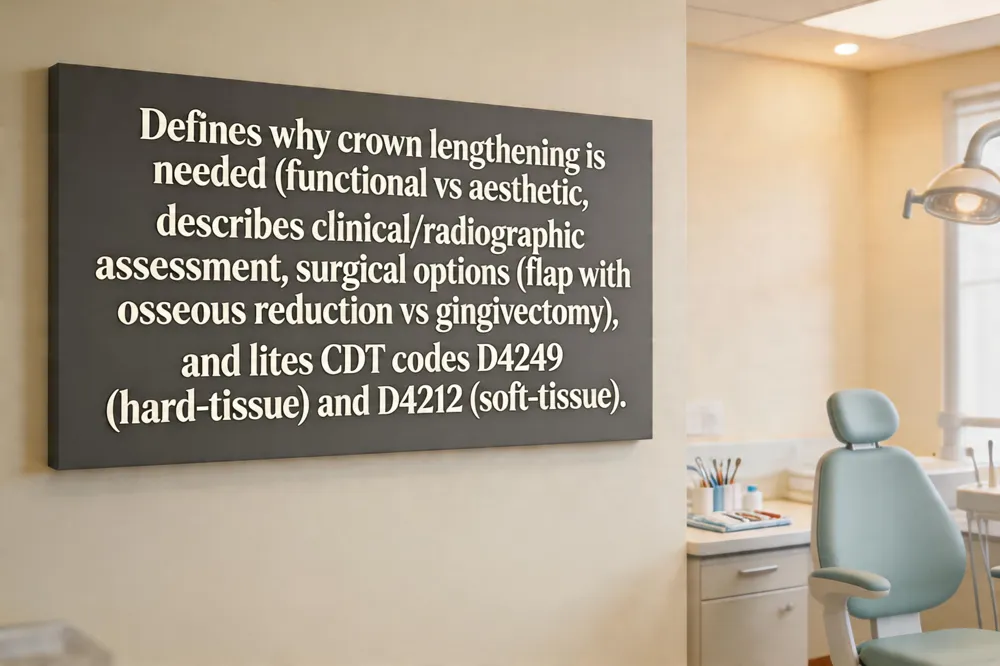 Crown lengthening is performed for functional reasons—such as exposing sub‑gingival decay, fractures, or creating a 1.5‑2 mm ferrule for durable crowns—and for aesthetic goals like correcting a gummy smile or uneven gingival contours.
The clinician first conducts a thorough clinical and radiographic assessment to determine the required tooth exposure and to measure the distance from the cement‑enamel junction to the bone crest.
If the bone is within 3 mm of the desired margin, an apically positioned flap with osseous reduction is performed; otherwise a simple gingivectomy or soft‑tissue trim may suffice.
After local anesthesia, the gingival tissue is reflected, excess gum and—when necessary—alveolar bone are removed, the flap is repositioned, and fine sutures secure the site.
Post‑operative care includes ice packs, analgesics, a soft diet, and gentle oral hygiene; soft‑tissue healing typically stabilizes in 4‑6 weeks, while bone remodeling may require up to 6 months before the final restoration is placed.
Crown lengthening vs. gingivectomy: Crown lengthening removes both gum tissue and bone to increase clinical crown height, often needed when decay or fracture extends below the gum line; a gingivectomy removes only soft tissue, ideal when bone height is already adequate.
Healing is longer for crown lengthening (3‑6 months) versus about a week for gingivectomy.
Billing: The CDT code for surgical hard‑tissue crown lengthening is D4249; soft‑tissue only procedures use D4212. When osseous surgery addresses periodontal disease, D4260/D4261 are appropriate. The comparable medical CPT code is 4182, though most dental insurers require CDT documentation.
Pain Management and Healing Timeline
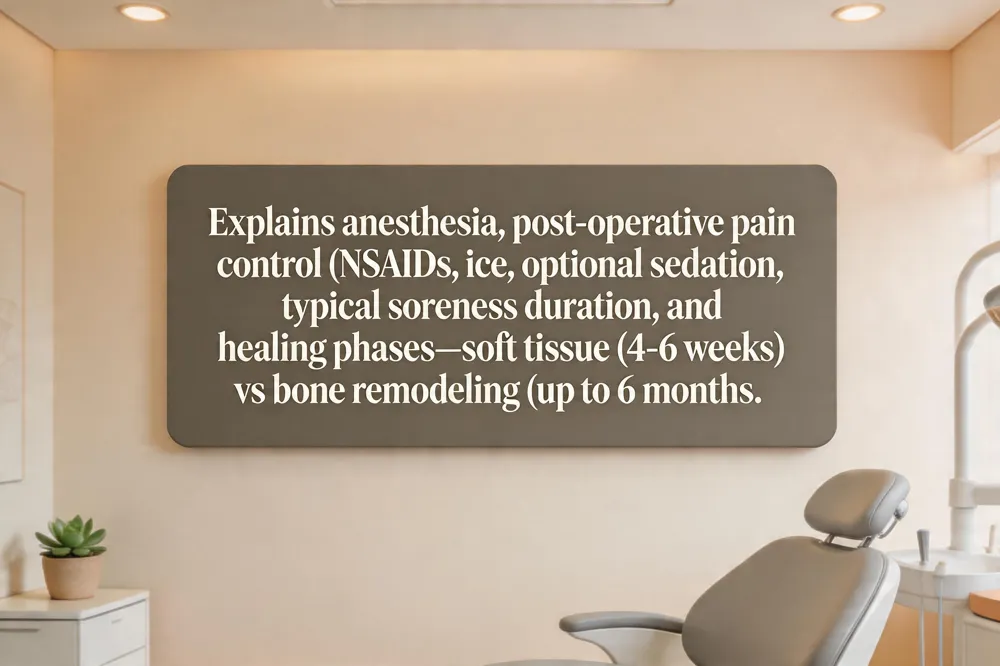 Crown‑lengthening surgery is performed under local anesthesia, so patients feel no pain during the procedure. Many offices also offer nitrous oxide or oral sedatives for anxious patients. Once the anesthetic wears off, most experience mild soreness or a throbbing ache that peaks within the first 24‑48 hours and usually subsides by day 3‑4. Over‑the‑counter NSAIDs such as ibuprofen, following the 3‑3‑3 rule (three 200 mg tablets every three hours for up to three days), and ice packs effectively control swelling and discomfort. Prescription pain medication may be used for more intense pain, and a soft‑food diet protects the surgical site. Healing can be prolonged because both soft tissue and, when needed, bone are reshaped; connective‑tissue fibers and blood vessels require several weeks to reorganize, and bone remodeling can take 3‑6 months before the gumline stabilizes. Conventional gingivectomy heals in 4‑6 weeks, while flap surgery with bone removal may need 8‑12 weeks; laser crown‑lengthening often shows soft‑tissue closure in 2‑3 weeks but still follows the same bone‑healing timeline. Patients should avoid smoking, straws, and vigorous brushing, and follow up with the periodontist to ensure proper tissue maturation before the final restoration is placed.
Cost, Insurance, and Financial Considerations
 Crown lengthening costs vary widely. A simple soft‑tissue procedure on a single tooth often starts around $300‑$500, while cases that require bone removal or treatment of several adjacent teeth can range from $800‑$2,000 per tooth and may exceed $3,000 for extensive surgery. Factors that drive price include the amount of gum versus bone tissue removed, the need for sedation or digital imaging, the number of teeth involved, and the practice’s geographic location.
Insurance generally distinguishes functional from cosmetic procedures. When crown lengthening is medically necessary—such as exposing enough tooth structure for a crown, bridge, implant, or to treat sub‑gingival decay—most dental plans will cover a portion of the fee after a pre‑authorization. Purely aesthetic cases, like correcting a “gummy” smile, are usually classified as elective and receive little or no reimbursement. Patients should expect to pay deductibles, coinsurance, or any annual maximum limits.
Regional cost differences are notable; metropolitan areas (e.g., New York City) tend toward the higher end of the $800‑$3,000 range, while smaller cities or dental schools may offer lower rates. To obtain an accurate estimate, contact several local periodontists or general dentists, request a detailed quote that lists surgical fees, anesthesia, post‑op care, and verify your insurance benefits before scheduling the procedure.
Post‑Operative Care: Instructions, Do’s and Don’ts, and Resources
 Standard post‑op protocol after crown‑lengthening includes taking any prescribed antibiotics on day 1, using NSAID pain relievers before the anesthetic wears off, and applying a cold pack to the face for 10‑15 minutes several times daily during the first 48‑72 hours. Keep the head elevated while sleeping, maintain a soft diet for the first two to three weeks, and rinse gently with warm salt water 4‑5 times daily starting the day after surgery. Do not brush, floss, or use a water‑pik near the treated site for at least four weeks, avoid smoking, alcohol, and vigorous exercise for the first week, and refrain from hot, spicy, acidic, or crunchy foods that could disturb the clot.
Printable PDF and video resources are available from Empower Your Smile. The office can provide a step‑by‑step PDF outlining medication, ice‑pack use, diet, and oral‑hygiene instructions. Educational videos on YouTube or VUmidi demonstrate the surgical steps—local anesthesia, flap placement, tissue reshaping, and suturing—giving patients a clear visual guide.
What to avoid during healing: no rinsing, spitting, or straw use for 24‑48 hours; no touching the surgical area; no smoking or tobacco; no hot, sharp, or hard foods; and no strenuous physical activity or vigorous flossing for at least a week. These guidelines help ensure optimal healing and a successful final restoration.
Outcomes, Risks, and Visual Results
 Crown lengthening can dramatically change a smile. Before‑and‑after photos show excess gum tissue removed, revealing longer, more symmetrical teeth and a balanced gum line. Patients with a "gummy" smile or sub‑gingival decay often end up with a natural‑looking smile that supports crowns, veneers or implants on solid tooth structure rather than gum.
Potential complications include infection, excessive bleeding, prolonged swelling, tooth sensitivity, gum recession, bone loss, or an over‑receded gum line that creates a "long‑tooth" appearance. If infection or bleeding persists, patients should contact their dentist for antibiotics or a follow‑up visit; severe sensitivity may require desensitizing treatment. In rare cases of over‑removal, a gum graft or corrective surgery may be needed.
Advantages of crown lengthening are improved restoration durability, better oral‑hygiene access, enhanced aesthetics, and increased self‑confidence. Disadvantages involve the surgical risks listed above, a healing period of several weeks to months, and possible need for retreatment if the desired tooth exposure is not achieved. When performed by a qualified periodontist, the procedure typically yields a stable, aesthetically pleasing result within six to eight weeks, as demonstrated in recovery pictures that show gradual tissue contraction and final gum‑margin stabilization.
Bringing It All Together: A Healthier, More Confident Smile
Crown lengthening delivers two distinct but complementary advantages. Functionally, it creates enough supragingival tooth structure to achieve a proper ferrule of 1.5‑2 mm, which dramatically improves the retention, resistance, the long‑term durability of crowns, bridges, veneers, or implants. By exposing sub‑gingival decay or fractures and restoring a healthy biologic width, the procedure also facilitates better oral‑hygiene access and reduces the risk of future periodontal disease. Aesthetically, reshaping the gum line corrects a “gummy smile,” evens uneven gingival contours, and balances the tooth‑to‑gum proportion, resulting in a brighter, more symmetrical smile that boosts self‑esteem. Patients seeking these benefits are encouraged to schedule a comprehensive evaluation at Empower Your Smile in Tribeca, NYC, where Dr. Moezinia and her team combine digital smile design, laser‑assisted techniques, and personalized treatment planning. Success hinges not only on expert surgery but also on diligent post‑operative care: follow prescribed medication regimens, apply ice packs to control swelling, maintain a soft‑food diet, practice gentle brushing with a soft‑bristled toothbrush, and attend all follow‑up appointments. Proper after‑care ensures optimal tissue healing, preserves the newly established biologic width, and sets the stage for a stable, lasting restoration.