Why the Hidden Costs Matter
When choosing between Invisalign clear aligners and traditional braces, most patients first compare the headline price—typically $3,000‑$8,000 for Invisalign and $2,500‑$7,500 for metal braces. However, the true expense extends far beyond that initial quote. Long‑term financial considerations include insurance caps (often $2,500‑$3,000), the need for retainers ($150‑$500 per set), possible refinement trays or replacement aligners ($100‑$300 each), and emergency visits (brackets may break, aligners can be lost). These hidden fees can add several hundred to a few thousand dollars over the course of treatment and into the retention phase. This article breaks down those hidden costs, compares visit‑term office‑visit schedules, and explains how financing options, compliance, and case complexity affect the overall budget, empowering you to make an informed, financially sound orthodontic decision.
Understanding Orthodontic Pricing and Insurance
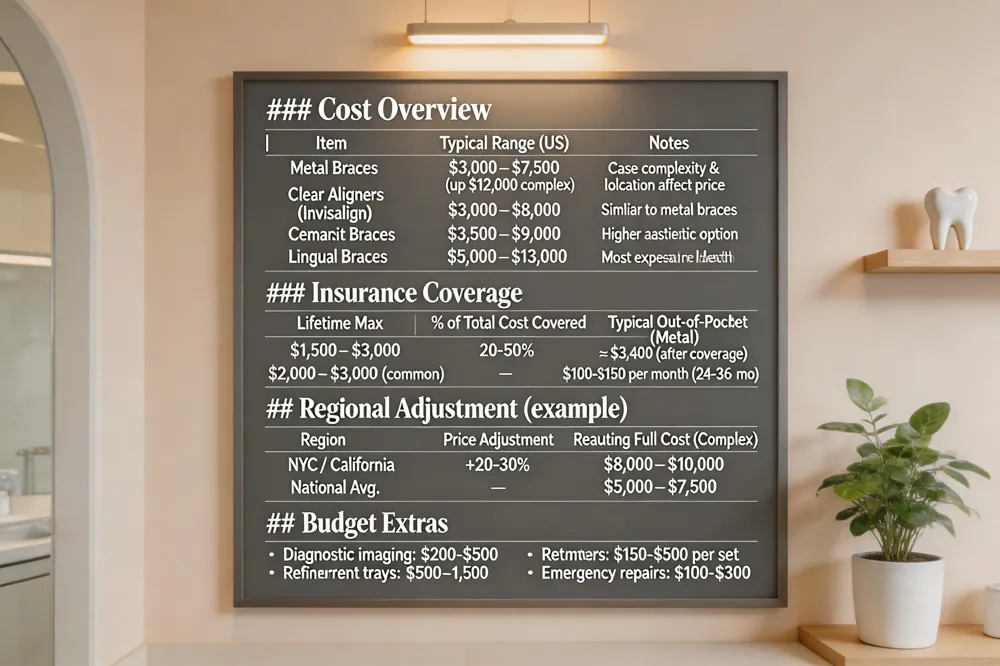
Cost Overview
| Item | Typical Range (US) | Notes |
|---|---|---|
| Metal Braces | $3,000 – $7,500 (up to $12,000 complex) | Case complexity & location affect price |
| Clear Aligners (Invisalign) | $3,000 – $8,000 | Similar to metal braces |
| Ceramic Braces | $3,500 – $9,000 | Higher aesthetic option |
| Lingual Braces | $5,000 – $13,000 | Most expensive, hidden behind teeth |
Insurance Coverage
| Lifetime Max | % of Total Cost Covered | Typical Out‑of‑Pocket (Metal) |
|---|---|---|
| $1,500 – $3,000 | 20‑50 % | ≈ $3,400 (after coverage) |
| $2,000 – $3,000 (common) | – | $100‑$150 per month (24‑36 mo) |
Regional Adjustment (example)
| Region | Price Adjustment | Resulting Full Cost (Complex) |
|---|---|---|
| NYC / California | +20‑30 % | $8,000 – $10,000 |
| National Avg. | — | $5,000 – $7,500 |
Budget Extras
- Diagnostic imaging: $200‑$500
- Refinement trays: $500‑$1,500
- Retainers: $150‑$500 per set
- Emergency repairs: $100‑$300
 Overall cost ranges for braces and Invisalign
In the United States, traditional metal braces typically run $3,000‑$7,500 (up to $12,000 for complex cases), while clear‑aligner therapy such as Invisalign falls between $3,000‑$8,000. Ceramic braces and lingual braces sit on the higher end of these bands, and the final bill depends on case complexity, treatment length, and geographic location.
Typical insurance coverage and lifetime maximums
Most dental plans cover orthodontic treatment up to a lifetime maximum of $1,500‑$3,000, often representing 20‑50% of the total cost. Coverage is similar for braces and Invisalign, though some insurers treat clear aligners as cosmetic and may reimburse less.
Monthly payment calculations after insurance
After insurance, the out‑of‑pocket balance for metal braces averages about $3,400. Spread over a 24‑36‑month course, patients usually pay $100‑$150 per month. Invisalign patients see a similar monthly range after their typical $2,500‑$5,000 out‑of‑pocket expense.
Regional price variations (NYC, California, etc.)
Urban markets such as New York City and California can be 20‑30% higher than the national average, pushing full‑cost quotes toward the $8,000‑$10,000 range for complex cases.
Budgeting for the full treatment period
Plan for additional costs: diagnostic imaging, refinement trays, retainers ($150‑$500 per set), and possible emergency repairs. Flexible payment plans, interest‑free financing, and HSA/FSA funds can smooth out the expense over the 12‑24‑month treatment window.
Answers to common questions
- How much do braces cost monthly with insurance? After typical insurance coverage, most patients pay $100‑$150 per month for a 24‑36‑month treatment.
- Long‑term cost of orthodontic treatment with insurance? Total costs range $5,000‑$13,000; insurance caps at $2,000‑$3,000 reduce out‑of‑pocket to roughly $3,400 for metal braces.
- Invisalign vs braces cost with insurance? Both are reimbursed up to $3,000; without insurance, braces $2,500‑$7,500 vs. Invisalign $3,000‑$8,000.
- How much is Invisalign with insurance? Out‑of‑pocket typically $2,500‑$5,000 after $1,000‑$3,500 insurance contributions.
- Average cost of braces without insurance? $3,000‑$12,000, depending on appliance type and complexity.
- How much do braces cost in California with insurance? Full cost $5,000‑$8,000; insurance pays $2,500‑$3,000, leaving $3,000‑$3,500 out‑of‑pocket.
- Long term cost of orthodontic treatment in California? $3,000‑$12,000 overall, with retainers and adjustments adding several hundred dollars.
- Long term cost of orthodontic treatment near me? Typically $5,000‑$9,000 for standard cases, rising above $10,000 for specialty appliances.
Specific Cost Scenarios and Price Perception
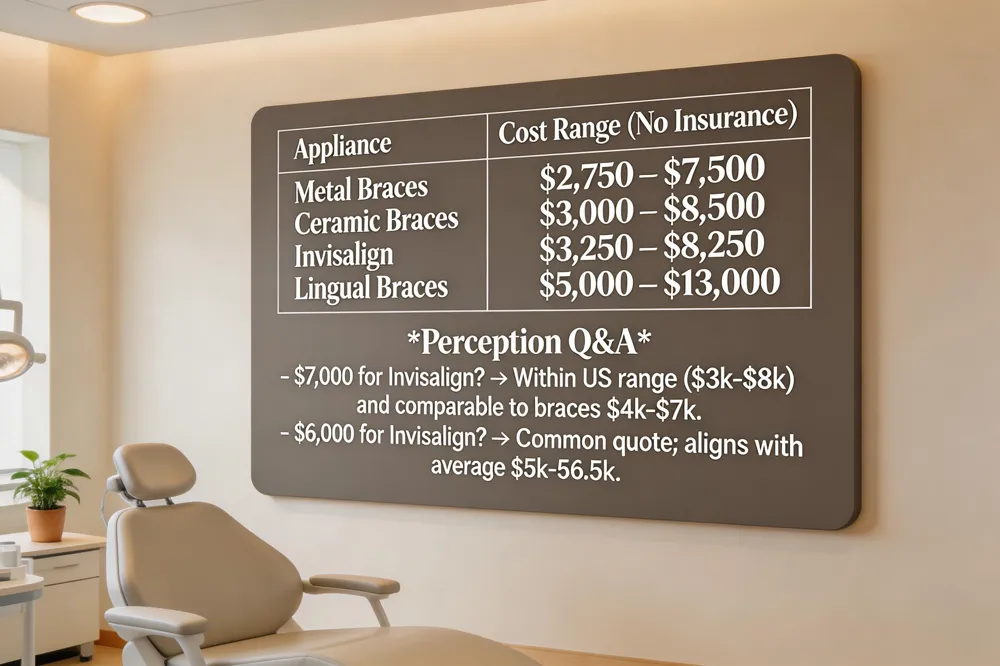
| Appliance | Cost Range (No Insurance) |
|---|---|
| Metal Braces | $2,750 – $7,500 |
| Ceramic Braces | $3,000 – $8,500 |
| Invisalign | $3,250 – $8,250 |
| Lingual Braces | $5,000 – $13,000 |
Perception Q&A
- $7,000 for Invisalign? → Within US range ($3k‑$8k) and comparable to braces $4k‑$7k.
- $6,000 for Invisalign? → Common quote; aligns with average $5k‑$6.5k.
 When planning a four‑year orthodontic journey, the total price hinges on the appliance type and case complexity.
Traditional metal braces are the most affordable, ranging from $2,750 – $7,500 for the full treatment.
Ceramic braces, which blend with tooth color, usually cost $3,000 – $8,500.
Clear‑aligner systems such as Invisalign fall in the $3,250 – $8,250 bracket, while lingual braces—mounted on the tongue side—can climb to $5,000 – $13,000.
Geographic location, provider experience, and insurance coverage further adjust the final bill.
Is $7,000 a lot for Invisalign? $7,000 sits comfortably within the U.S. Invisalign range of $3,000 – $8,000 and aligns with traditional brace costs of $4,000 – $7,000. In high‑cost cities it is typical; in simpler cases with good insurance the out‑of‑pocket amount may be lower.
Is $6,000 normal for Invisalign? Yes. The average Invisalign expense without insurance hovers around $5,000 – $6,500, making $6,000 a common quote for a full series of aligners.
Long‑term adult orthodontic expense overview Adults typically spend $2,500 – $7,000 on orthodontic care, depending on appliance type and treatment length (18 months to three years). Many adult plans limit coverage, so out‑of‑pocket costs are frequent, but FSAs, HSAs, and interest‑free payment plans can ease the burden.
Braces vs. Invisalign for long‑term outcomes Braces provide the greatest control for complex movements, often yielding slightly higher stability in severe cases. Invisalign delivers comparable results for moderate issues when patients wear aligners 20‑22 hours daily and follow a strict retention protocol. Success in either option ultimately rests on compliance and proper retention after treatment.
Pros, Cons, and Effectiveness of Braces vs Invisalign
| Factor | Braces | Invisalign |
|---|---|---|
| Effectiveness (mild‑moderate) | High | Comparable |
| Effectiveness (severe) | Superior (continuous force) | Limited; may need adjuncts |
| Aesthetic | Visible metal/ceramic | Virtually invisible |
| Comfort | Fixed, may cause irritation | Removable, no wires |
| Compliance Needed | Low | High (20‑22 h/day) |
| Food Restrictions | Yes (avoid hard foods) | None (removable) |
| Office Visits | 30 % more, 4‑8 wk intervals | Fewer visits |
| Underbite Correction | Elastics, surgery possible | Attachments, mild cases |
| Cost After Insurance (avg) | $3,400 total, $100‑$150/mo | $2,500‑$5,000 total, similar monthly |
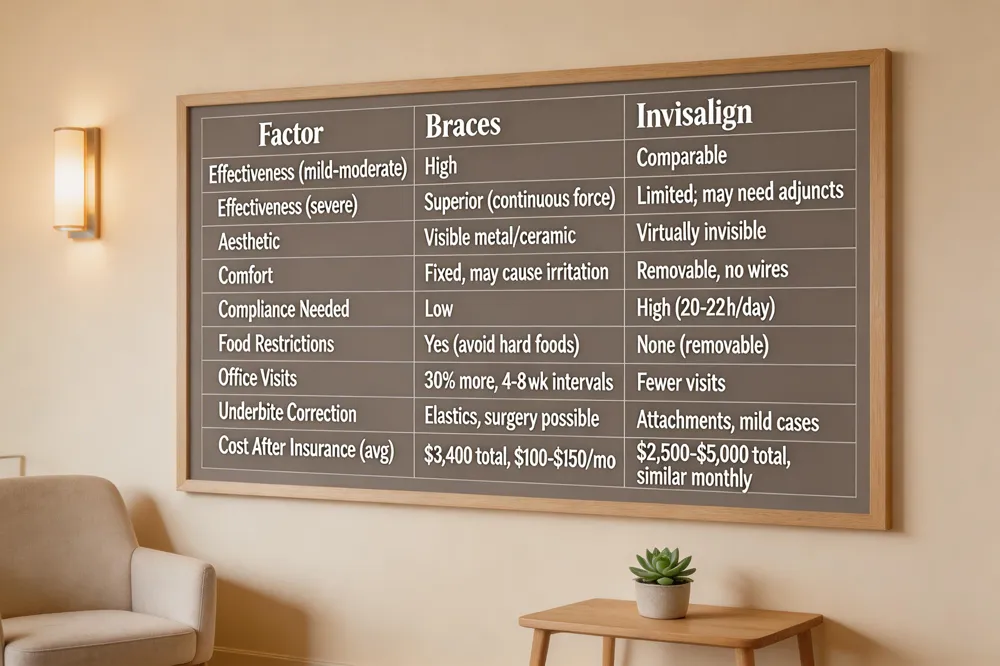 In most cases vs and Invisalign are both effective, but their success depends on case complexity. For mild to moderate crowding, spacing, and simple bite issues, Invisalign can achieve results comparable to braces while offering a virtually invisible, removable appliance. Severe malocclusions, large gaps, or significant rotations usually require the continuous force and precise control of metal or ceramic braces, which work automatically after placement.
Aesthetically, clear aligners are discreet and can be taken out for eating, brushing, and flossing, eliminating food restrictions and reducing gum‑health problems. Braces are more noticeable and can cause irritation to gums and cheeks, but they have no wear‑time compliance requirement beyond regular office visits.
Compliance is a key differentiator. Invisalign patients must wear each aligner 20‑22 hours daily; missed wear can extend treatment by months and add $500‑$2,000 in extra trays. Braces work 24 hours a day and need only routine adjustments every 4‑8 weeks, but they often involve more frequent visits—about 30 % more than Invisalign.
Underbite correction is possible with both modalities. Braces can be combined with elastics, facemasks, or even orthognathic surgery for severe cases. Invisalign can address mild underbites using custom attachments and refined aligner sequences, though complex skeletal discrepancies may still need braces or surgical assistance. Ultimately, the choice hinges on treatment complexity, aesthetic preference, lifestyle, and budget.
Visible Transformations: Before and After
| Aspect | Before Treatment | After Treatment (Braces) | After Treatment (Invisalign) |
|---|---|---|---|
| Food Restrictions | None (normal) | Limited (avoid sticky/hard) | None (removable) |
| Office Visits | Routine check‑ups | 30 % more visits | ~30 % fewer visits |
| Emergency Appointments | Rare | 80 % fewer emergencies | 80 % fewer emergencies |
| Hygiene | Standard brushing | More careful around brackets | Easier brushing (removable) |
| Aesthetic Impact | Misaligned smile | Visible brackets | Invisible aligners |
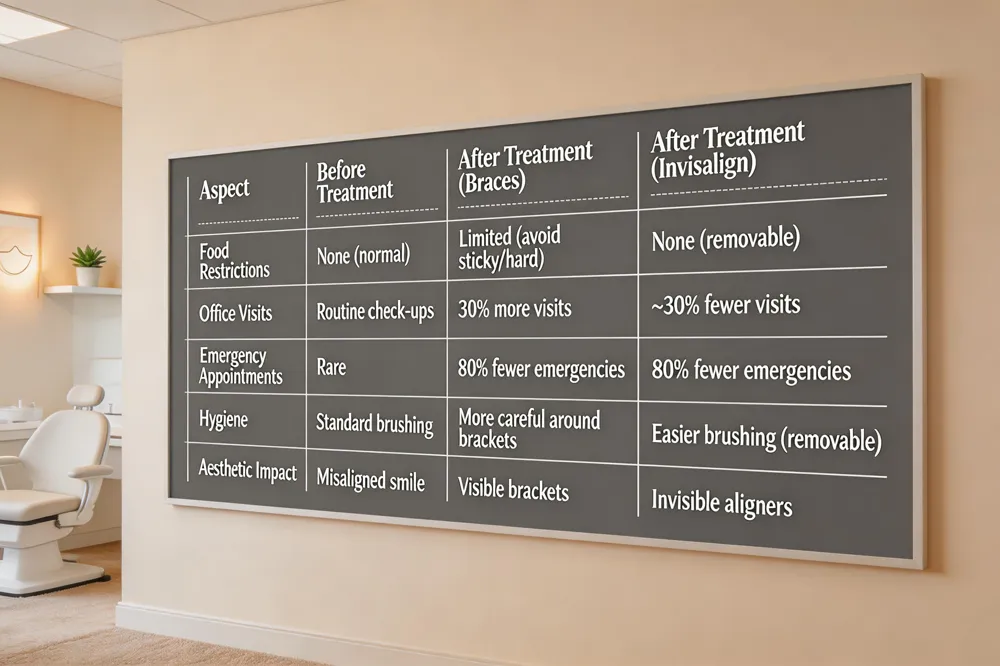 Before treatment, patients with misaligned or crowded teeth often notice visible gaps, overlapping teeth, and difficulty cleaning, which can lead to gum irritation and bite problems. Both Invisalign and traditional braces begin with a comprehensive assessment and a customized plan, but the visual impact differs: clear aligners are virtually invisible, while metal brackets are noticeable on the smile.
During the course of treatment, Invisalign’s removable trays allow patients to eat and brush normally, eliminating the food restrictions that require special care with braces. Braces, on the other hand, demand careful food choices and extra hygiene steps around wires and brackets to prevent plaque buildup and enamel demineralization. Patients wearing Invisalign typically experience about 30 % fewer routine office visits and roughly 80 % fewer emergency appointments, contributing to a smoother overall experience.
After a typical 6‑ to 12‑month period for Invisalign (or 18‑24 months for braces), both options can achieve dramatically straighter teeth, improved bite function, and healthier gums. Invisalign often shows smoother, more gradual transitions in the final photos, while braces may leave tiny metal traces until the retainer phase. Ultimately, the “before and after” comparison reveals that either method can deliver a confident, aesthetic smile; the choice hinges on lifestyle preferences, case complexity, and the patient’s commitment to wearing aligners as prescribed.
Long‑Term Stability and Retention
| Factor | Details |
|---|---|
| Retention Needed | Full‑time retainer 6‑12 mo, then nightly |
| Risk of Movement | Ongoing for up to 10 yr without retainers |
| Typical Long‑Term Cost (Adults) | $2,500 – $7,000 (incl. retainers) |
| Better Long‑Term Stability | Braces (precise control) |
| Comparable Stability (Compliance) | Invisalign if 20‑22 h/day wear |
| Common Causes of Relapse | Not wearing retainers, aging, wisdom teeth, grinding |
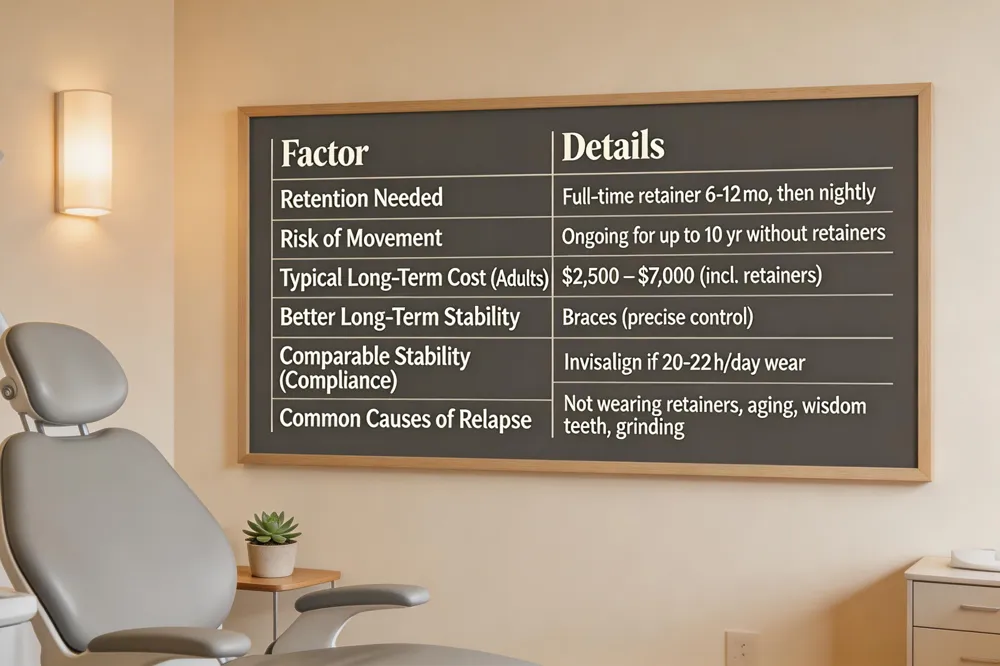 Maintaining the results of orthodontic treatment goes beyond the active phase. After braces or Invisalign are removed, the teeth and surrounding bone continue to remodel, so the risk of movement remains for years. Without proper retention, teeth can drift back toward their original positions, especially during the first decade after treatment.
Will my teeth move 10 years after braces? Yes, teeth can continue to shift even a decade after braces. The bone and periodontal ligament remain dynamic, and without ongoing support teeth may gradually drift toward their original positions. Common reasons include not wearing retainers, natural aging, wisdom‑tooth eruption, and habits such as grinding or clenching. Regular dental check‑ups and a well‑fitted retainer are essential to keep your results stable for years. If you notice movement, an adult orthodontist can correct it quickly with clear aligners or a minor retainer.
Are braces or Invisalign better long term? Traditional braces generally provide the most precise control over tooth movement, which can translate into slightly higher long‑term stability, especially for complex cases. Invisalign offers a more aesthetic and comfortable experience, and when patients wear the aligners as directed (20–22 hours per day), long‑term results are comparable for many moderate issues. Success depends on strict adherence to the treatment plan and a proper retention strategy.
Long term cost of orthodontic treatment for adults The long‑term cost for adults typically ranges from $2,500 to $7,000, covering the appliance, adjustments, and retainers. Insurance may cover part of the fee, but many adult plans have limited orthodontic benefits. Flexible spending accounts, payment plans, and financing options help spread expenses over time. Ultimately, the exact cost depends on case complexity, required refinements, and any additional restorative work needed before treatment can begin.
Financing, Hidden Fees, and Smart Budgeting
| Fee Type | Typical Cost | Notes |
|---|---|---|
| Diagnostic Scans / 3‑D Imaging | $200 – $500 | Often bundled? |
| Attachments / Refinements | $500 – $1,500 | For complex movements |
| Lost/Damaged Tray | $75 – $300 per set | Prevent with careful handling |
| Retainers (post‑treatment) | $150 – $500 per set | May need 2‑3 sets |
| Emergency Repairs | $100 – $300 | Broken brackets/wires |
| Financing | 0 % APR 12‑24 mo plans | Interest‑free if on time |
| Discounts | 5‑15 % upfront payment | Ask office |
| Tax‑Advantaged Accounts | HSA/FSA | Pre‑tax payment for eligible fees |
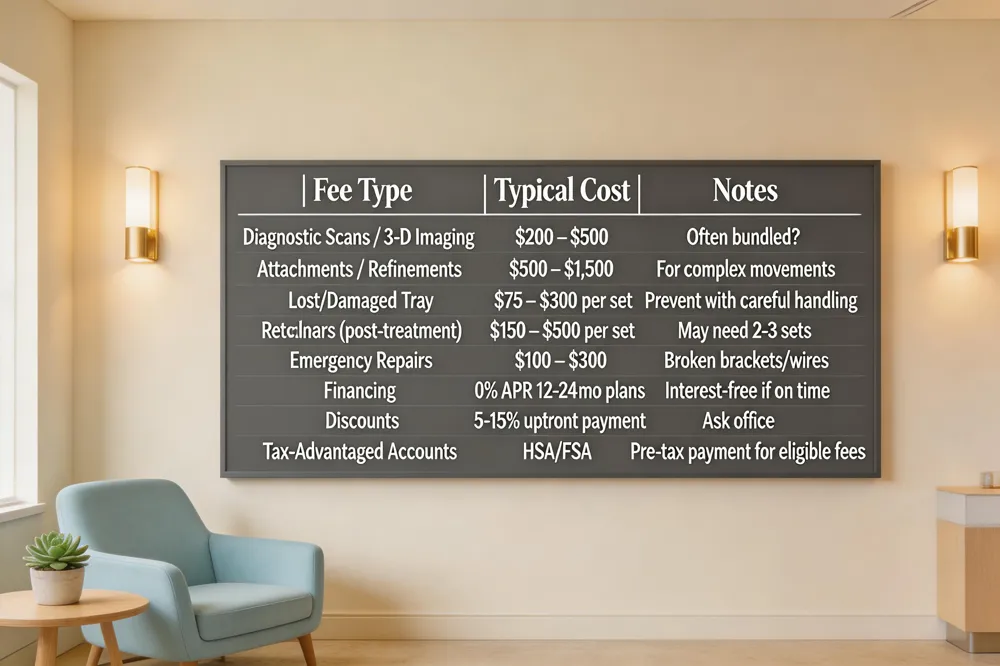 Most orthodontic offices—including those that provide Invisalign and traditional braces—offer interest‑free monthly payment plans that spread the $3,000‑$9,000 treatment price over 12‑24 months, often with 0 % APR if payments are made on time. These plans can be combined with dental‑insurance benefits that typically cover up to $3,000 of orthodontic care, leaving the patient responsible for the balance. Hidden expenses that frequently appear after the initial quote include diagnostic scans and 3‑D imaging ($200‑$500), attachments or refinements for complex movements ($500‑$1,500), and replacement trays when an aligner is lost or damaged ($75‑$300 per set). Retainers after treatment add another $150‑$500 per set, and occasional emergency visits for broken brackets or wires can cost $100‑$300. To reduce out‑of‑pocket costs, patients should ask whether diagnostics, attachments, refinements and retainers are bundled in the quoted price, use Health‑Savings Accounts (HSAs) or Flexible‑Spending Accounts (FSAs) for pre‑tax payment of these fees, and take advantage of any upfront‑payment discounts (5‑15 %). Scheduling regular check‑ups, maintaining strict aligner wear compliance, and promptly reporting lost trays can also prevent the need for costly extra visits or extensive refinements.
Making an Informed Choice for Your Smile
Choosing between Invisalign and traditional braces isn’t just about the sticker price; it’s a balance of cost, convenience, and aesthetics. Invisalign’s clear, removable aligners typically run $3,000‑$8,000, comparable to metal braces ($3,000‑$7,500) but often include hidden fees for scans, refinements, and replacements. The advantage is fewer office visits—about 30 % less—and no food restrictions, which many patients value for daily convenience and a discreet look. Both options require a retention phase; retainers cost $150‑$500 per set and are essential for maintaining gum health and preventing relapse, especially since Invisalign users report better oral hygiene during treatment. Empower Your Smile can simplify these decisions by offering a transparent cost breakdown, flexible monthly payment plans, and personalized treatment timelines based on case complexity. Our team also coordinates insurance benefits and guides you through financing options such as HSA/FSA or 0 % APR plans, ensuring you achieve the smile you want without unexpected financial strain.