Why Oral Cancer Exams Matter
Each year about 54,000 Americans are diagnosed with oral or oropharyngeal cancer, and the overall five‑year survival rate hovers near 57 %. Early detection dramatically improves outcomes—when lesions are caught at an early stage, five‑year survival can exceed 80 %, compared with roughly 30 % for later‑stage disease. Dentists and other oral‑health providers are uniquely positioned to perform these life‑saving exams because they see patients regularly, use bright lighting, and can inspect the lips, cheeks, gums, tongue, floor and roof of the mouth, and tonsils in just a few minutes. A routine visual inspection and gentle palpation—often completed in under five minutes—allow clinicians to spot white (leukoplakia) or red (erythroplakia) patches, lumps, or other abnormalities and refer suspicious findings for definitive biopsy testing.
What Happens During an Oral Cancer Exam
Oral Cancer Exam Workflow
| Step | Description |
|---|---|
| History | Brief health history (tobacco, alcohol, HPV, prior lesions, symptoms). |
| Visual Inspection | Bright light, mirror, tongue depressor; examine lips, gums, cheeks, tongue (top, bottom, underside), floor, roof, tonsillar area. Look for white patches (leukoplakia), red patches (erythroplakia), ulcerations, discoloration. |
| Palpation | Gentle feel of face, neck, jaw, cervical lymph nodes for firm/fixed lumps, asymmetry, tenderness. |
| Adjunctive Tools (optional) | Toluidine‑blue dye, VELScope® or ViziLite® fluorescence lighting to highlight abnormal mucosa. |
| Findings & Referral | Immediate communication; photograph suspicious area; explain risk; refer to oral surgeon/oncolologist for biopsy. |
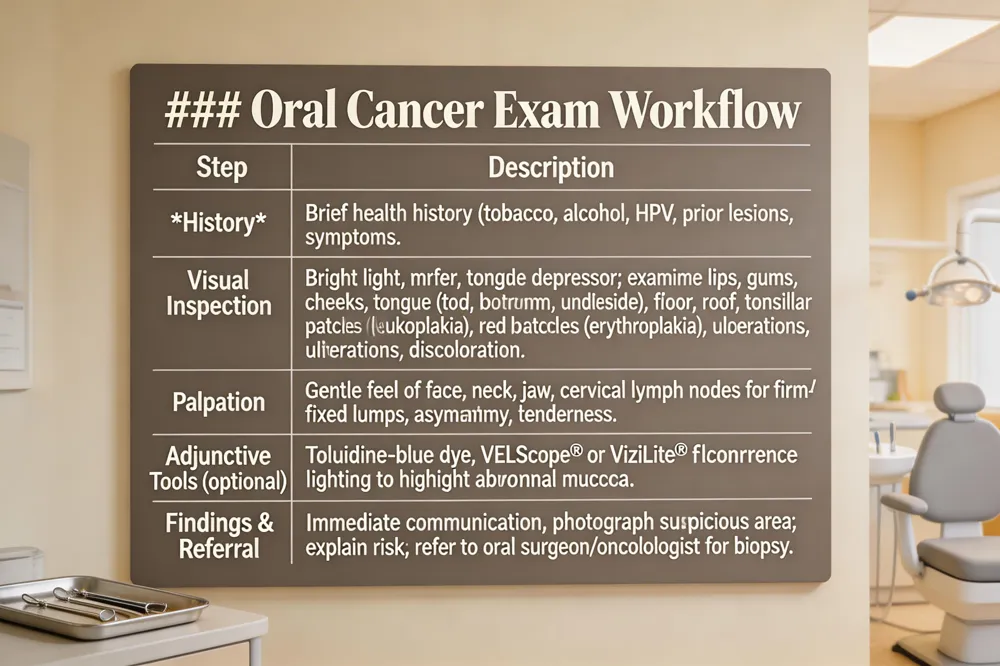 During an oral cancer exam the clinician first takes a brief health history and then moves to a systematic visual inspection. With a bright light, mirror and tongue depressor the lips, gums, cheeks, tongue, floor mouth roof of the mouth and the tonsillar area are examined for white patches (leukoplakia), red patches (erythroplakia), ulcerations, or any discoloration. The patient may be asked to say “Ahh” to reveal the back of the throat.
Next, a gentle palpation of the face, neck, jaw and cervical lymph nodes is performed to feel for firm, fixed lumps, asymmetry or tenderness. This tactile step is essential because many early lesions are not visually apparent.
Adjunctive tools can be added: a blue‑white diagnostic dye (toluidine blue) may be applied to highlight abnormal cells, and special lights such as VELScope® or ViziLite® emit violet illumination that causes healthy tissue to fluoresce differently from suspicious tissue. These aids are quick, non‑invasive and help the dentist decide which area warrants a biopsy.
Findings are communicated immediately; if a lesion looks concerning, the clinician photographs it, explains the risk, and refers the patient to an oral surgeon or oncologist for definitive testing. The gold‑standard for diagnosis is a tissue biopsy, while brush cytology or imaging may be used for further evaluation. Early detection—looking for persistent sores, non‑healing ulcers, red or white patches, unexplained lumps, numbness, or pain—dramatically improves survival rates.
Finding an Oral Cancer Screening Near You
Typical Screening Location & Workflow (Manhattan Example)
| Provider | Typical Workflow | Approx. Time | Cost (patient) | Insurance Coverage |
|---|---|---|---|---|
| Empower Your Smile (Tribeca) | History → bright‑light visual inspection → palpation → optional dye/photography → possible brush biopsy | ≤ 5 min (during routine cleaning) | Visual exam: $0‑$19 (often covered); VELScope: $19‑$150 (may be separate) | Visual exam usually covered; adjunctive devices billed separately, sometimes covered if medically necessary |
| Tribeca Dental Studio / City Dental Group NYC | Same as above; may add VELscope or toluidine‑blue | 5‑10 min | Similar range | Same as above |
| Community Events / Awareness Months | Free basic visual exam, optional paid adjunctive tools | 5 min | $0‑$30 (often free) | Often funded by sponsors; insurance not required |
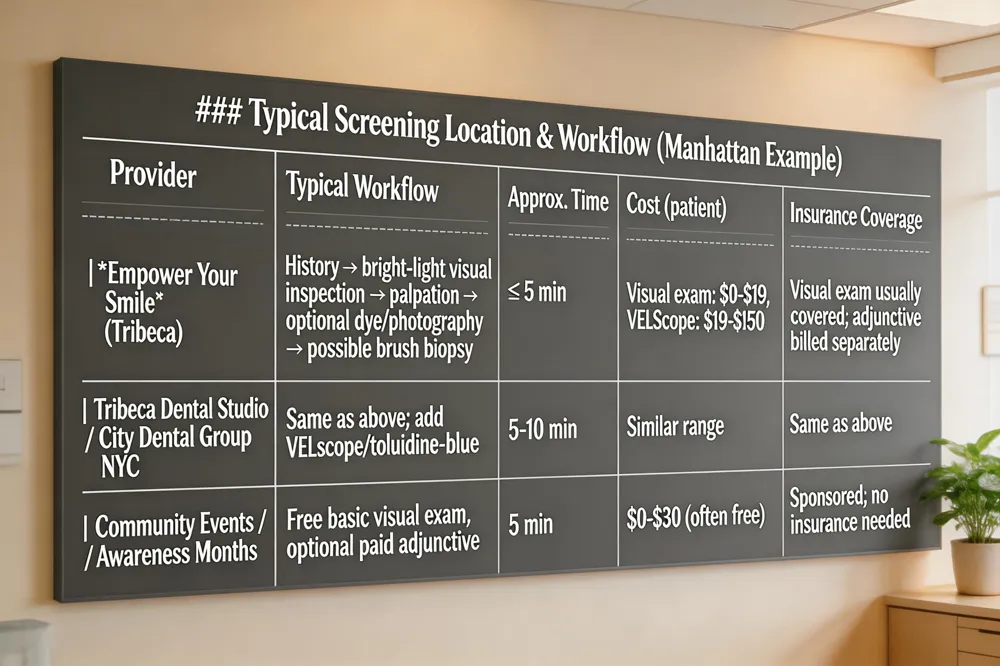 Manhattan residents and visitors have several convenient options for oral cancer screening. In Tribeca, Empower Your Smile offers a quick, painless exam as part of every routine dental check‑up. Nearby practices such as Tribeca Dental Studio and City Dental Group NYC also provide comprehensive visual and tactile screenings, often adding adjunctive tools like VELscope or toluidine‑blue dye for enhanced detection.
At Empower Your Smile, the appointment begins with a brief medical history, followed by a bright‑light visual inspection of the lips, cheeks, gums, tongue, floor and roof of the mouth, and tonsils. The dentist then gently palpates the jaw, neck, and lymph nodes. The entire workflow usually takes under five minutes and can be completed during a standard cleaning. If a suspicious area is identified, the clinician may take photographs, apply a diagnostic dye, or schedule a non‑invasive brush biopsy for further evaluation.
Insurance plans typically cover the visual exam at no extra charge; VELscope or other advanced adjuncts may be billed separately, ranging from $19 to $150 depending on the practice and whether the service is bundled with a routine visit. Many offices offer promotional or low‑cost screenings during awareness months, and uninsured patients often receive a free basic exam. Overall, cost is modest and frequently offset by dental benefits, making regular bi‑annual screenings an accessible preventive measure.
Self‑Examination and Early Detection at Home
Monthly Self‑Exam Checklist
| Action | Details |
|---|---|
| Mirror & Flashlight | Well‑lit bathroom, handheld mirror, bright flashlight. Inspect lips, inner lips, cheeks, gums, tongue (top, bottom, underside), floor, roof, back of throat. |
| Palpation | Gently feel neck, jawline, inside of lips/cheeks for lumps or tenderness. |
| Three‑Finger Test | Fit three fingers between upper and lower front teeth. Inability → possible trismus (requires professional eval). |
| Warning Signs (7) | 1) Ulcer > 3 weeks, 2) Persistent red/white patches, 3) Unexplained lump/swelling, 4) New/persistent pain, 5) Difficulty swallowing/speaking, 6) Hoarse voice, 7) Unexplained weight loss or sore throat. |
| When to Seek Care | Any above findings, persistent soreness, new lump, difficulty chewing/swallowing → schedule dentist or healthcare provider visit promptly. |
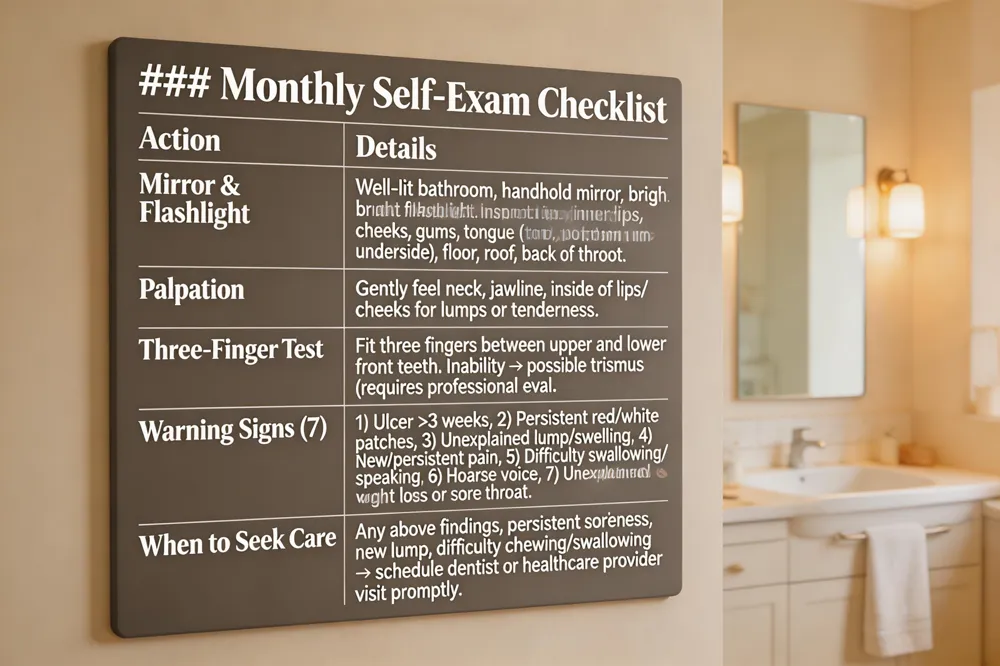 Monthly mirror‑and‑flashlight self‑exam steps – In a well‑lit bathroom, use a handheld mirror and a bright flashlight. Remove dentures, then inspect the lips, the inner lips, cheeks, gums, tongue (top, bottom and underside), floor and roof of the mouth, and the back of the throat. Look for persistent ulcers, red (erythroplakia or white (leukoplakia patches, discoloration, or any texture changes. Palpate the neck, jawline, and the inside of the lips/cheeks for lumps, bumps, or tenderness.
Three‑finger test for trismus – Try to fit three fingers between the upper and lower front teeth. If the mouth cannot open wide enough, trismus may be present, which can be a sign of oral or head‑and‑neck mouth cancer. A positive test is not diagnostic; it warrants a prompt professional evaluation.
Seven key warning signs of mouth cancer – 1) ulcer or sore that does not heal within three weeks, 2) persistent red or white patches, 3) unexplained lump, thickening or swelling in the mouth, lip, neck or throat, 4) new or persistent pain, 5) difficulty swallowing or speaking, 6) hoarse voice, 7) unexplained weight loss or a persistent sore throat.
When to seek professional evaluation – Any of the above findings, persistent soreness, new lumps, or difficulty chewing/swallowing should prompt an appointment with a dentist or healthcare provider for a thorough visual exam, palpation, and, if needed, a biopsy.
Screening Guidelines and Frequency Recommendations
Recommended Screening Frequency & Triggers
| Population | Minimum Frequency | High‑Risk Triggers | Adjunctive Tool Use |
|---|---|---|---|
| All adults | At least once per year (comprehensive intra‑oral & extra‑oral exam) | Tobacco use, heavy alcohol, HPV infection, prior lesions, any new symptoms | Optional (toluidine‑blue, fluorescence) |
| High‑Risk (tobacco/alcohol/HPV) | Every 6 months | Same as above + persistent sores | More likely to employ adjunctive tools for earlier detection |
| After abnormal finding | Immediate follow‑up (within a week) | Any suspicious lesion | Biopsy recommended; adjunctive tools may guide biopsy site |
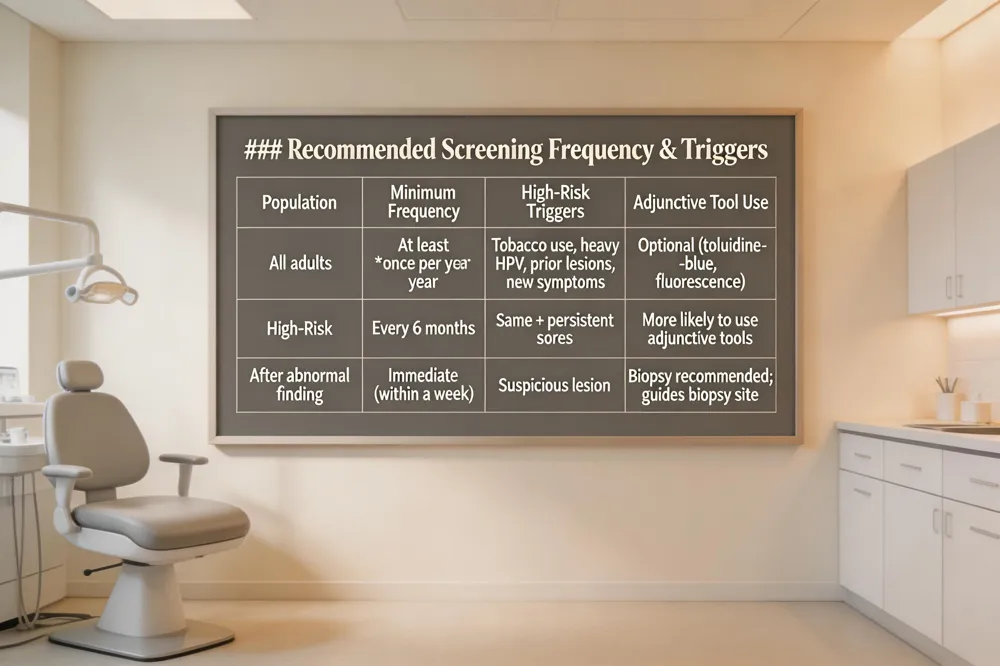 The American Dental Association (ADA) recommends that every adult receive a comprehensive intra‑oral and extra‑oral visual and tactile examination at least once a year. During each visit the clinician updates the medical, social, and dental history, focusing on tobacco use, alcohol consumption, HPV infection, prior oral lesions, and any new symptoms such as persistent sores or lumps. These high‑risk factors trigger more frequent screening—often every six months—and may prompt the use of adjunctive tools such as toluidine‑blue dye or fluorescence light to highlight suspicious tissue.
When a lesion appears abnormal, the dentist should either perform an immediate biopsy or refer the patient to an oral surgeon or oncologist for definitive histopathologic diagnosis. Cytology‑based adjuncts (brush or swab) can be employed as a triage step in high‑risk patients, but current guidelines do not endorse salivary biomarkers or light‑based devices for definitive cancer assessment. Prompt biopsy of concerning areas, combined with regular bi‑annual or annual exams, markedly improves early detection rates and overall survival for oral cancer.
Adjunctive Tools, Emerging Tests, and Dietary Prevention
Adjunctive Tools & Emerging Tests
| Tool / Test | Modality | Sensitivity (≈) | Typical Cost | FDA Status |
|---|---|---|---|---|
| VELScope® / ViziLite® | Blue‑white (violet) fluorescence lighting | 70‑90 % for detecting dysplasia (varies) | $19‑$150 per use | FDA cleared for adjunctive use |
| Toluidine‑blue dye | Visual dye application | 80‑90 % for highlighting abnormal cells | $10‑$30 | Not a diagnostic device (used as aid) |
| OralCDx® brush biopsy (WATS3D) | Brush collection + AI analysis | Sensitivity comparable to scalpel biopsy (~90 %) | $100‑$250 | FDA cleared as adjunct to visual exam |
| Blood‑based liquid biopsy (experimental) | Circulating tumor DNA, miRNA, protein signatures | Early‑stage sensitivity still under study | $200‑$500 (research) | No FDA‑approved test yet |
| Home saliva kits (e.g., Viome CancerDetect) | Saliva DNA/RNA analysis | Claims high sensitivity, but no FDA clearance | $150‑$250 | Not FDA cleared; results must be followed by professional evaluation |
Dietary Prevention Highlights
| Food Group | Key Protective Compounds | Example Foods |
|---|---|---|
| Berries | Vitamin C, polyphenols, anthocyanins | Blueberries, cranberries, raspberries |
| Citrus & Other Fruits | Vitamin C, flavonoids | Oranges, lemons, papaya |
| Whole Apples | Quercetin, fiber | Apples |
| Grapes (especially red) | Resveratrol | Grapes |
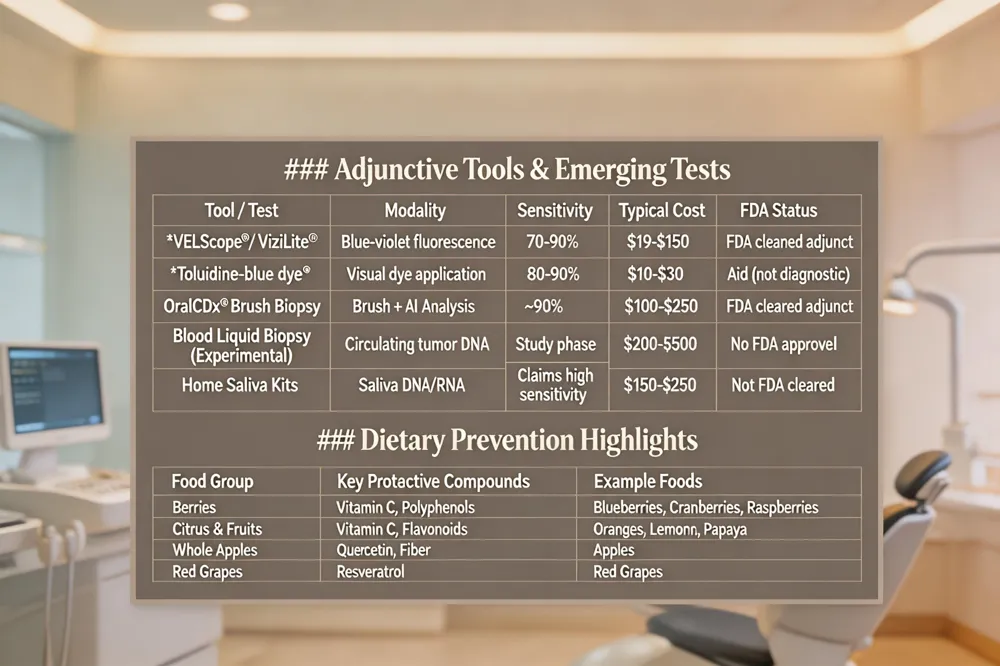 Oral cancer screening lights such as VELScope® and ViziLite® use a blue‑white (violet) illumination that makes abnormal mucosa fluoresce differently from healthy tissue, allowing clinicians to pinpoint suspicious areas within minutes. These non‑invasive, quick adjuncts are now routine in many dental offices and community screenings, improving early‑detection rates.
The most widely used non‑invasive mouth‑cancer test is the OralCDx® brush biopsy (WATS3D platform). A specially designed brush collects cells from the full thickness of the epithelium; AI‑enabled analysis then flags dysplasia or malignancy with sensitivity comparable to a scalpel biopsy.
Blood‑based liquid biopsies are still experimental. Researchers are evaluating circulating tumor DNA, micro‑RNAs, and protein signatures (e.g., TP53, EGFR) as early‑stage markers, but no FDA‑approved test exists yet. Until validation, definitive diagnosis remains visual exam plus tissue biopsy.
Home‑use kits (e.g., Viome’s CancerDetect saliva test) claim high sensitivity and specificity but lack FDA clearance; positive results must be followed by professional examination, and negative results do not rule out disease in high‑risk individuals.
Dietary prevention focuses on antioxidant‑rich fruits. Berries—blueberries, cranberries, raspberries—are best because they supply high levels of vitamin C, polyphenols, and phytochemicals that neutralize free radicals and reduce inflammation in oral tissues. Apples, grapes, citrus fruits, and papaya also contribute protective vitamins and polyphenols, supporting overall oral‑cancer risk reduction.
Understanding Costs, Insurance, and Follow‑Up Care
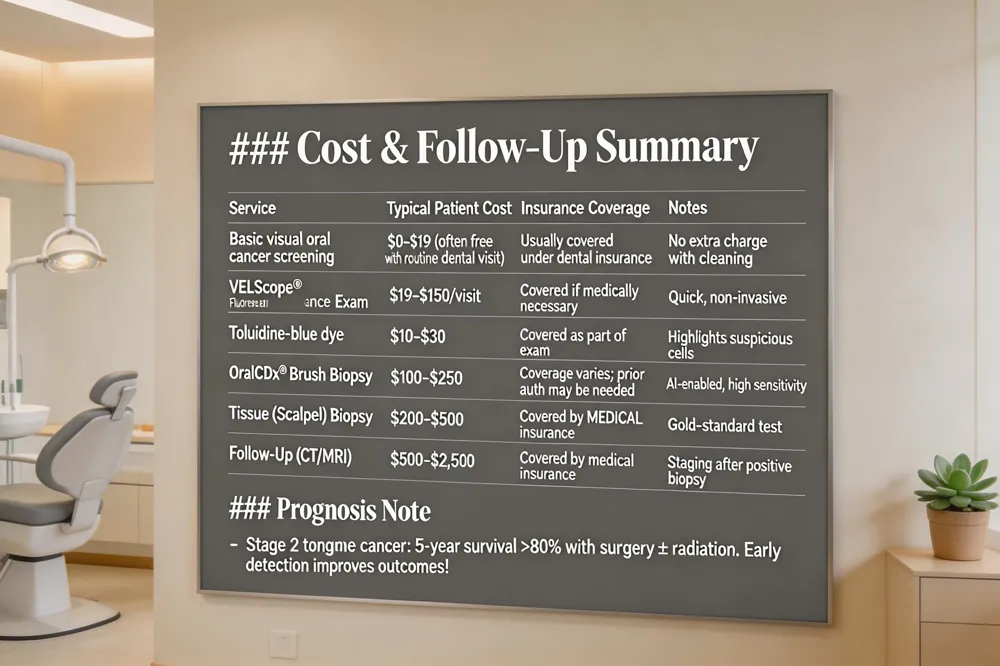
Cost & Follow‑Up Summary
| Service | Typical Patient Cost | Insurance Coverage | Notes |
|---|---|---|---|
| Basic visual oral cancer screening | $0‑$19 (often free with routine dental visit) | Usually covered under dental insurance | No extra charge when bundled with cleaning |
| VELScope® or other fluorescence exam | $19‑$150 per visit | May be covered if deemed medically necessary; otherwise out‑of‑pocket | Quick, non‑invasive adjunct |
| Toluidine‑blue dye application | $10‑$30 | Often covered as part of exam | Used to highlight suspicious cells |
| OralCDx® brush biopsy | $100‑$250 | Coverage varies; may require prior authorization | AI‑enabled analysis, high sensitivity |
| Tissue (scalpel) biopsy | $200‑$500 (depends on setting) | Covered by medical insurance (not dental) | Gold‑standard diagnostic test |
| Follow‑up imaging (CT, MRI) | $500‑$2,500 | Covered by medical insurance | Used for staging after positive biopsy |
Prognosis Note
- Stage 2 tongue cancer: 5‑year survival > 80 % with surgical removal ± postoperative radiation. Early detection dramatically improves outcomes.
 If a suspicious lesion is identified, the dentist refers the patient to an oral surgeon or oncologist for a biopsy. The referral typically occurs within a week, and biopsy results are available in three to five days. Early detection allows for less invasive surgery, radiation, or targeted therapy and raises the five‑year survival rate from about 30 % (late stage) to 80 % or higher for early‑stage disease.
Oral cancer screening cost: Oral cancer screenings are usually included in routine dental exams and often cost nothing to the patient when covered by dental insurance. If a practice uses an advanced device such as the VELscope, the out‑of‑pocket fee typically ranges from $19 for a basic screening and follow‑up to $50‑$150 per visit, depending on location and whether the exam is bundled with a regular check‑up. Many offices offer complimentary or low‑cost screenings during special awareness months or community events, and some insurers will cover the full cost of a VELscope exam when it’s deemed medically necessary. For patients without insurance, a visual exam may be free or a small fee applied, while a VELscope exam can be billed at the practice’s standard rate. Ultimately, the exact price varies by practice, but most patients can expect the cost to be modest and often offset by insurance or promotional offers.
Is stage 2 tongue cancer curable?: Yes, stage 2 tongue cancer is generally curable. At this stage the tumor is larger than 2 cm but remains confined to the tongue without spread to regional lymph nodes. The standard treatment is surgical removal of the tumor, often followed by postoperative radiation therapy, which together achieve high cure rates—typically exceeding 80 % 5‑year survival. When needed, a multidisciplinary team may add chemotherapy or targeted therapies to further improve outcomes. Early detection and timely, personalized care are key to achieving a full recovery.
Take Control of Your Oral Health Today
Routine oral cancer exams are a quick, painless part of regular dental care that can catch early‑stage disease before symptoms appear. Because more than 54,000 Americans are diagnosed each year and the five‑year survival rate rises from about 30 % to over 80 % when cancer is found early, these bi‑annual check‑ups are essential for protecting your smile and overall health. Empower Your Smile is ready to perform a comprehensive screening during your next visit—just call or book online to secure an appointment. In addition to professional exams, perform a monthly self‑check at home, looking for persistent sores, red or white patches, lumps, or unexplained pain, and report any changes promptly. Adopt healthy habits such as quitting tobacco, limiting alcohol, maintaining a balanced diet rich in fruits and vegetables, and staying up‑to‑date on the HPV vaccine to further reduce risk for a brighter future and lasting confidence in your oral well‑being today.