
Why Timely Periodontal Care Matters
Inflation is pushing dental fees upward—operational costs, professional wages, and material prices all rise, making each visit more expensive. Yet a six‑month cleaning that costs $150‑$250 today can prevent cavities, crowns, root canals, or deep‑cleaning series that run $1,000‑$5,000, a stark preventive‑vs‑restorative cost gap. Gum disease also fuels systemic conditions such as heart disease, diabetes, and respiratory infections, adding thousands of dollars in medical expenses over a lifetime. To shield both oral and overall health, patients should budget for routine cleanings and allocate a contingency fund for unexpected periodontal maintenance or emergency work. Many practices offer membership plans, financing, and insurance coordination that can offset inflation‑driven costs, turning a modest annual preventive budget into a long‑term savings strategy.
Baseline Costs of Routine Dental Cleanings
Cost Summary for Routine & Deep Dental Cleanings
| Service | Typical Cost (USD) | Notes |
|---|---|---|
| Routine cleaning (exam, plaque removal, polishing) | $75 – $200 per visit | Price varies by geography; metro areas at higher end |
| Scaling & root planing (deep cleaning) – per quadrant | $150 – $400 | Full‑mouth deep cleaning can exceed $600 |
| Diagnostic X‑rays (series) | $30 – $100 | Often added to routine visit |
| Fluoride treatment | $20 – $50 | Optional preventive service |
| Periodontal maintenance (deep cleaning for gum disease) | $150 – $300 per appointment | Usually required after initial SRP |
Additional costs depend on plaque/tartar extent, extra procedures, and local cost of living.
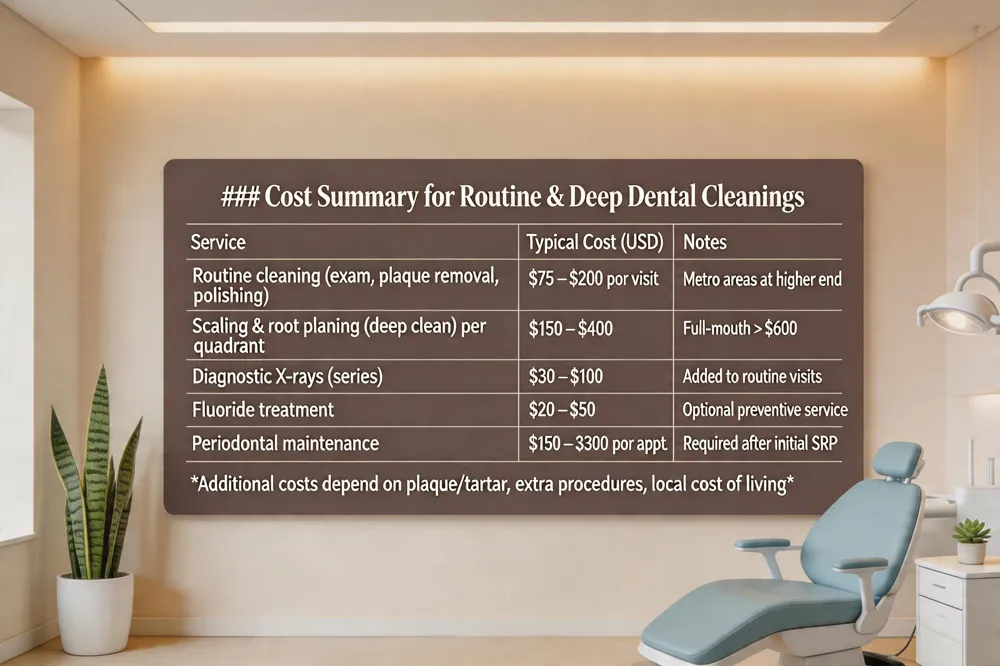 In the United States, a routine dental cleaning without insurance typically costs between $75 and $200 per visit, covering a basic exam, plaque removal and polishing. When a deeper cleaning—scaling and root planing—is required, prices rise to $150‑$400 per quadrant, so a full‑mouth deep cleaning can exceed $600. Pricing varies by geography; major metropolitan areas such as New York City, San Francisco or Boston tend to sit at the higher end of the range because of greater office overhead, while rural regions and smaller towns often charge $50‑$100 less. Additional services can increase the bill: a series of diagnostic X‑rays usually adds $30‑$100, fluoride treatments run $20‑$50, and periodontal maintenance visits (deep cleanings for those with gum disease) are typically $150‑$300 per appointment. Consequently, the total out‑of‑pocket expense depends on the extent of plaque/tartar, any extra procedures needed, and the local cost of living.
How Often Should Maintenance Visits Occur and What They Include
Recommended Maintenance Schedule & Components
| Patient Profile | Recommended Interval | Typical Procedures Included |
|---|---|---|
| Diagnosed periodontitis (moderate‑severe) | Every 3–4 months | Sub‑gingival debridement, pocket‑depth assessment, bone loss evaluation, supragingival polishing |
| Aggressive disease or systemic risks | Every 3 months | Same as above; may add localized SRP if active inflammation |
| Milder periodontitis | Every 4 months | Standard periodontal maintenance |
| Healthy gums, no periodontal involvement | Twice a year (every 6 months) | Routine prophylaxis cleaning, exam, polishing |
Full‑mouth SRP is not performed at every maintenance visit; only localized SRP when needed.
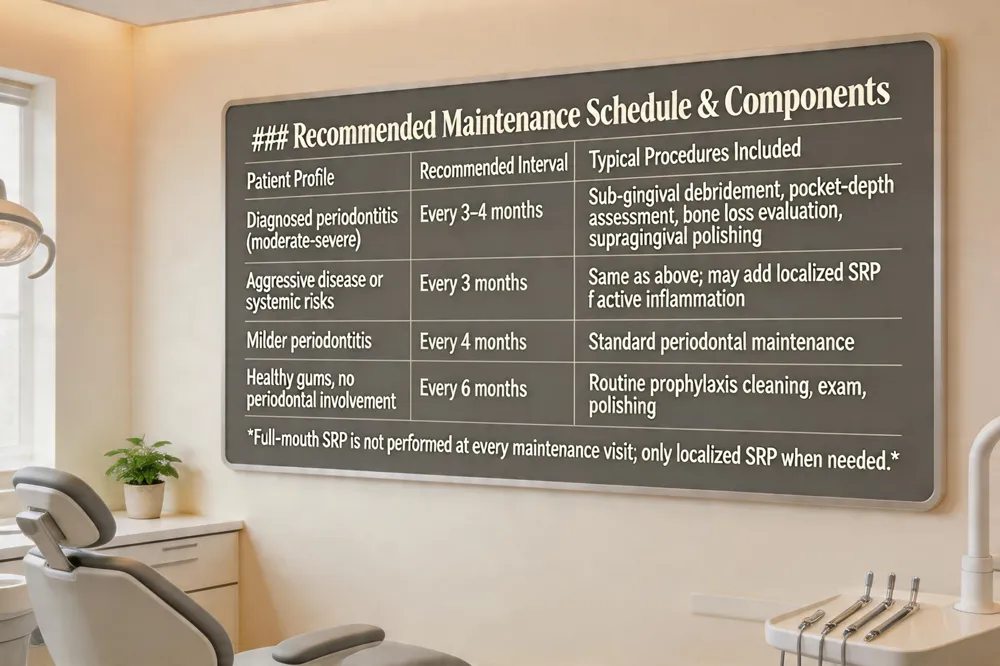 Patients with diagnosed periodontitis are generally advised to schedule periodontal maintenance every 3‑4 months, not the usual six‑month prophylaxis. The tighter interval helps control recolonization of pathogenic biofilm and stabilizes pocket depths after scaling and root planing (SRP). Those with aggressive disease or systemic risk factors may be seen every 3 months; milder cases can extend to 4 months. For individuals with healthy gums and no periodontal involvement, a routine cleaning twice a year is sufficient.
Periodontal maintenance differs from routine prophylaxis in that it includes sub‑gingival debridement, pocket‑depth assessment, and evaluation of bone loss, in addition to supragingival polishing. It is a non‑surgical visit aimed at preserving the results of prior deep cleaning. A full‑mouth SRP is not performed at every maintenance appointment, but localized SRP may be added when specific sites show active inflammation.
Insurance Coverage for Periodontal Maintenance
Typical Dental Insurance Coverage for Periodontal Maintenance
| Coverage Aspect | Typical Benefit | Patient Responsibility |
|---|---|---|
| Classification | “Therapeutic” service (after initial SRP) | May have lower coverage limits than preventive cleanings |
| Percentage Covered | 70 % – 80 % of the visit fee | Remaining 20 % – 30 % plus any deductible or co‑pay |
| Deductible | Must be met before any benefit applies | Out‑of‑pocket until deductible satisfied |
| Annual Maximum | $1,000 – $2,000 per year (common) | Costs exceeding maximum are paid by patient |
| Visit Limits | Typically 3–4 maintenance visits covered annually | Extra visits may be uncovered or require prior authorization |
Coverage can vary based on pocket depth (>4 mm) and plan specifics; always verify with insurer and dental office.
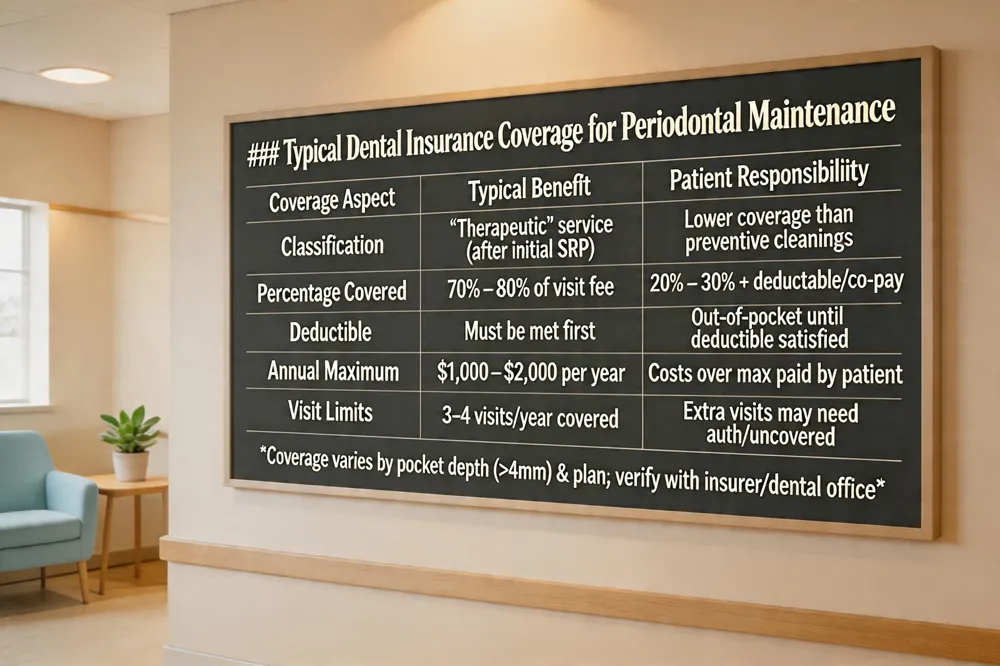 Typical dental insurance plans treat periodontal maintenance as a covered basic service once an initial deep‑cleaning (scaling and root planing) has been done. Most policies pay a set percentage—often 70‑80 %—of the visit fee, but you remain liable for any deductible, co‑pay, or amounts that exceed your annual maximum. The classification of the visit matters: many insurers label routine cleanings as "preventive" and cover them at 100 % after the deductible, whereas periodontal maintenance is often classified as "therapeutic" and may have lower coverage limits or require prior authorization. Deductibles must be met before any benefit applies, co‑pays are usually a fixed dollar amount per visit, and annual maximums (commonly $1,000–$2,000) cap the total insurer payout for the year, so excess costs become out‑of‑pocket.
Is periodontal maintenance cleaning covered by insurance? Yes—most dental insurance plans treat periodontal maintenance as a covered, basic service, especially after an initial deep‑cleaning (scaling and root planing) has been performed. The plan will usually pay a set percentage of the cost, but you may still be responsible for any applicable deductible, co‑pay, or the portion that exceeds your annual maximum. Coverage often depends on the severity of your gum disease; pockets deeper than 4 mm can trigger higher patient cost or limit the number of cleanings covered each year. Many plans allow for three to four maintenance visits annually, but they may limit coverage to a specific number of appointments or require prior authorization. It’s a good idea to check your specific policy’s details and ask your dental office to verify exactly what your insurer will cover.
Does insurance cover periodontal maintenance? Yes—most dental insurance plans treat periodontal maintenance as a covered, basic service, especially after an initial deep‑cleaning (scaling and root planing) has been performed. The plan will usually pay a set percentage of the cost, but you may still be responsible for any applicable deductible, co‑pay, or the portion that exceeds your annual maximum. Coverage often depends on the severity of your gum disease; pockets deeper than 4 mm can trigger higher patient cost or limit the number of cleanings covered each year. Many plans allow for three to four maintenance visits annually, but they may limit coverage to a specific number of appointments or require prior authorization. It’s a good idea to check your specific policy’s details and ask your dental office to verify exactly what your insurer will cover.
Financial Strategies When Periodontal Care Feels Out of Reach
Financial Strategies to Reduce Out‑of‑Pocket Costs
| Strategy | Description | Potential Savings |
|---|---|---|
| In‑house low‑interest payment plans | Office‑offered financing spread over several months | Reduces immediate cash burden |
| CareCredit or similar dental credit cards | Consumer credit line for dental procedures | 0 % intro‑period rates if paid on time |
| Dental school clinics | Supervised student treatment at 30 % – 50 % of private rates | Up to 70 % reduction in fees |
| Community health clinics & charitable programs | Sliding‑ scale or fully covered care for low‑income patients | May eliminate cost entirely for eligible patients |
| Verify insurance & use maximum benefits early | Schedule needed procedures before annual max is reached | Maximizes insurer payout, minimizing out‑of‑pocket |
The 2‑year rule (maximum interval between any dental visit) does not replace the recommended 3‑4‑month maintenance for gum disease.
 Payment‑plan and financing options are widely offered by dental offices; many provide low‑interest in‑house plans, CareCredit, or split‑payment schedules that spread the out‑of‑pocket cost of a $150‑$300 periodontal maintenance visit over several months. Community health clinics, dental schools, and charitable programs can dramatically cut fees—students supervised by faculty often perform scaling, root planing, and maintenance at 30‑50 % of private‑practice rates, and nonprofit initiatives may cover all or part of the expense for low‑income patients. The 2‑year rule for dentists is an insurer‑guided maximum interval between any dental visit, but it does not replace the standard six‑month recommendation for preventive care; most patients, especially those with gum disease, should see a periodontist every 3‑4 months to avoid costly disease progression. If you can’t afford treatment, talk to your periodontist about payment plans, verify insurance coverage, and explore sliding‑scale or charitable options through local health departments or dental schools.
Clinical Benefits and Practical Tips for Gum Health
Clinical Benefits & Practical Tips for Maintaining Gum Health
| Benefit | How It Is Achieved | Estimated Cost Savings |
|---|---|---|
| Reduced gum recession | Deep scaling removes sub‑gingival plaque, smooths root surfaces, allows re‑attachment | Prevents need for graft surgery (often $2,000+ per quadrant) |
| Prevention of costly procedures | Regular maintenance (3–4 months) avoids deep scaling, surgery, extractions, implants | $1,200 – $2,300 saved over 10 years per patient |
| Systemic health risk reduction | Controlled periodontal inflammation lowers risk of heart disease, diabetes complications | Indirect health cost savings (not quantified) |
| Post‑procedure comfort | “3‑3‑3 rule” – 200 mg ibuprofen every 3 hours, up to 3 days | Improves recovery, reduces additional visits |
| Home care reinforcement | Twice‑daily brushing, daily floss, balanced diet | Supports professional work, prolongs intervals between visits |
Consistent professional care combined with diligent home hygiene offers the best protection for both oral health and your wallet.
 Scaling (deep cleaning) can improve mild to moderate gum recession by removing plaque and tartar below the gumline, reducing inflammation and smoothing root surfaces so the tissue can re‑attach. When bone loss is minimal, this non‑surgical approach often halts further recession; severe loss still requires graft surgery. Regular periodontal maintenance—typically every 3–4 months—costs $150‑$300 per visit in the U.S., yet it prevents far more expensive procedures such as deep scaling, surgery, extractions or implants that can run $2‑$5 hundred per quadrant. Studies show patients who keep up with maintenance save $1,200‑$2,300 over ten years and reduce systemic health risks. Home care (twice‑daily brushing, daily floss, and a balanced diet) supports the professional work. After a scaling session, the “3‑3‑3 rule” (200 mg ibuprofen every 3 hours, up to 3 days) helps control post‑procedure inflammation. Investing in these preventive steps protects both oral health and your wallet.
Take Action Today for a Healthier Smile
Regular dental cleanings and periodontal maintenance are not luxuries; they are financial safeguards. Skipping a six‑month cleaning can let plaque harden into tartar, leading to cavities, gum disease, and costly procedures—fillings, root canals, crowns, or even implants—that can run into the thousands of dollars. Repeated missed maintenance visits also raise the risk of advanced periodontitis, which often requires deep scaling, surgery, bone grafts, or extractions, each adding $2,000‑$5,000+ to a patient’s bill. Moreover, untreated gum disease is linked to systemic illnesses such as heart disease and diabetes, potentially adding thousands more in medical expenses. To protect both your smile and your wallet, schedule cleanings every six months (and periodontal maintenance every 3‑4 months if you have gum disease), explore insurance benefits or financing plans, and set aside a modest preventive‑care budget. Investing a few hundred dollars annually now can avert emergency visits and expensive restorative work later.