Introduction
Dental crowns are celebrated as durable restorations, yet they are not permanent fixtures. Clinical studies show that about 97 % of crowns remain functional after ten years and 85 % after fifteen, with the average lifespan ranging from ten to fifteen years. Some materials, such as gold alloys and high‑strength zirconia, can extend that range to twenty‑plus years when conditions are optimal.
A common misconception is that the crown itself will “decay.” In reality, the most frequent cause of failure is secondary caries or gum disease at the crown margin, not the crown material. This is why patients often hear that “the crown lasts forever” while neglecting the underlying tooth health.
Material choice and daily care are therefore pivotal. Metal crowns and zirconia offer the longest durability, whereas porcelain‑fused‑metal and all‑ceramic options balance aesthetics with a ten‑to‑fifteen‑year expectancy. Maintaining meticulous oral hygiene, avoiding hard or sticky foods, and using a night guard for bruxism significantly prolong this lifespan, ensuring the restoration performs as intended for years to come.
Understanding Crown Lifespan by Tooth Location
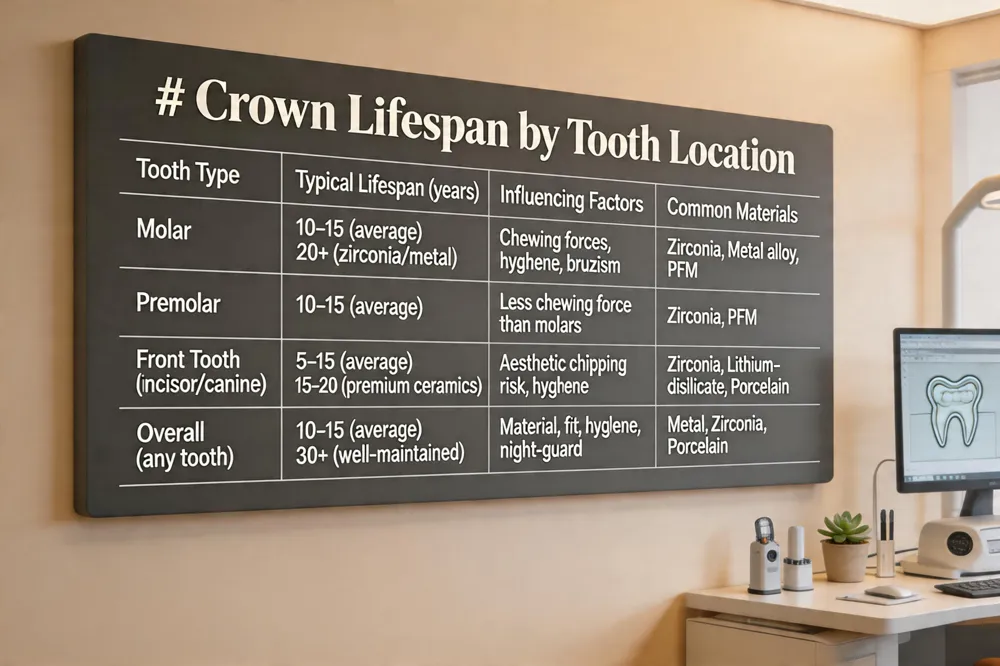
Crown Lifespan by Tooth Location
| Tooth Type | Typical Lifespan (years) | Influencing Factors | Common Materials |
|---|---|---|---|
| Molar | 10‑15 (average) <br>20+ (high‑strength zirconia or metal‑alloy) | Chewing forces, oral hygiene, bruxism, hard‑object biting | Zirconia, Metal alloy, PFM |
| Premolar | 10‑15 (average) | Similar to molars but slightly less force | Zirconia, PFM |
| Front Tooth (incisor/canine) | 5‑15 (average) <br>15‑20 (premium ceramics) | Aesthetic demand, porcelain chipping risk, hygiene | Zirconia, Lithium‑disilicate, Porcelain |
| Overall (any tooth) | 10‑15 (average) <br>30+ (well‑maintained metal or zirconia) | Material choice, fit (CAD/CAM), brushing/flossing, night‑guard for bruxism | Metal, Zirconia, Porcelain |
How long does a crown last on a molar?
Molar crowns survive on average 10‑15 years; high‑strength zirconia or metal‑alloy crowns often reach 20 years or more because molars bear the greatest chewing forces. Good oral hygiene, regular cleanings, and avoiding bruxism or hard‑object biting are essential to prevent marginal decay and fracture.
How long does a crown last on a front tooth?
Front‑tooth crowns typically last 5‑15 years, with premium ceramics (zirconia, lithium‑disilicate) extending life to 15‑20 years. Aesthetics are better on front teeth, but porcelain is more prone to chipping, so daily flossing, brushing, and a night‑guard for grinders help preserve the restoration.
How long do crowns last on front teeth?
When well‑maintained, front‑teeth crowns can remain functional for 15‑20 years. Materials such as zirconia or high‑quality porcelain provide the best durability, while regular dental visits catch early decay or looseness that could shorten lifespan.
Tooth crown lifespan
Overall, dental crowns average 10‑15 years; metal or zirconia crowns can exceed 30 years. The key factors are material choice, precise fit (enhanced by CAD/CAM scanning), diligent brushing/flossing, and protecting the crown from grinding with a custom night‑guard.
Dental crown lifespan Reddit
Reddit users report experiences that mirror clinical data: most crowns last 10‑15 years, with many users celebrating 20‑year survivals when proper care is observed.
Materials Matter: Zirconia, Metal, Porcelain and More
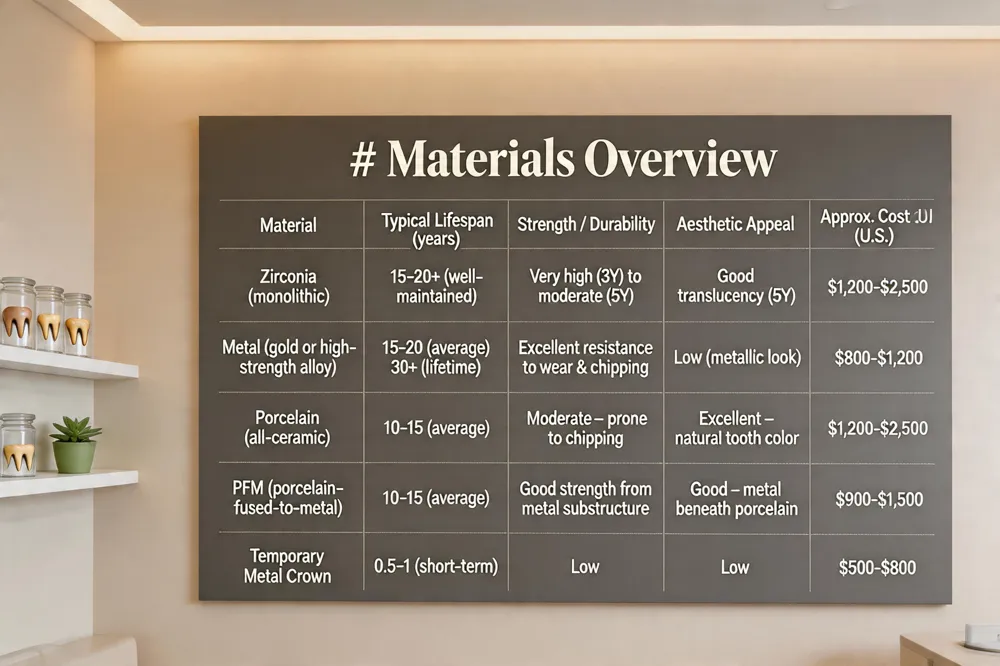
Materials Overview
| Material | Typical Lifespan (years) | Strength / Durability | Aesthetic Appeal | Approx. Cost (U.S.) |
|---|---|---|---|---|
| Zirconia (monolithic) | 15‑20+ (well‑maintained) | Very high (3Y) to moderate (5Y) | Good translucency (5Y) | $1,200‑$2,500 |
| Metal (gold or high‑strength alloy) | 15‑20 (average) <br>30+ (lifetime) | Excellent resistance to wear & chipping | Low (metallic look) | $800‑$1,200 |
| Porcelain (all‑ceramic) | 10‑15 (average) | Moderate – prone to chipping | Excellent – natural tooth color | $1,200‑$2,500 |
| PFM (porcelain‑fused‑to‑metal) | 10‑15 (average) | Good strength from metal substructure | Good – metal beneath porcelain | $900‑$1,500 |
| Temporary Metal Crown | 0.5‑1 (short‑term) | Low | Low | $500‑$800 |
 Zirconia crown
s are made from high‑strength zirconium‑dioxide ceramic, offering exceptional durability (10‑20 years) and biocompatibility. Modern formulations (3Y for strength, 5Y for translucency) are milled via CAD/CAM, often allowing same‑day placement. Good oral hygiene, regular check‑ups, and a night guard for bruxism extend their life.
Zirconia crown
Zirconia crowns are made from high‑strength zirconium‑dioxide ceramic, offering exceptional durability (10‑20 years) and biocompatibility. Modern formulations (3Y for strength, 5Y for translucency) are milled via CAD/CAM, often allowing same‑day placement. Good oral hygiene, regular check‑ups, and a night guard for bruxism extend their life.
Zirconia crown lifespan Clinical data show 90‑95 % survival at 5‑10 years for monolithic zirconia and 15‑20 years or more for well‑maintained restorations. Factors that help include high‑quality cement, precise occlusion, healthy supporting tooth, and avoidance of hard foods.
How long does a Metal crown last? Metal crowns (gold or high‑strength alloys) are the most durable, averaging 15‑20 years and often lasting 30 years or a lifetime when the underlying tooth stays healthy. Their resistance to chipping and wear makes them ideal for molars.
Types of dental crowns and cost Metal crowns: $800‑$1,200. PFM crowns: $900‑$1,500. All‑ceramic (zirconia, lithium disilicate): $1,200‑$2,500. Temporary metal crowns: $500‑$800. Costs vary by lab, location, and case complexity.
Porcelain and PFM crowns Porcelain crowns offer superior aesthetics but are prone to chipping; PFM crowns balance strength and appearance. Both average 10‑15 years with proper care.
The Crown Procedure From Start to Finish
Crown Placement Workflow
| Step | Description | Approx. Time | Key Notes |
|---|---|---|---|
| 1. Evaluation & Anesthesia | Clinical exam, X‑ray, local anesthetic | 5‑15 min | Ensures healthy tooth structure |
| 2. Tooth Preparation | Remove decay/old restoration, reshape (1‑2 mm reduction) | 30‑45 min | Preserve as much healthy tooth as possible |
| 3. Impression / Digital Scan | Traditional tray or intra‑oral scanner | 5‑10 min | Scan gives higher accuracy & faster turnaround |
| 4. Temporary Crown Placement | Cement temporary restoration to protect tooth | 5‑10 min | Avoid hard foods, chew opposite side |
| 5. Lab Fabrication (if not same‑day) | Crown milled/pressed based on impression | 1‑2 weeks | May be ceramic, zirconia, metal, etc. |
| 6. Same‑Day CAD/CAM (optional) | Design & mill crown in‑office | 90‑120 min total visit | Eliminates temporary crown & lab delay |
| 7. Permanent Crown Cementation | Try‑in, adjust occlusion, bond crown | 30‑45 min | Mild post‑placement sensitivity normal |
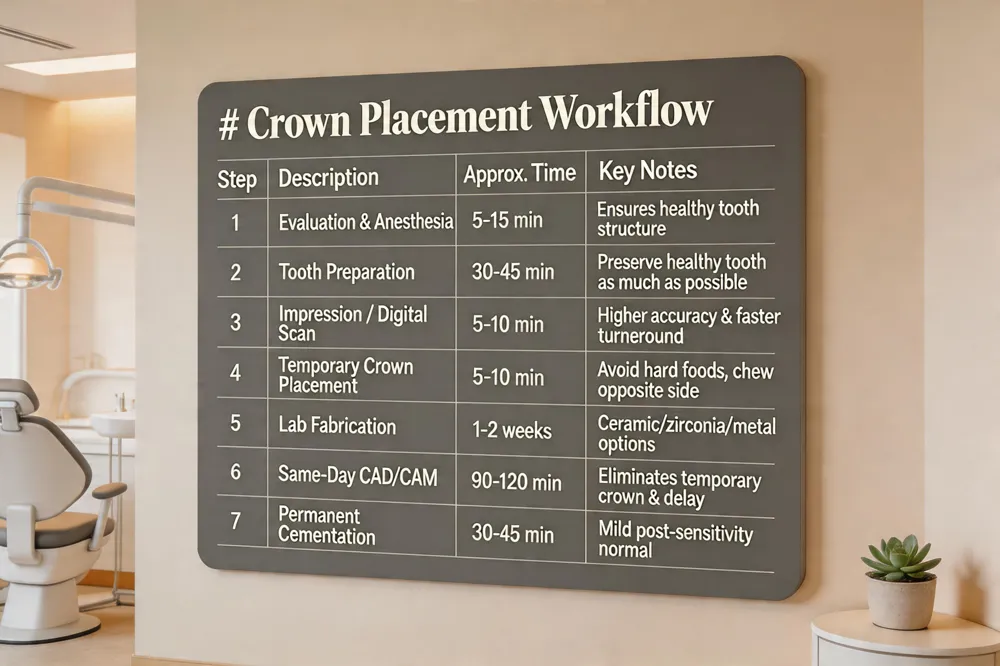 A dental crown procedure begins with a thorough evaluation and local anesthesia. Preparing a tooth for a crown – the dentist removes decay or old restoration, cleans the site, and reshapes the tooth (≈1‑2 mm reduction) while preserving healthy structure; a core may be placed after a root canal. An impression or, preferably, a digital scan captures the tooth’s dimensions. Impression vs digital scan – traditional tray impressions are reliable, but intra‑oral scanners provide higher accuracy, reduce distortion, and speed up lab work. A temporary crown is then cemented to protect the prepared tooth while the permanent restoration is fabricated, usually taking 1‑2 weeks for lab‑made crowns. Same‑day CAD/CAM crowns bypass the lab: the digital design is milled in‑office and placed in a single visit, often within 90‑120 minutes.
Dental crown procedure: after preparation and scanning, the permanent crown (porcelain, zirconia, or PFM) is bonded; mild post‑placement sensitivity is normal.
How long do dental crowns take? Two appointments (30‑60 min prep + 30‑45 min placement) or one same‑day CAD/CAM session (≈90‑120 min).
Caring for Your Crown: Daily Habits and Professional Maintenance
Daily Care & Maintenance Checklist
| Habit | Recommendation | Benefit |
|---|---|---|
| Brushing | Soft‑bristled toothbrush, fluoride toothpaste, 2×/day | Removes plaque, protects margins |
| Flossing | Careful floss around crown margin daily | Prevents decay under crown |
| Mouthwash | Antimicrobial (e.g., chlorhexidine) 1×/day | Reduces bacterial load |
| Diet | Avoid hard foods (ice, nuts), sticky treats (caramel, taffy), excessive acidic drinks | Reduces risk of chipping & cement erosion |
| Night‑Guard | Custom guard for bruxism patients, worn nightly | Doubles functional life, prevents cracks |
| Professional Visits | Check‑up & cleaning every 6 months | Early detection of decay, recession, marginal gaps |
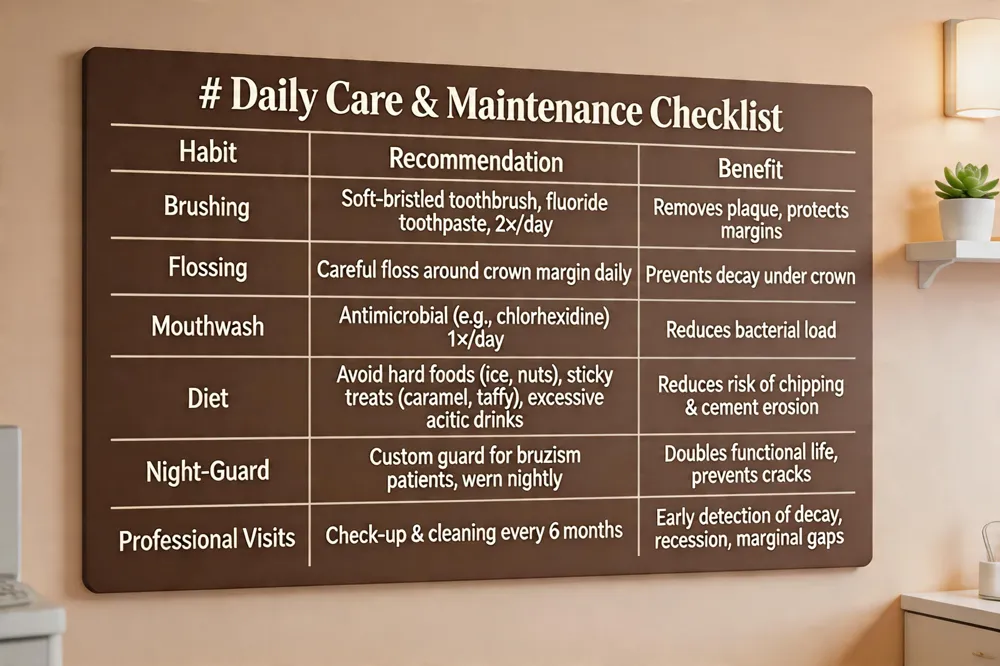 Good oral hygiene is the cornerstone of crown longevity. Brush twice daily with a soft‑bristled toothbrush and fluoride toothpaste, floss carefully around the margin, and use an antimicrobial mouthwash to keep plaque away from the seal. Dietary habits also matter; avoid hard foods (ice, nuts, hard candy) and extremely sticky treats (caramel, taffy) that can chip or loosen a crown, and limit acidic drinks that erode cement. For patients with bruxism, a custom night guard protects the restoration from grinding forces that can cause cracks or debonding; wearing it nightly can double a crown’s functional life. Regular check‑ups every six months let the dentist spot early decay, gum recession, or marginal gaps and perform professional cleanings that reach areas a toothbrush cannot.
Disadvantages of dental crowns include the permanent removal of healthy tooth structure, higher cost, potential for decay beneath the crown, and material‑specific issues such as metal allergies or porcelain chipping. No scientific evidence links crowns to cancer. Crowns can be replaced when cracked, loose, or decayed; the old crown is removed, the tooth inspected, and a new one fabricated, often in a single visit with CAD/CAM technology. Early failure usually stems from decay, poor fit, bite misalignment, or bruxism. When a crown fails, it may become loose or detach, allowing bacteria to invade, causing pain, sensitivity, and possible infection; prompt dental treatment restores protection. Temporary crowns require gentle care: wait for numbness to wear off, chew on the opposite side, avoid hard or sticky foods, brush softly, floss cautiously, and keep the crown cemented; contact the dentist if it loosens. The informal “3‑3‑3 rule” (brush three times a day for three minutes each) promotes thorough cleaning, while the U.S. standard remains bi‑monthly professional visits.
Special Situations: Bruxism, Root Canals, and Long‑Term Success
Managing Special Cases
| Situation | Impact on Crown | Recommended Management |
|---|---|---|
| Bruxism (grinding) | Increases risk of fracture, debonding, chipping | Custom night‑guard; consider high‑strength zirconia or metal crown |
| Post‑Root Canal | Tooth becomes brittle, needs full coverage | Well‑fitted crown (preferably zirconia or metal) for stability |
| Long‑Term Success (>20 yr) | Rare, requires excellent material & care | High‑quality zirconia, meticulous oral hygiene, regular exams |
| Early Failure Signs | Marginal decay, looseness, pain | Prompt dental evaluation, possible re‑cementation or replacement |
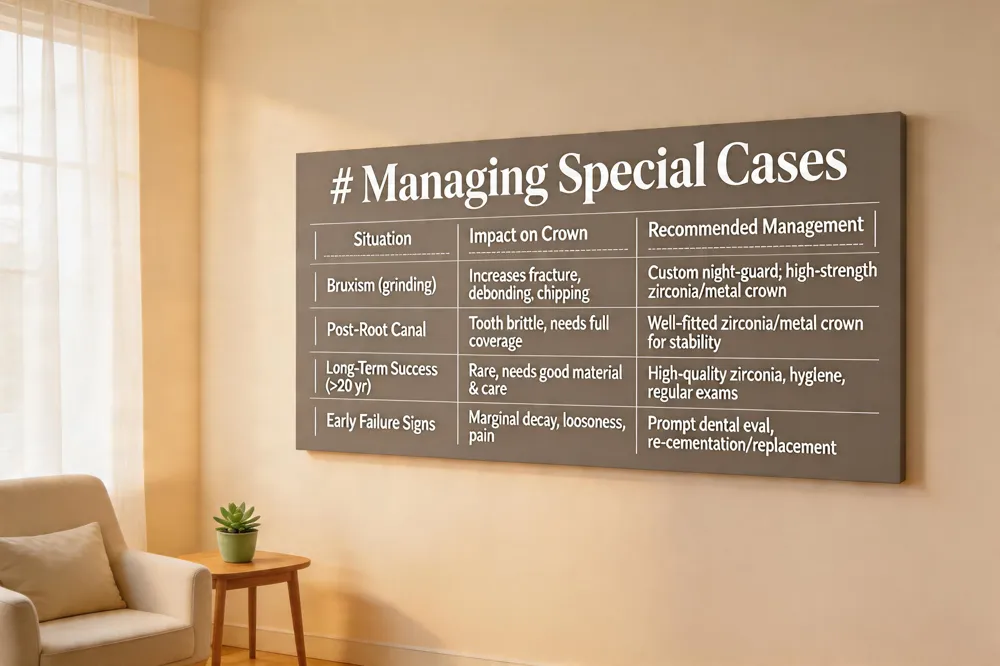 Grinding (bruxism) exerts excessive forces that can chip, fracture, or loosen a crown. A custom night guard distributes these forces, often doubling a crown’s functional life. After a root canal, a well‑fitted crown can keep the tooth stable for a decade; studies show 90‑95 % of such teeth remain healthy after ten years when oral hygiene and regular check‑ups are maintained. Early crown failure usually stems from decay at the margin, poor fit, bite misalignment, or trauma. While rare, high‑quality zirconia crowns placed expertly can survive up to 40 years. Crowns are replaceable whenever they crack, wear, become loose, discolor, or develop decay. The dentist removes the old crown, assesses the tooth, and fabricates a new one—often in a single visit with CAD/CAM technology. Routine bi‑annual exams and diligent home care are essential for long‑term success.
Financial and Insurance Realities
Cost & Coverage Summary
| Item | Cost Range (U.S.) | Typical Insurance Coverage | Notes |
|---|---|---|---|
| Metal Crown | $800‑$1,200 | ~50 % of major restorative fee | Most durable, lower aesthetic |
| Porcelain‑Fused‑to‑Metal (PFM) | $900‑$1,500 | ~50 % | Balanced strength & looks |
| All‑Ceramic / Zirconia | $1,200‑$2,500 | ~50 % | Highest aesthetics, good durability |
| Temporary Metal Crown | $500‑$800 | Usually not covered | Short‑term protection |
| Full Crown Procedure (incl. prep, anesthesia, lab) | $800‑$3,000 per tooth | Up to 50 % depending on plan | Material choice drives price |
| Membership / Savings Plans | Varies (flat annual fee) | N/A (out‑of‑pocket discount) | Can reduce per‑crown cost |
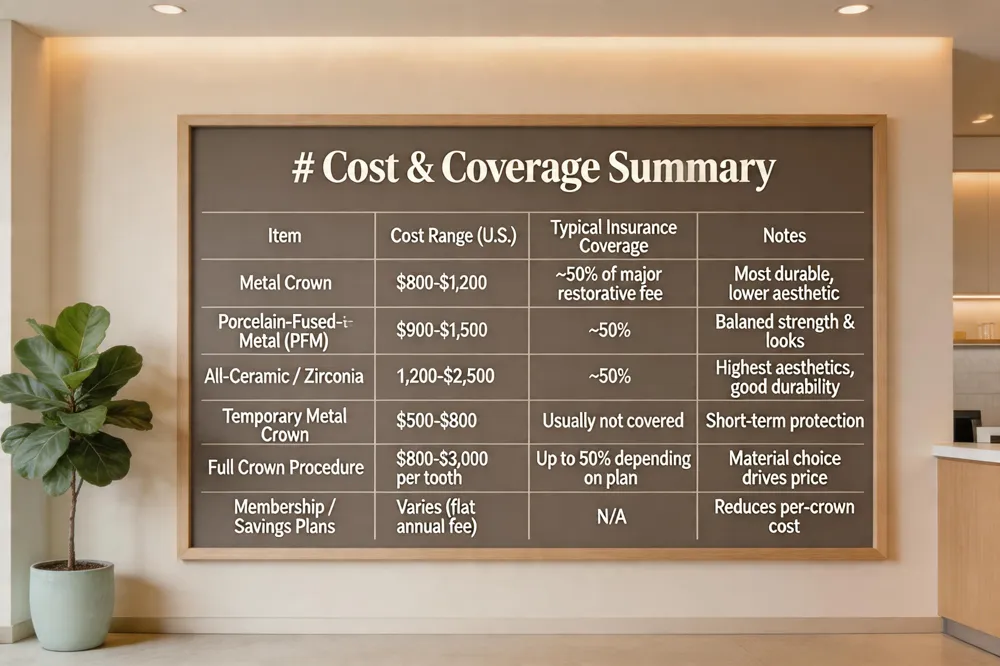 Crown cost breakdown – In the U.S., a permanent dental crown typically costs $800‑$3,000 per tooth. The price includes the permanent crown, any temporary crown, local anesthesia, lab fees, and the dentist’s chair time. Material choice drives cost: metal crowns ($800‑$1,200), porcelain‑fused‑to‑metal ($900‑$1,500), all‑ceramic/zirconia ($1,200‑$2,500) and temporary metal crowns ($500‑$800).
Insurance coverage limits – Most dental plans cover about 50 % of major restorative procedures, but limits are often set to one crown per tooth every 5‑8 years. Coverage varies by network status, plan type, and whether additional work (root canal, core build‑up) is required.
Membership plans – In‑house dental‑savings memberships can reduce out‑of‑pocket costs, offering discounted rates on crowns and related procedures for a flat annual fee.
Value of quality material – Investing in high‑quality ceramics (zirconia, lithium disilicate) or gold alloys can extend crown lifespan (15‑30+ years) and reduce future replacement costs, offsetting the higher upfront price.
Permanent teeth cap price
A permanent tooth cap, or dental crown, typically costs between $800 and $3,000 per tooth in the United States. The exact price depends on the material—porcelain or zirconia crowns run $1,000‑$2,500, porcelain‑fused‑to‑metal $900‑$2,000, and metal crowns $800‑$2,000. Insurance may cover a portion of the fee, but out‑of‑pocket costs can vary by provider and location.
Dental crown cost
A dental crown in the United States typically runs between $800 and $3,000 per tooth, with the exact price depending on the material you choose (e.g., metal, porcelain‑fused‑to‑metal, all‑ceramic, zirconia, or gold). The cost includes the permanent crown, any temporary crown, local anesthesia, laboratory fees, and the dentist’s time.
Types of dental crowns and cost
Dental crowns come in several material types, each with its own price range and aesthetic profile. Metal crowns—typically gold or base‑metal alloys—are the most durable and usually cost between $800 and $1,200. Porcelain‑fused‑to‑metal (PFM) crowns combine a metal substructure with a tooth‑colored porcelain coating, ranging from $900 to $1,500. All‑ceramic options such as zirconia or lithium disilicate offer superior translucency and natural appearance, with costs typically from $1,200 to $2,500.
Conclusion
Key takeaways: most crowns last 10‑15 years, but with proper care they can reach 20‑30 years; material choice, flawless placement, and diligent oral hygiene are the biggest determinants of longevity. Empowering patients: understand that daily brushing, flossing, antimicrobial mouthwash, and regular six‑month check‑ups are the most effective tools you control; use a night‑guard if you grind, avoid hard or sticky foods, and treat any gum irritation promptly. Next steps: schedule a comprehensive exam to assess current crown health, discuss the best material for your bite and aesthetics, and create a personalized maintenance plan that includes professional cleanings, possible fluoride or resin‑modified cement, and a custom guard if needed. Consistent, proactive care will keep your crown—and your smile—healthy for years to come.