
Why Crown Lengthening Matters Beyond Aesthetics
Crown lengthening is a surgical procedure that removes excess gingival tissue and, when needed, alveolar bone to expose additional natural tooth structure. It is performed to correct subgingival decay, fractures, or a ‘gummy’ smile, and to create a proper biologic width (≈2 mm) and a 1.5‑2 mm ferrule for durable restorations. By increasing clinical crown height, the tooth can meet opposing teeth at the correct vertical dimension, establishing balanced occlusion. Sufficient tooth height prevents over‑contouring of the crown, which otherwise creates occlusal interferences, premature wear, and TMJ strain. When crown lengthening is coordinated with precise prosthetic design or orthodontic treatment, it restores proper bite alignment, distributes chewing forces evenly, and reduces temporomandibular discomfort.
Crown Lengthening: Procedure Steps, Costs, and Healing Timeline
Crown Lengthening Overview
| Phase | Step | Details |
|---|---|---|
| Evaluation | Clinical & radiographic | Map biologic width, plan amount of tooth structure to expose |
| Anesthesia | Local infiltration | |
| Soft‑tissue | Trim gingiva | Scalpel, laser, or soft‑tissue trimmer |
| Flap | Reflect if bone crest is too close | Apically positioned flap |
| Bone removal | Remove bone | Rotary bur or piezoelectric instrument to achieve proper crown‑to‑root ratio |
| Tissue shaping | Re‑contour, irrigate, suture | |
| Post‑op | Instructions & medication | Soft diet, NSAIDs, ice‑pack protocol |
| Follow‑up | Clinical review | 4–6 weeks for tissue stabilization; up to 3 months for bone remodeling before final crown |
Cost Range
| Procedure | Cost per tooth |
|---|---|
| Gum‑only (soft‑tissue only) | $300‑$500 |
| Bone removal (hard‑tissue) | $2,000‑$3,000 |
| Multi‑tooth cases | $1,800‑$2,000 total |
Healing Timeline
- Soft tissue stabilizes in 4–6 weeks
- Bone remodeling may require up to 3 months before definitive restoration
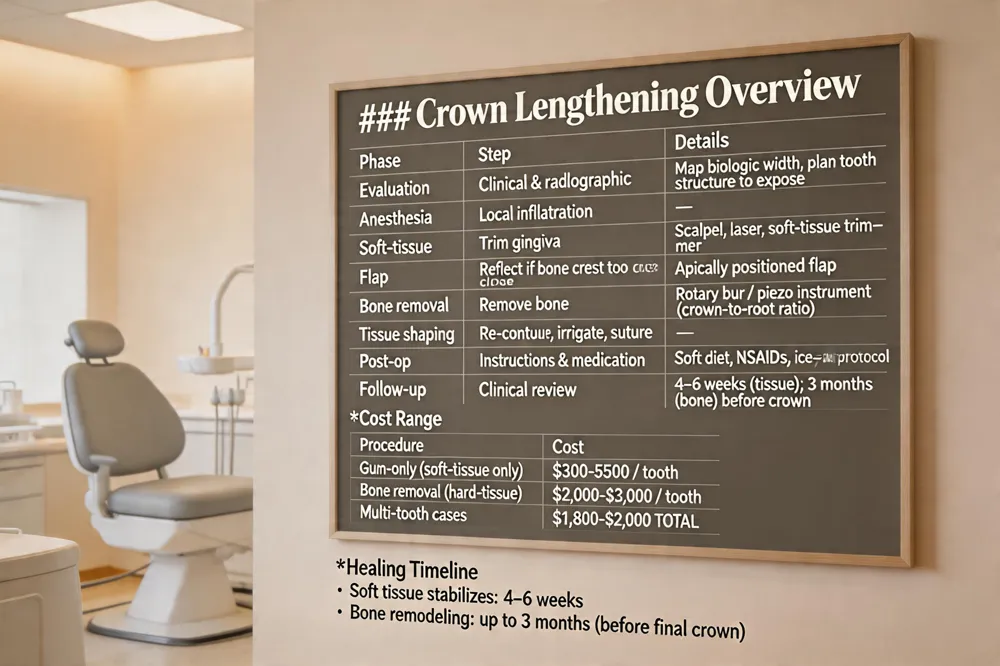 Crown lengthening begins with a thorough clinical and radiographic evaluation to map the biologic width and plan the amount of tooth structure that must be exposed. After local anesthesia, the dentist trims excess gingiva with a scalpel, laser, or soft‑tissue trimmer and, if the bone crest is too close, reflects an apically positioned flap. Using a rotary bur or piezoelectric instrument, the required bone is removed to achieve a proper crown‑to‑root ratio, then the gum tissue is re‑contoured, irrigated, and sutured. Patients receive post‑operative instructions, a soft diet, NSAIDs, and an ice‑pack protocol; a follow‑up at 4–6 weeks assesses tissue stabilization before the final crown is fabricated.
Cost varies by case complexity and number of teeth. A single‑tooth, gum‑only procedure typically costs $300‑$500, while bone removal can raise the price to $2,000‑$3,000 per tooth. Insurance may cover medically necessary cases but rarely cosmetic “gummy‑smile” corrections. The healing period is prolonged because both soft tissue and bone need remodeling—soft tissue stabilizes in 4–6 weeks, whereas bone remodeling may require up to three months before definitive restoration can be placed.
Biologic Width, Ferrule, and Their Role in Bite Alignment
Biologic Width & Ferrule Summary
| Parameter | Typical Value | Clinical Significance |
|---|---|---|
| Biologic Width | ~2 mm total (≈0.97 mm epithelium + ≈1.07 mm connective tissue) | Must be preserved to avoid inflammation, bone loss, and recession |
| Ferrule | 1.5–2 mm of supragingival tooth structure | Provides resistance & retention for crowns; prevents fracture |
| Minimum Crown‑to‑Root Ratio | ≥1:1 (ideally 1.2:1) | Ensures adequate support after lengthening |
| Bone‑to‑Margin Distance | ≥3 mm | If less, osseous reduction is required to re‑establish biologic width |
When Dimensions Are Insufficient
- Crown lengthening creates adequate tooth height → restores occlusal contacts & bite alignment.
- Adequate ferrule (1.5–2 mm) improves long‑term restoration success.
Common Q&A
- Crown lengthening vs. gingivectomy?
- Gingivectomy: soft‑tissue only, heals ~1 week, for mild overgrowth.
- Crown lengthening: soft‑tissue ± bone removal, heals 4–6 weeks, for subgingival decay or aesthetic correction.
- Osseous reduction needed?
- If bone crest <3 mm from intended margin → flap raised & bone trimmed.
- Downsides?
- Pain, swelling, recession, sensitivity, infection risk, possible bite changes.
- Relation to occlusal adjustment?
- Surgical exposure + occlusal reshaping eliminates interferences, improves jaw function.
 Biologic width, the ~2 mm combination of epithelial (≈0.97 mm) and connective tissue (≈1.07 mm) attachment, must be maintained to prevent inflammation and bone loss. Biologic width, the ~2 mm combination of epithelial (≈0.97 mm) and connective tissue (≈1.07 mm) attachment, must be maintained to prevent inflammation and bone loss.
A ferrule of 1.5–2 mm of supragingival tooth structure gives crowns resistance and retention, avoiding fracture. “A ferrule of 1.5–2 mm of tooth structure supracing the preparation margin is essential for long‑term restoration success; when insufficient, crown lengthening is often indicated.”
When these dimensions are insufficient, crown lengthening creates adequate height, restoring occlusal contacts and bite alignment.
Crown height distributes chewing forces evenly, reduces premature contacts, and eases strain.
Q: Crown lengthening vs gingivectomy?
A: Gingivectomy trims only soft tissue, healing in about a week, suitable for mild gum overgrowth.
Crown lengthening removes gum and possibly bone to expose more crown for subgingival decay or aesthetic correction; healing may take 4–6 weeks. “Crown lengthening removes gum tissue and bone to expose more tooth structure.”
Q: Crown lengthening with osseous reduction?
A: If bone is <3 mm from the intended margin, a flap is raised and bone trimmed to re‑establish biologic width, providing stable gingival margins and crown height. “If bone crest <3 mm from the intended margin, osseous reduction is required to maintain biologic width.”
Q: Downsides?
A: Post‑op pain, swelling, recession, sensitivity, infection risk, and bite changes.
Q: Crown lengthening and occlusal adjustment?
A: Treatment eliminates occlusal interferences, improves jaw function, and achieves bite. “Occlusal adjustment reshapes tooth surfaces to eliminate bite interferences.”
Post‑Crown Bite Adjustments: Managing Discomfort and Restoring Balance
Post‑Crown Bite Adjustment Guide
| Issue | Typical Symptoms | Management Steps |
|---|---|---|
| High crown / premature contact | Sharp pain when chewing, jaw soreness | Locate high spots with articulating paper → gentle reshaping with handpiece (single visit) |
| Uneven bite / “off” feeling | One side feels “falling,” discomfort | Adjust occlusal surfaces; if persistent, evaluate for TMJ involvement |
| Temporary crown looseness | Mobility, bulkiness, gag sensation | Allow soft as adapt (≈1 week) → re‑check fit; re‑cement if needed |
| Persistent pain/swelling | Ongoing inflammation, possible infection | Schedule follow‑up; consider antibiotics, re‑evaluation of crown margin |
Timeline for Relief
- Minor adjustments: immediate (same visit) →n resolves within a few days.
- Temporary crown adaptation: ≈1 week.
- Persistent issues: evaluate within 1–2 weeks; may require crown removal & remake.
Why Prompt Correction Matters
- Protects restoration integrity
- Prevents TMJ strain
- Ensures long‑term oral health and proper bite harmony
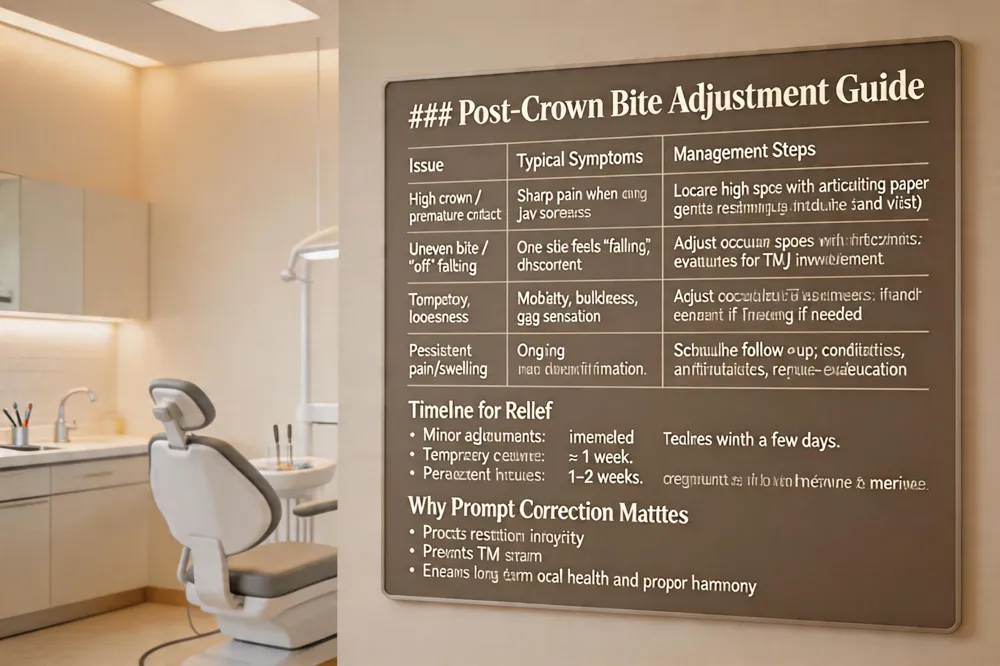 After a crown is placed, patients often notice bite changes. Common problems include a high crown that creates premature contact, an uneven bite that feels “off,” or sensitivity from an ill‑fitted temporary crowns. These issues can cause sharp pain when chewing, jaw soreness, or a feeling that one side of the mouth is “falling.” A quick occlusal adjustment—using articulating paper to locate high spots and gently reshaping the crown with a handpiece—usually resolves the discomfort in a single visit. If the crown is too high, the pain is only present when the teeth meet; grinding down the excess restores proper contact. Temporary crowns may feel loose or bulky, but most patients adapt within a week as the gums settle. The bite often self‑adjusts over a few days, but persistent pain, swelling, or uneven pressure warrants a follow‑up. Adjustments can be made after cementation; minor reshaping is routine, while severe misfits may require crown removal and replacement. Prompt correction protects the restoration, prevents TMJ strain, and ensures long‑term oral health.
Financial Realities: Insurance, Codes, and Patient Planning
Financial & Coding Overview
| Aspect | Details |
|---|---|
| Insurance Coverage | Limited to function‑restoring cases (broken, decayed, sub‑gingival teeth). Cosmetic “gummy‑smile” corrections rarely reimbursed. |
| Healing Requirement for Payment | Many plans require a 6‑week healing period before final restoration before payment. |
| CDT Codes | - D4249: Clinical crown‑lengthening (hard‑tissue, bone &/or gum removal).<br>- D4212: Soft‑tissue only (gingivectomy/gingivoplasty). |
| Documentation Needed | Periodontal health records, radiographs, and justification of medical necessity for D4249. |
| Cost Breakdown | - Gum‑only: $300‑$500 per tooth<br>- Bone removal: $2,000‑$3,000 per tooth<br>- Multi‑tooth cases: $1,800‑$2,000 total (varies by geography, technique, sedation). |
| Patient Planning Tips | 1. Request a detailed written estimate.<br>2. Verify insurance benefits and pre‑authorization.<br>3. Discuss payment options (e.g., financing, sliding scale). |
Key Takeaway Understanding codes and coverage helps avoid surprise bills and ensures patients can plan for both surgical and restorative phases.
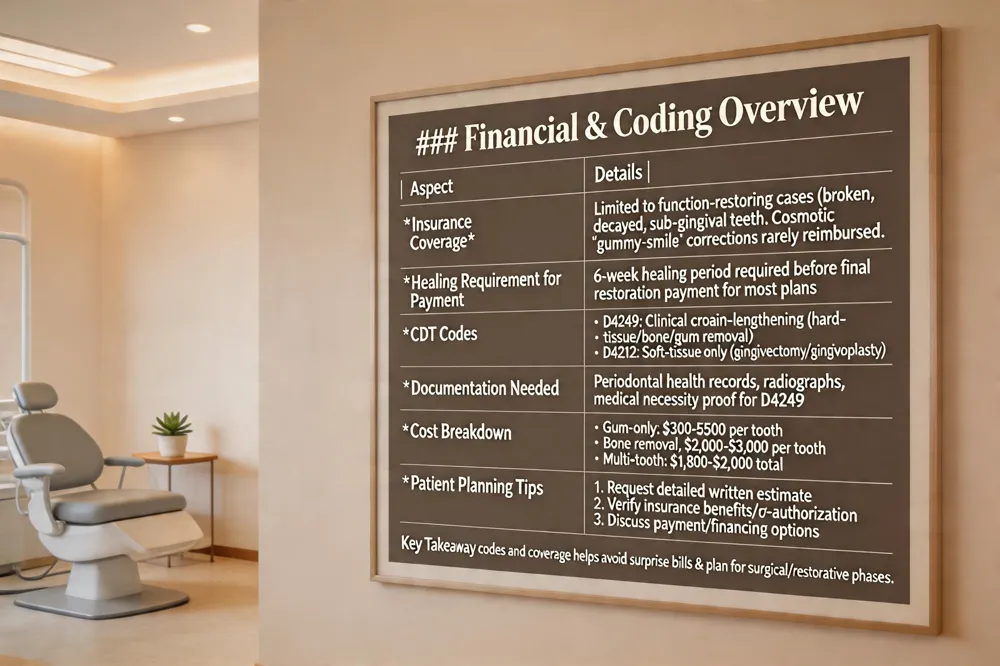 Understanding the financial side of crown‑lengthening helps patients avoid surprises. Insurance coverage is typically limited to procedures that restore function; a broken, decayed, or sub‑gingival tooth qualifies, while pure cosmetic “gummy‑smile” corrections are rarely reimbursed. When the surgery is deemed medically necessary, many plans will pay a portion of the fee after the patient meets a six‑week healing period before the final restoration.
CDT codes – The clinical crown‑lengthening code for hard‑tissue work (bone and/or gum removal) is D4249. Soft‑tissue only procedures use D4212 (gingivectomy/gingivoplasty). Documentation of a healthy periodontal environment and radiographs is required for D4249, and it is limited to once‑per‑tooth, lifetime coverage.
Cost breakdown – Average fees range from $300‑$500 for a single tooth (gum‑only) up to $2,000‑$3,000 when bone removal is needed. Multi‑tooth cases can exceed $1,800‑$2,000 total. Prices vary by geography, technique (laser vs. scalpel), and any sedation required. Patients should request a detailed estimate and verify insurance benefits before scheduling.
Coordinating Care: Orthodontics, Digital Planning, and Long‑Term Success
Multidisciplinary Coordination & Digital Workflow
| Team Member | Role in Crown Lengthening & Restoration |
|---|---|
| Periodontist | Evaluate biologic width, perform surgical exposure, manage soft‑tissue healing |
| Orthodontist | Adjust tooth positions before/after surgery to optimize ferrule & occlusion |
| Prosthodontist | Design final crown, ensure proper reduction‑to‑root ratio, perform occlusal adjustments |
| Digital Lab/Technician | Create 3‑D printed surgical guides, intra‑oral scan models, fabricate provisional crowns |
Digital Tools
- Intra‑oral scanners → accurate tooth & gingival morphology.
- 3‑D printed surgical guides → precise bone removal depth & flap design.
- T‑Scan or digital bite registration → predict vertical dimension changes, verify occlusal contacts.
Typical Workflow
- Initial assessment – Radiographs + scans to map biologic width.
- Digital planning – Virtual mock‑up of crown lengthening & final restoration.
- Surgical guide fabrication – Guides bone & soft‑tissue removal.
- Surgery – Perform lengthening per plan.
- Healing phase – 4–6 weeks soft tissue; up to 3 months bone remodeling.
- Orthodontic integration – Move teeth if needed to improve alignment before final crown.
- Prosthetic phase – Fabricate and place final crown; perform occlusal adjustment.
Potential Complications & Mitigation
- Infection, bleeding, sensitivity → Strict aseptic technique, post‑op antibiotics if indicated.
- Over‑resection of bone → Use digital planning & guides to stay within safe limits.
- Bite misalignment → Combine surgical exposure with occlusal adjustment; verify with digital bite analysis.
Outcome Benefits
- Harmonious, functional bite
- Stable gingival margins
- Long‑term restoration success with minimal retreatment
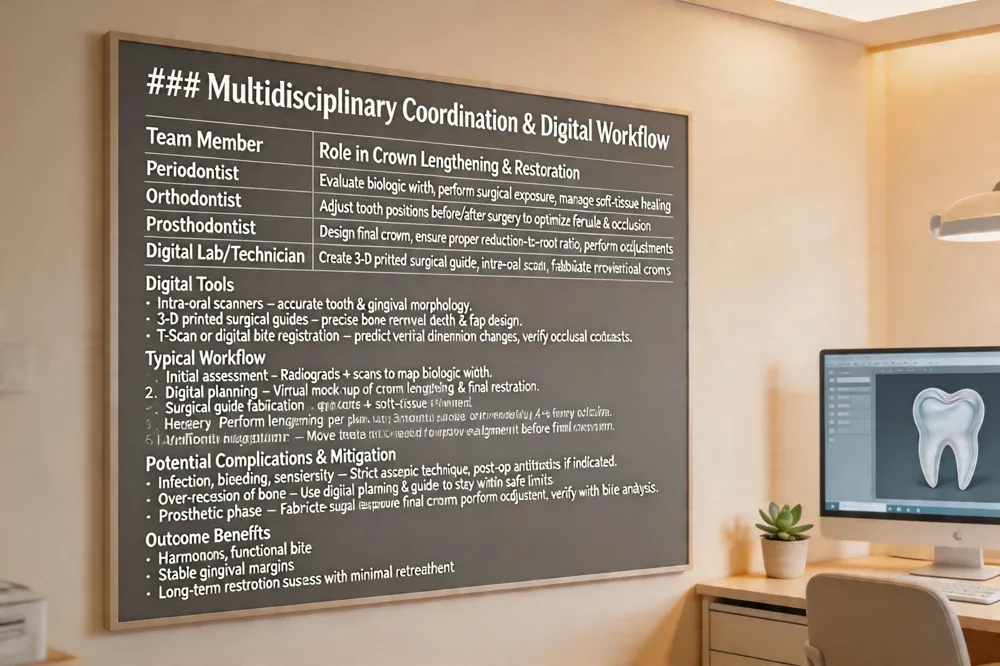 A multidisciplinary approach is key when integrating crown lengthening with orthodontic treatment and digital planning. Periodontists, orthodontists, and prosthodontists collaborate to preserve biologic width, achieve a proper ferrule, and maintain a balanced occlusion. Advanced tools such as intra‑oral scanners, 3‑D printed surgical guides, and digital bite registration (e.g., T‑Scan) allow clinicians to predict how tissue removal will affect vertical dimension and contact points, reducing the risk of bite misalignment.
What can go wrong with crown lengthening? Post‑operative infection, excessive bleeding, heightened tooth sensitivity, gum recession, and over‑resection of bone that compromises tooth stability are the most common complications. Careful case selection and precise surgical technique mitigate these risks.
Crown lengthening before and after: The procedure lowers and evens the gingival margin, exposing more tooth structure for restorative work and converting a “gummy smile” into a harmonious, functional bite.
Multidisciplinary treatment with adjunctive orthodontics: By adjusting gingival levels before or after orthodontic movement, clinicians can correct edge‑to‑edge bites, improve overbite/overjet, and stabilize the final prosthesis.
Why is my bite suddenly misaligned? Changes in vertical tooth height from crown lengthening, uncontrolled bone removal, or underlying TMJ disorders can shift occlusal contacts, producing a feeling of a “off” bite.
Crown lengthening and occlusal adjustment: Combining surgical exposure with selective reshaping of occlusal surfaces eliminates interferences, promotes even force distribution, and supports long‑term bite harmony.
Your Bite, Your Smile: Takeaway
Key points to remember: Crown lengthening creates adequate tooth height, respects biologic width, and supplies a proper ferrule, all of which support balanced occlusion and reduce TMJ strain. Over‑contouring or excessive bone removal can cause malocclusion, so precise planning and digital occlusal analysis are essential. Healing stabilizes in 4–6 weeks (soft tissue) to 3 months (bone). Next steps for patients: Follow post‑operative instructions, maintain gentle oral hygiene, attend scheduled follow‑ups, and allow the dentist to evaluate bite before final crown placement; consider occlusal adjustment or orthodontic consultation if alignment concerns persist.