Why Time Matters in Clear‑Aligner Therapy
Most patients expect Invisalign to finish within a year, but reality ranges from six to twenty‑four months depending on case complexity. When aligners are worn the recommended 20‑22 hours daily, tooth movement proceeds as planned, often cutting the schedule by 30‑50 %. Poor compliance—missed wear time or delayed tray changes—creates gaps in force delivery, prolonging treatment and increasing the need for refinements. Faster completion also brings economic advantages: fewer office visits, reduced material costs, and less time off work or school. Lifestyle-wise, patients enjoy a shorter period of dietary restrictions, oral‑hygiene vigilance, and aesthetic concern, allowing them to return to their normal routines sooner. Moreover, a streamlined timeline reduces the stress of prolonged orthodontic treatment, and the confidence boost from seeing results sooner can improve patient satisfaction and adherence to retention protocols.
Accelerated Wear Schedules and Compliance
Wear‑Time Compliance Summary
| Scenario | Max Continuous Removal | Total Daily Removal Allowed | Recommended Compensation |
|---|---|---|---|
| Meal / Drink (non‑water) | 30 minutes | 2 hours total (split) | Add extra wear later in the day or night |
| Single hygiene break | 60 minutes | 2 hours total (split) | Same as above |
| Combined removal (e.g., meals + hygiene) | 30–60 min per interval | 3 hours total only if split | Avoid a single 3‑hour stretch; wear extra at night |
| Non‑compliance (missing >2 h) | – | – | Extend nightly wear to 22 h‑ compensate 1‑2 h per day |
Key Takeaways
- Maintain 20‑22 h daily wear to shave 1–2 months (simple) or 3–4 months (moderate) off treatment.
- Short, frequent removals are acceptable; long uninterrupted gaps are not.
- Use reminders or apps to track wear time.
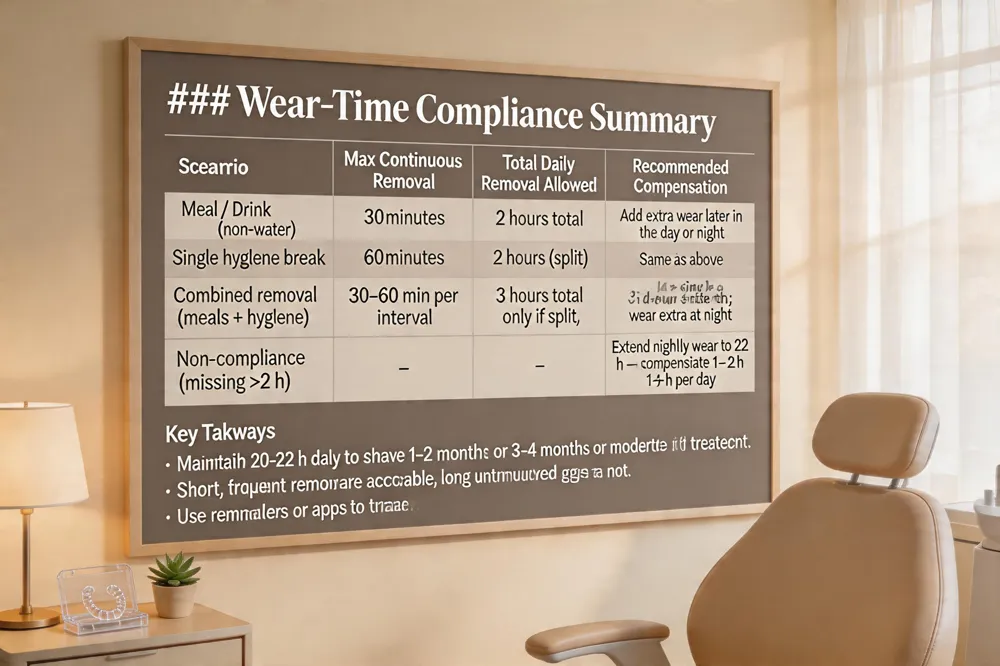 The 30‑minute rule for Invisalign advises that after removing your trays for a meal, drink (other than water), or oral hygiene, you should re‑insert them within 30 minutes. This keeps the recommended 20‑22 hours of daily wear, maintains continuous pressure, and prevents enamel erosion from trapped food and bacteria. Short breaks of up to two hours total are acceptable if split into brief intervals (e.g., meals); each stretch should stay under 30–60 minutes, and any lost time can be made up by wearing the trays a little longer later. A combined three‑hour daily removal is permissible only when divided into separate meals and hygiene periods—avoid a single three‑hour stretch, and compensate by extra wear at night. Consistently meeting the 22‑hour wear rule can shave 1–2 months off simple cases and up to 3–4 months from moderate ones. Many patients overlook hidden challenges: frequent tray removal, a brief lisp, the discipline of 20‑22 hours wear, visible tooth‑colored attachments, and an intensified oral‑hygiene routine needed to prevent decay and staining.
Digital Planning, SmartTrack, and Express Protocols
Digital Workflow & Efficiency
| Phase | Typical Duration | In‑Office Option | Effect on Treatment Time |
|---|---|---|---|
| 3‑D Scan | < 15 min | In‑office scanner (e.g., iTero) | Immediate digital model |
| n | ClinCheck Planning | 1‑2 days (lab) | Same‑day turnaround in some offices |
| Fabrication of First Tray | 2‑4 weeks (lab) | ~1 week (in‑office) | Faster start → earlier progression |
| Express Protocol (minor corrections) | 3‑6 months total | – | ~50 % faster than full‑arch plan |
SmartTrack Benefits: up to 25 % more efficient tooth movement, smoother 0.25 mm shifts, fewer refinements.
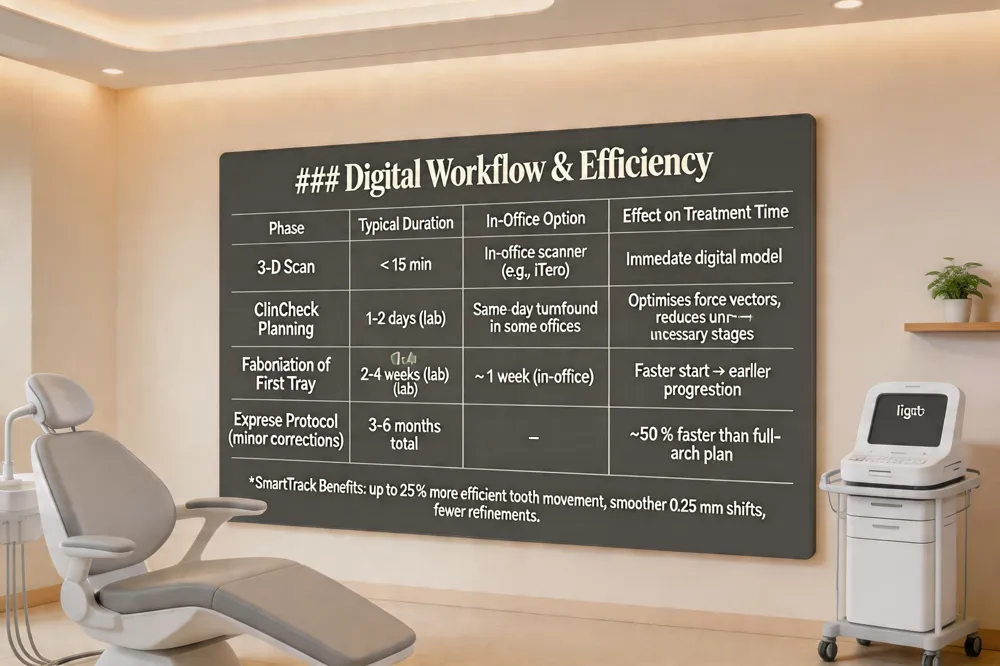 3‑D Scanning & ClinCheck Software
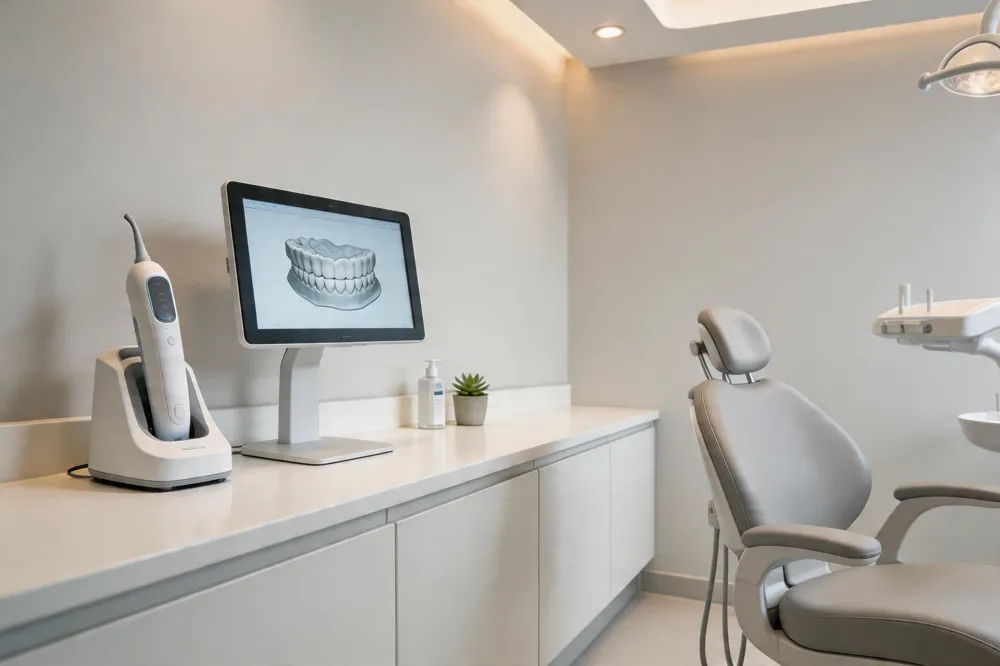
Modern offices use intra‑oral 3‑D scanners (e.g., iTero) to capture a digital model in minutes. The ClinCheck platform then simulates the entire tooth trajectory, allowing the orthodontist to eliminate unnecessary stages and optimise force vectors before any tray is made.
3‑D Scanning & ClinCheck Software
Modern offices use intra‑oral 3‑D scanners (e.g., iTero) to capture a digital model in minutes. The ClinCheck platform then simulates the entire tooth trajectory, allowing the orthodontist to eliminate unnecessary stages and optimise force vectors before any tray is made.
SmartTrack Material Advantages SmartTrack™ delivers a more consistent, gentle force than earlier plastics, providing up to 25 % more efficient tooth movement while maintaining comfort. This results in fewer refinements and a smoother glide across each 0.25 mm shift.
Invisalign Express for Minor Corrections For simple crowding or spacing, the Express protocol uses fewer aligners and a shorter change interval (5‑7 days), often completing treatment in 3‑6 months—about 50 % faster than a full‑arch plan.
Timeline from Scan to First Tray After the 3‑D scan, the lab typically requires 2‑4 weeks to fabricate the initial set; in‑office scanning can cut this to about one week. Most patients begin wearing their first trays within a month of the scan.
FAQs
- Invisalign before and after: Before‑and‑after photos show dramatic, natural‑looking changes over 6‑18 months, with visible improvement after a few weeks.
- Invisalign time lapse: First shifts appear in 2‑3 weeks; clearer progress at 10‑12 weeks.
- Invisalign treatment time for adults: 6‑18 months (mild 6‑9 mo, moderate 9‑15 mo, complex ≥15 mo).
- How long does it take to get Invisalign after scan: 2‑4 weeks for lab; in‑office can be ~1 week.
- How long is a normal Invisalign treatment?: 6‑18 months, average ~12 months, 20‑30 trays changed every 1‑2 weeks.
- Cut Invisalign duration before and after: High compliance can shave 1‑4 months off the typical 12‑18 month timeline.
Adjunctive Accelerators: Vibration, Laser, and Micro‑Procedures
Adjunctive Acceleration Options
| Accelerator | Mechanism | Reported Acceleration | Evidence Quality |
|---|---|---|---|
| AcceleDent (micro‑vibration) | 20 min/day soft‑pulse vibrations | Up to 50 % faster movement (manufacturer) | Mixed; independent studies often show modest/no effect |
| Propel (micro‑osteoperforation) | Tiny bone perforations | 20‑30 % faster remodeling | Limited long‑term data |
| Low‑Level Laser / LIPUS | Photobiomodulation / ultrasonic stimulation | Potential modest acceleration | Sparse; requires professional supervision |
Bottom Line: Strict compliance remains the most reliable way to reduce treatment time.
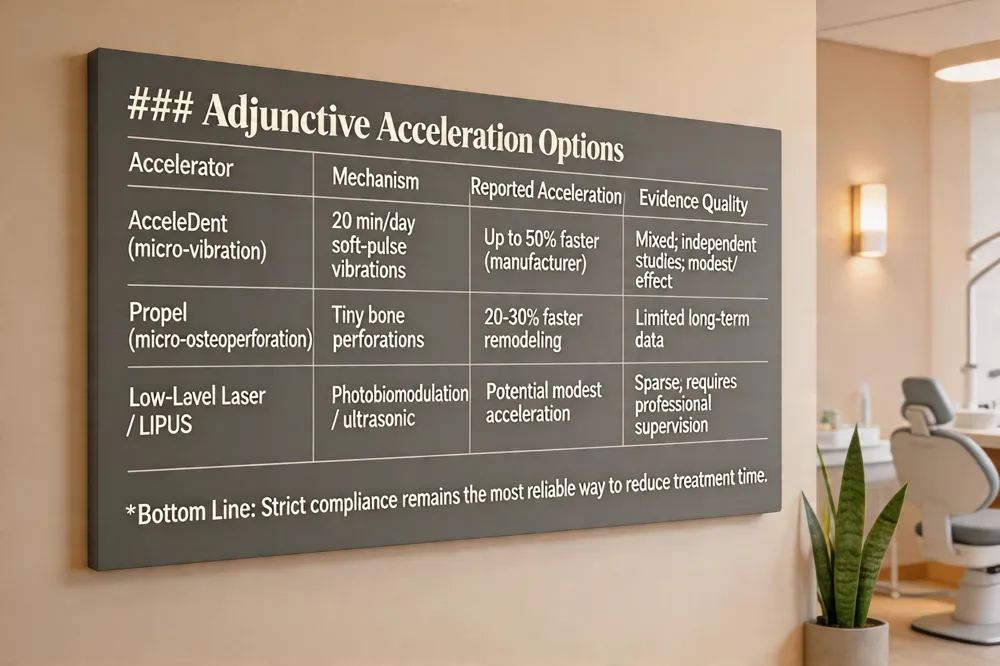 AcceleDent and micro‑vibration – AcceleDent is a portable, hands‑free device that delivers SoftPulse micro‑vibrations via a custom‑fit mouthpiece for about 20 minutes daily. It aims to stimulate bone remodeling, potentially speeding tooth movement by up to 50 % and reducing discomfort. Manufacturer‑funded studies show benefit, but independent peer‑reviewed research is mixed, with many finding little effect. Empower Your Smile does not currently offer AcceleDent; we can refer patients to trusted orthodontists for acceleration options.
Propel micro‑osteoperforation – Propel uses tiny perforations in the alveolar bone to trigger rapid remodeling. Clinical data suggest a 20‑30 % acceleration, yet long‑term outcomes remain under investigation.
Low‑level laser therapy and LIPUS – Both modalities claim to boost cellular activity and shorten treatment, but robust evidence is limited and they should be used only under professional supervision. Low‑level laser therapy and LIPUS are examples.
Evidence and limitations – While adjunctive technologies are promising, the single most reliable way to cut Invisalign time is strict compliance: wear aligners 20‑22 hours daily, change trays on schedule, and maintain excellent oral hygiene.
Practical Patient Hacks: Hygiene, Eating, and Comfort
Daily Care Checklist
| Task | Frequency | Quick Tips |
|---|---|---|
| Tray cleaning | After each removal | Soft toothbrush + lukewarm water (no toothpaste) |
| Removal tool | As needed | Use flexible‑tool tip; avoid metal pliers |
| Eating | Every meal | Remove trays, place in case, brush/floss, re‑insert |
| Drinking (non‑water) | As consumed | Remove trays, use straw past teeth, rinse, brush before reinserting |
| Pain management | New tray start | Ibuprofen 30 min before, cold compress, chewies, warm salt‑water rinse at night |
| Orthodontic wax | When irritation occurs | Apply softened wax; replace every 2 days |
| Reminders | Daily | Set phone/alarm for 20‑22 h wear schedule |
Extra Hacks: Crystal soaking for extra clean, keep backup trays, stay hydrated, and follow Reddit’s top tips for compliance.
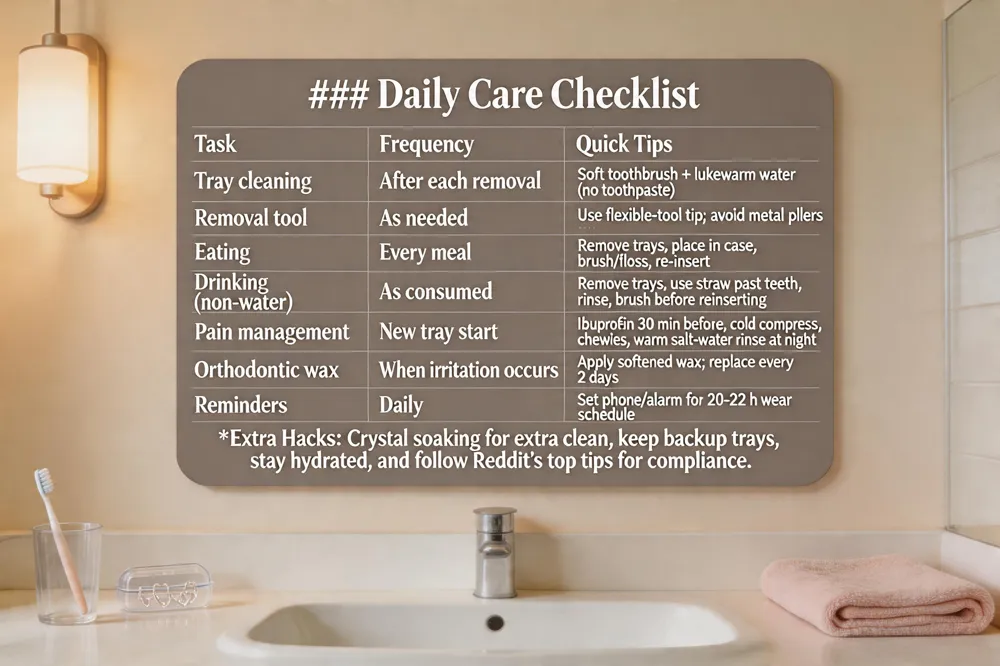 Keeping aligners spotless is easy with a soft toothbrush, lukewarm water and no toothpaste; for a quick, damage‑free removal, the reusable PUL tool’s flexible tip pulls trays out without nails or metal pliers. When eating, always remove trays, place them in their case, brush and floss before reinserting, and stick to soft foods for the first few days to ease soreness. Drink only water with trays in; for other drinks, take them out, use a straw past the teeth, rinse, and brush before putting the tray back on—avoid hot, colored, or acidic beverages that can warp or stain the plastic. Pain can be managed with an OTC ibuprofen 30 minutes before a new tray, a cold compress, chewies to seat the tray, or warm salt‑water rinses at night. Orthodontic wax—softened beeswax or paraffin—covers irritating brackets or wires and should be replaced every two days. Beginners should wear aligners 20‑22 hours daily, set reminders, store trays in a case, stay hydrated, and follow Reddit’s top tips: 22‑hour wear, crystal soaking, backup trays, and meticulous oral hygiene.
Financial and Lifestyle Considerations
Cost & Lifestyle Overview
| Item | Typical Range (U.S.) | Common NYC Price | Insurance Coverage | Out‑of‑Pocket Estimate |
|---|---|---|---|---|
| Invisalign treatment | $3,500‑$7,000 | $5,500‑$7,000 | 50‑80 % (varies) | $1,000‑$2,500 |
| Monthly financing | $50‑$250 | – | – | – |
| Retainer (post‑treatment) | Included in fee | – | – | – |
Lifestyle Points
- Aligners are discreet; kissing and social interactions are unaffected.
- Retainer wear: full‑time 3‑6 months, then nightly indefinitely.
- Celebrity example: Billie Eilish completed ~18 months of treatment.
- Common misconceptions: need to remove trays for every bite, brief lisp, strict oral hygiene required.
 Invisalign typically costs $3,500‑$7,000 in the U.S.; $6,000 is a common price point and falls within the $3,000‑$7,000 range. At Empower Your Smile in Tribeca, NYC, fees usually run $5,500‑$7,000, and dental insurance can cover 50‑80 %, leaving $1,000‑$2,500 out‑of‑pocket. Most offices offer monthly financing ($50‑$250) to spread the expense.
Socially, clear trays are discreet and stay securely in place, so you can kiss without anyone noticing; just keep the 20‑22 hour wear schedule. After treatment, wear your retainer full‑time for 3‑6 months, then nightly; a four‑day break may cause slight shifting, but returning to full‑time wear usually corrects it.
Celebrity case: Billie Eilish wore Invisalign for about 18 months, showing the trays in public and a music video, proving that high‑profile patients can achieve results while staying stylish.
Q&A:
- Is $6000 normal for Invisalign? Yes—within the typical range.
- How much does Invisalign cost? $3,500‑$7,000, often $5,500‑$7,000 in NYC.
- Can I still kiss with Invisalign? Absolutely, the trays are snug and invisible.
- Will my teeth shift if I don’t wear my retainer for 4 days? Minor movement may occur; resume full‑time wear and schedule a check‑up if needed.
- How long does Invisalign last after treatment? Retainers are worn full‑time 3‑6 months, then nightly indefinitely.
- How long did Billie Eilish have Invisalign? About a year and a half.
- What does no one tell you about Invisalign? You must remove trays for every bite, expect a brief lisp, maintain strict 20‑22 hour wear, and commit to rigorous oral hygiene.
- What is the rule of 5 in orthodontics? It divides the face into five equal vertical segments, each roughly the width of an eye, guiding balanced treatment planning.
Putting It All Together for a Faster Smile
Success with clear aligners hinges on three pillars: strict wear compliance, cutting‑edge technology, and smart daily habits. Wearing trays 20‑22 hours each day creates the continuous force needed to move teeth efficiently; missing even a few hours can add weeks. Advanced tools such as SmartTrack material, ClinCheck 3‑D planning, and vibration devices like AcceleDent or VPro amplify bone remodeling, often cutting individual movement phases by 30‑50 %. Lifestyle hacks—using chewies to seat trays, rinsing after meals, swapping to the next set on schedule, and maintaining impeccable oral hygiene with electric brushes and water flossers—keep the process on track. When patients combine these strategies, many Tribeca cases finish in half the typical 12‑18‑month timeline, delivering a confident smile faster than ever. You’ll enjoy faster results, proudly.