
Why Tooth‑Colored Fillings Matter
Composite resin fillings are made of a plastic‑based matrix reinforced with fine glass or ceramic particles that can be shade‑matched to each tooth’s natural color. The material bonds chemically to enamel and dentin, allowing a conservative preparation that preserves healthy structure, creates a tight seal to block bacteria, and reduces temperature sensitivity. Patients expect a restoration that looks indistinguishable from surrounding teeth, feels smooth, and can be placed in a single visit. They also anticipate long‑term durability, minimal postoperative discomfort, and easy maintenance through regular brushing, flossing and routine check‑ups. When these expectations are met, confidence in the smile is restored.
Understanding Composite Fillings: Materials and Costs
Composite Fillings – Materials & Cost Overview
| Component | Details |
|---|---|
| Resin Matrix | Synthetic resin (bisphenol‑A‑glycidyl methacrylate – Bowen’s resin) that hardens with blue curing light |
| Inorganic Fillers | Fine glass, quartz, nanohybrid particles – improve strength, wear resistance, translucency |
| Pigments & Stabilizers | Shade‑matching pigments, coupling agents, polymerization initiators for handling & durability |
| Typical US Cost | $173‑$439 per tooth (average $250‑$300) |
| NYC Cost | $300‑$400 per tooth |
| Insurance Impact | Out‑of‑pocket often reduced to $100‑$200; many plans cover a portion of the cost |
| Financing | In‑house plans, savings programs, or monthly payments with little/no interest |
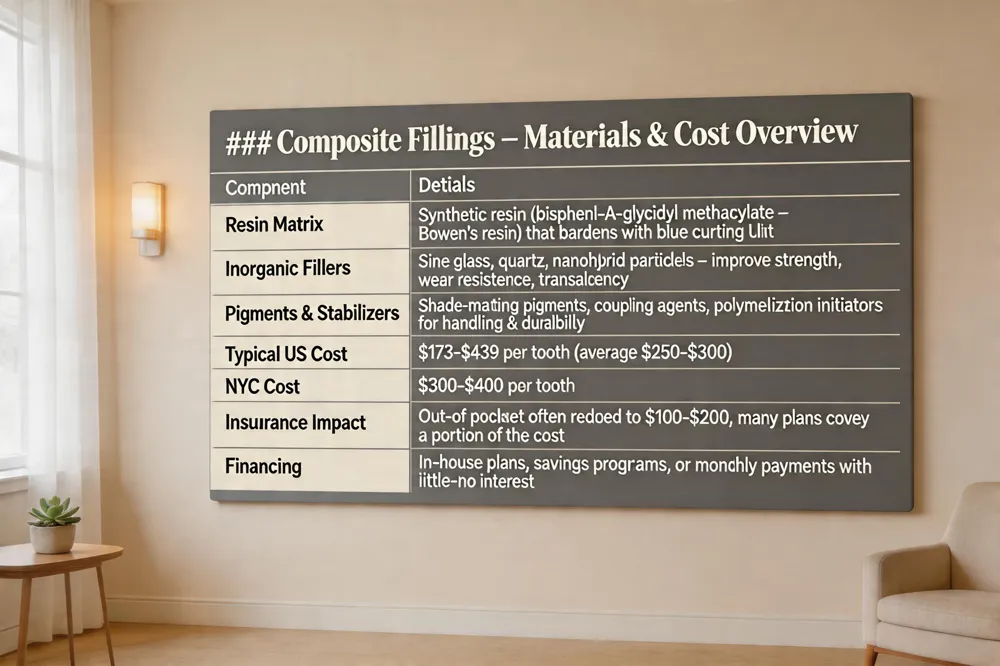 Composite fillings are made from a synthetic resin matrix—most often bisphenol‑A‑glycidyl methacrylate (Bowen’s resin)—that hardens when a blue curing light is applied. Inorganic filler particles such as fine glass, quartz or nanohybrid particles are blended into the resin to boost strength, wear resistance and translucency. Pigments are added to match the tooth’s natural shade, and stabilizers, coupling agents and polymerization initiators fine‑tune handling and durability. The result is a tooth‑colored restoration that bonds directly to enamel and dentin, preserving more healthy tooth structure.
In the United States, Composite fillings typically cost $173‑$439 per tooth, with an average of $250‑$300. In New York City, prices often fall in the $300‑$400 range, reflecting higher overhead and advanced technology. Dental insurance can lower out‑of‑pocket costs to $100‑$200, and many practices offer financing or savings plans to further reduce expenses. Overall, composite fillings provide a cost‑effective, aesthetic solution for restoring decayed teeth.
Clinical Advantages: Preservation, Bonding, and Longevity
Clinical Advantages of Composite Fillings
| Advantage | Description | Typical Lifespan |
|---|---|---|
| Preservation | Bonds directly to enamel/dentin → only decayed tissue removed, conserving healthy tooth | |
| Micromechanical Lock | Adhesive bond creates a seal that reduces micro‑leakage and reinforces remaining structure | |
| Durability | With good oral hygiene, restorations last 10–12 years before replacement may be needed | |
| Ease of Repair | Cracks, wear, staining, or sensitivity can be addressed with a new shade‑matched composite | |
| Anterior Use | Ideal for front teeth – precise shade match, natural finish, 5–10 years longevity | |
| Chipped Tooth | Direct bonding restores shape/strength in one visit, 5+ years with care | |
| Gap Closure | Non‑surgical bonding closes small gaps, lasting 5–10 years when maintained |
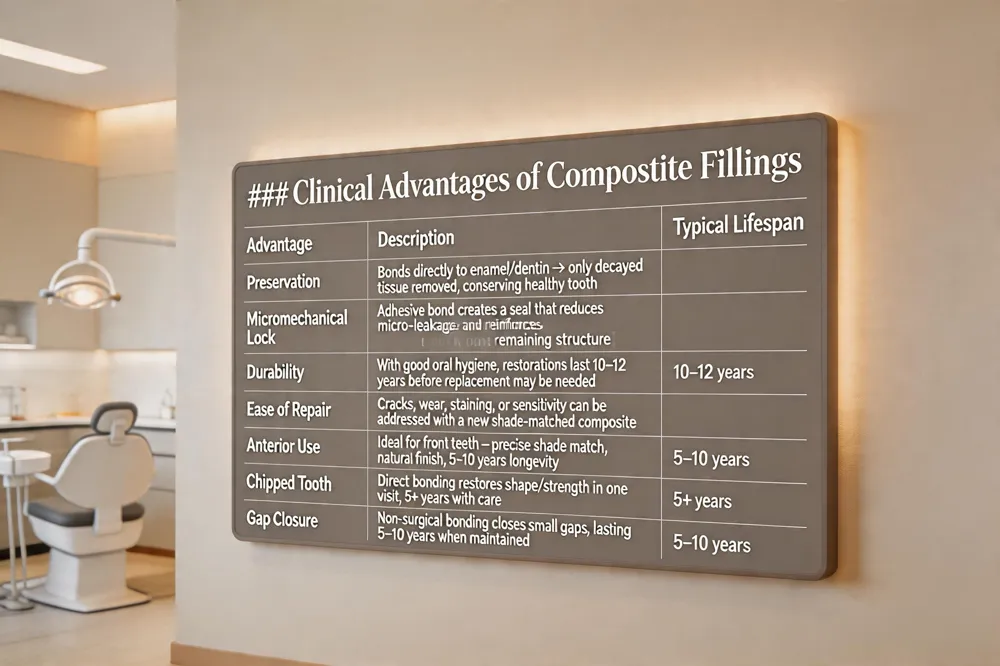 Tooth‑colored composite fillings preserve more natural tooth structure than amalgam because the material bonds directly to enamel and dentin, allowing only the decayed portion to be removed. This adhesive bond creates a micromechanical lock that reinforces the remaining tooth and reduces micro‑leakage, giving restorations high bond strength and a seal against future decay. With proper oral hygiene and regular check‑ups, composite restorations typically last 10–12 years before replacement may be needed.
Do tooth colored fillings need to be replaced? They are durable but not permanent; cracks, wear, staining, or sensitivity signal replacement, which can be performed with a new shade‑matched composite for a seamless look.
Composite fillings front teeth: Ideal for anterior teeth due to precise shade matching, minimal invasiveness, and a smooth, natural finish that can last 5–10 years.
Composite filling for chipped tooth: Direct bonding of shade‑matched resin restores shape and strength in one visit, lasting five years or more with good care.
Composite filling for teeth gap: Non‑surgical composite bonding closes small gaps in a single appointment, lasting five to ten years when maintained.
Comparing Options: Composite vs Amalgam vs Crowns
Composite vs Amalgam vs Crowns – Quick Comparison
| Feature | Composite Fillings | Silver Amalgam | Crowns |
|---|---|---|---|
| Aesthetic | Tooth‑colored, shade‑matched, virtually invisible | Metallic gray, visible | Porcelain‑based can be natural‑looking but bulkier |
| Strength & Durability | Adequate for small‑to‑medium cavities, 5‑10 years | Superior for large posterior loads, 10‑15 years | Full‑coverage protection, 10‑15 years+ |
| Tooth Conservation | Minimal removal, bonds to enamel/dentin | Requires removal of more healthy tooth | Requires significant reduction of tooth structure |
| Cost (per tooth) | $150‑$400 | $100‑$250 | $800‑$1,500 |
| Number of Visits | One appointment | One appointment | Typically two appointments (prep & placement) |
| Replacement Frequency | May need earlier replacement (5‑10 years) | Longer lifespan but can cause micro‑leakage | Long‑term but may need replacement after 10‑15 years |
 Aesthetic vs Metal
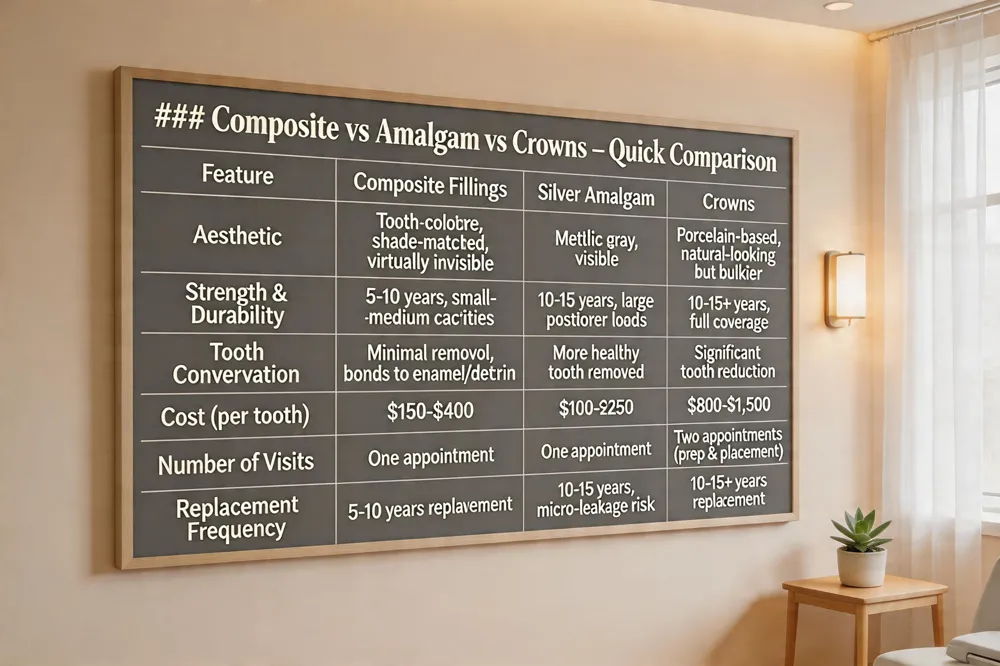
Composite resin fillings are tooth‑colored and can be shade‑matched to natural enamel, making them virtually invisible, whereas silver amalgam fillings are metallic and noticeable, especially on front teeth. Crowns can be porcelain‑based for a natural look but are bulkier.
Strength & Durability
Composite bonds chemically to the tooth, preserving healthy structure and providing adequate strength for small‑to‑medium cavities; they typically last 5‑10 years. Amalgam offers superior durability for large posterior loads, often lasting 10‑15 years, but requires removal of more healthy tooth. Crowns give full‑coverage protection and can endure 10‑15 years or more, especially on heavily stressed molars.
Cost Considerations
Composite resin fillings run about $150‑$400 per tooth, less expensive than crowns ($800‑$1,500) but pricier than amalgam ($100‑$250). Crowns also need two appointments, increasing overall cost.
Composite resin fillings vs amalgam
Composite resin fillings are aesthetic, conserves enamel, and bonds to tooth structure, but costs more and may need earlier replacement. Amalgam is durable, cheaper, and handles strong chewing forces, yet is visible and removes more healthy tooth.
Tooth composite filling vs Crown
Composite resin fillings is ideal for small‑to‑medium cavities, preserving tooth structure and completed in one visit; crowns are reserved for extensive damage, offering greater strength and longevity at higher cost.
What issues do silver fillings cause over time?
Amalgam can develop micro‑leakage, expand/contract causing cracks, increase sensitivity, and become visible as it wears, potentially leading to secondary decay and the need for more extensive treatment.
Patient Considerations: Insurance, Financing, and Treatment Planning
Patient Considerations – Financial & Planning Aspects
| Aspect | Details |
|---|---|
| Insurance Coverage | Most plans cover a portion of composite fillings, reducing out‑of‑pocket to $50‑$150 per tooth |
| Typical Cost (NYC) | Single composite: $150‑$300; three fillings: $450‑$900 before insurance, $150‑$450 after benefits |
| Financing Options | In‑house financing, low‑interest monthly payments, cash‑discount programs |
| Treatment Planning | Evaluate cavity size, location, patient budget, and aesthetic goals before choosing material |
| Alternative Materials | Amalgam (cheaper) or crowns (more expensive) – consider longevity vs. aesthetics |
| Special Rules | 3‑3‑3 rule: three 200 mg ibuprofen tablets every three hours for up to three days to manage post‑procedure inflammation |
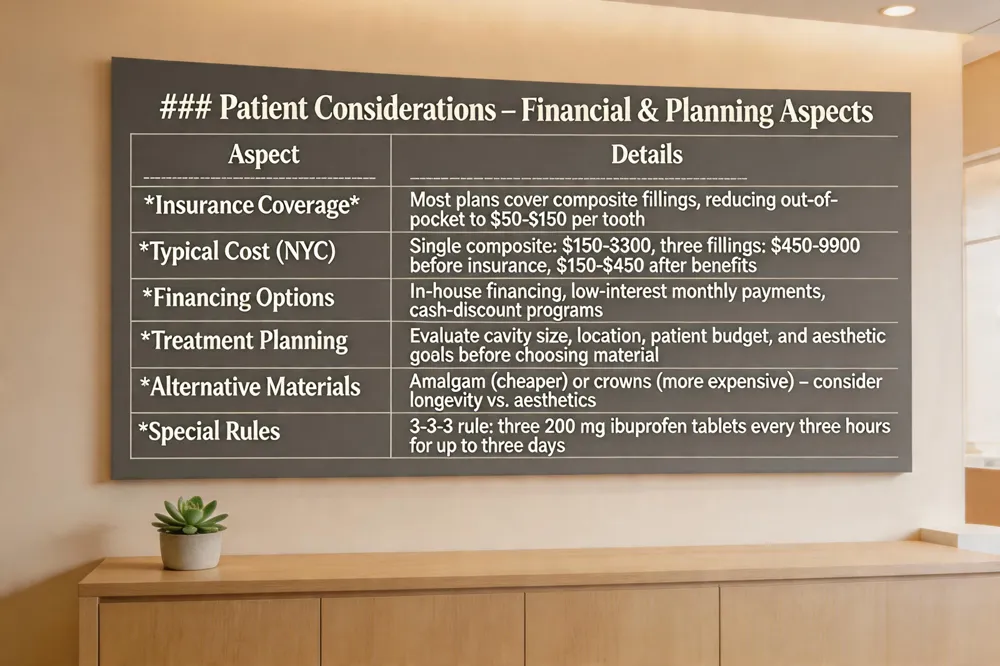 When planning restorative work, understanding insurance, financing, and treatment options is essential. Most dental insurance plans cover a portion of the cost of composite (tooth‑colored fillings), lowering out‑of‑pocket expenses to roughly $50‑$150 per tooth. For three fillings, patients typically pay $150‑$450 after insurance. If coverage is limited, many practices offer in‑house financing, allowing monthly payments with little or no interest, and some provide discount programs for cash or immediate payment.
How much should 3 fillings cost? In New York City, a single composite filling ranges $150‑$300; three would be $450‑$900 before insurance, or $150‑$450 after benefits. Amalgam is cheaper, while porcelain or gold can exceed $13,500 for three.
Does Aspen Dental fix cavities? Yes—Aspen Dental removes decay and restores teeth with composite, glass ionomer, or amalgam fillings, typically costing about $259 per filling, with financing and savings plans available.
What is the 3‑3‑3 rule in dentistry? It advises taking three 200 mg ibuprofen tablets every three hours for up to three days to manage post‑procedure inflammation.
Aesthetic Impact and Patient Confidence
Aesthetic Impact & Patient Confidence
| Impact | Description | Patient Outcome |
|---|---|---|
| Natural Appearance | Shade‑matched composite blends with surrounding enamel, eliminating metallic gray | Higher satisfaction, willingness to smile openly |
| Confidence Boost | Seamless repair improves self‑esteem and social interactions | Patients report increased confidence in speaking, laughing, and daily activities |
| Conservative Prep | Minimal tooth removal preserves healthy structure | Better long‑term oral health and reduced need for future extensive work |
| Future Advances | Nanohybrid & bulk‑fill composites → greater translucency, wear resistance, faster placement | Continued improvement in aesthetics and durability, reinforcing patient trust |
 Aesthetic (tooth‑colored) fillings are created from composite resin that can be shade‑matched to the surrounding enamel, making the restoration virtually invisible. This visual benefit preserves the natural look of the smile, especially in front teeth, and eliminates the metallic gray of traditional amalgam. When patients see a seamless repair, their confidence rises; studies show that a natural‑looking restoration improves self‑esteem and willingness to smile, talk, and laugh openly. The bonding technique also allows a more conservative preparation, preserving healthy tooth structure and further enhancing long‑term oral health. Looking ahead, advances in nanohybrid and bulk‑fill composites promise even greater translucency, wear resistance, and faster placement, reinforcing both aesthetics and durability.
Answer to the question: One of the most notable differences is appearance. Aesthetic fillings are color‑matched to the natural teeth providing a discreet, natural look. They are especially favored for front teeth and visible areas. Traditional metal fillings are metallic and easily noticeable, which can affect the aesthetics of a smile.
Embracing a Healthier, Brighter Smile
Tooth‑colored composite fillings offer a blend of aesthetic appeal and functional health that modern patients demand. By shade‑matching the resin to each tooth, restorations become virtually invisible, preserving a natural smile. The mercury‑free resin eliminates toxic metal exposure, while its chemical bond to enamel and dentin reinforces the remaining structure and reduces micro‑leakage. Because the material requires only minimal removal of healthy tooth, more of the original anatomy is conserved, supporting long‑term strength. Composite’s thermal expansion mirrors natural dentin, decreasing post‑procedure temperature sensitivity compared with silver amalgam. Advanced nanohybrid formulations provide wear resistance comparable to traditional fillings, allowing normal chewing forces for up to fifteen years when proper oral hygiene is maintained. The single‑visit, light‑cured technique reduces chair time and lets patients eat immediately after treatment. Empower Your Smile invites you to experience these advantages firsthand. Schedule a convenient consultation today, and let our skilled team restore your confidence with safe, durable, and beautifully matched composite restorations. Contact us now for a brighter future.