A New Era for Composite Restorations
Since the 1960s, tooth‑colored fillings have progressed from early resin mixes using tertiary amine and benzoyl peroxide to today’s nanohybrid and bulk‑fill composites with superior strength, polishability, and reduced shrinkage. Patients and dentists favor composites because they are mercury‑free, bond directly to enamel, preserve healthy tooth structure, and can be shade‑matched for seamless aesthetics. This article examines modern advances—nanofillers, bioactive ions, antibacterial agents, and digital workflows—showcasing how today’s restorations combine durability with cosmetic excellence today.
Cost, Coverage, and the 3‑3‑3 Oral‑Care Rule
 How much does a tooth-colored filling cost?
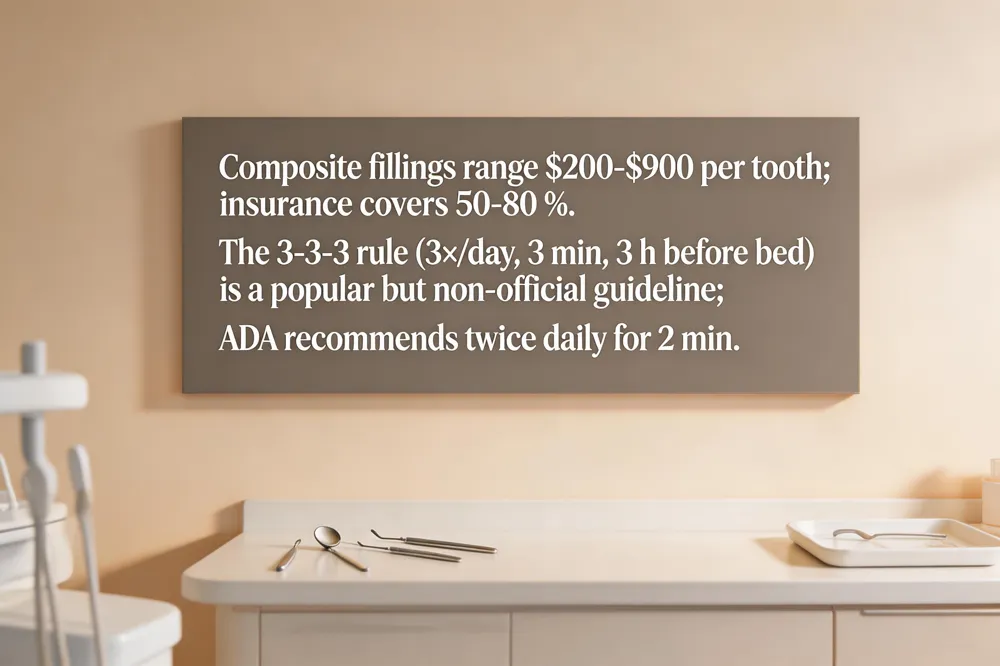
A tooth‑colored (composite) filling generally runs between $200 and $500 per tooth when you’re paying out‑of‑pocket. If the cavity is large, in a hard‑to‑reach area, or requires additional layering for strength, the price can climb to $600–$900 or more. In a metropolitan practice like Empower Your Smile in Tribeca, the cost is often a bit higher than the national average, typically falling in the $300–$700 range per tooth. Most dental insurance plans cover a portion of the expense—often 50 % to 80 %—so the out‑of‑pocket amount depends on your specific coverage. Factors that influence the final price include the size and location of the decay, the type of composite material used, and the dentist’s expertise and technology.
How much does a tooth-colored filling cost?
A tooth‑colored (composite) filling generally runs between $200 and $500 per tooth when you’re paying out‑of‑pocket. If the cavity is large, in a hard‑to‑reach area, or requires additional layering for strength, the price can climb to $600–$900 or more. In a metropolitan practice like Empower Your Smile in Tribeca, the cost is often a bit higher than the national average, typically falling in the $300–$700 range per tooth. Most dental insurance plans cover a portion of the expense—often 50 % to 80 %—so the out‑of‑pocket amount depends on your specific coverage. Factors that influence the final price include the size and location of the decay, the type of composite material used, and the dentist’s expertise and technology.
What is the 3-3-3 rule for teeth? The 3‑3‑3 rule is a simple oral‑care guideline that suggests brushing your teeth three times a day, spending three minutes each session, and then avoiding food or drinks for at least three hours before bedtime. Proponents say the extra brushing and longer duration help remove more plaque and reduce the risk of cavities and gum disease. However, the rule is not an official dental recommendation; most professionals, including the American Dental Association, advise brushing twice daily for two minutes with a fluoride toothpaste. Over‑brushing or brushing immediately after acidic meals can damage enamel, so timing and gentle technique are also important. In practice, following the evidence‑based twice‑a‑day, two‑minute routine, coupled with flossing and regular dental visits, provides the most reliable protection for a healthy, confident smile.
Materials Brands, and the Strongest Composites
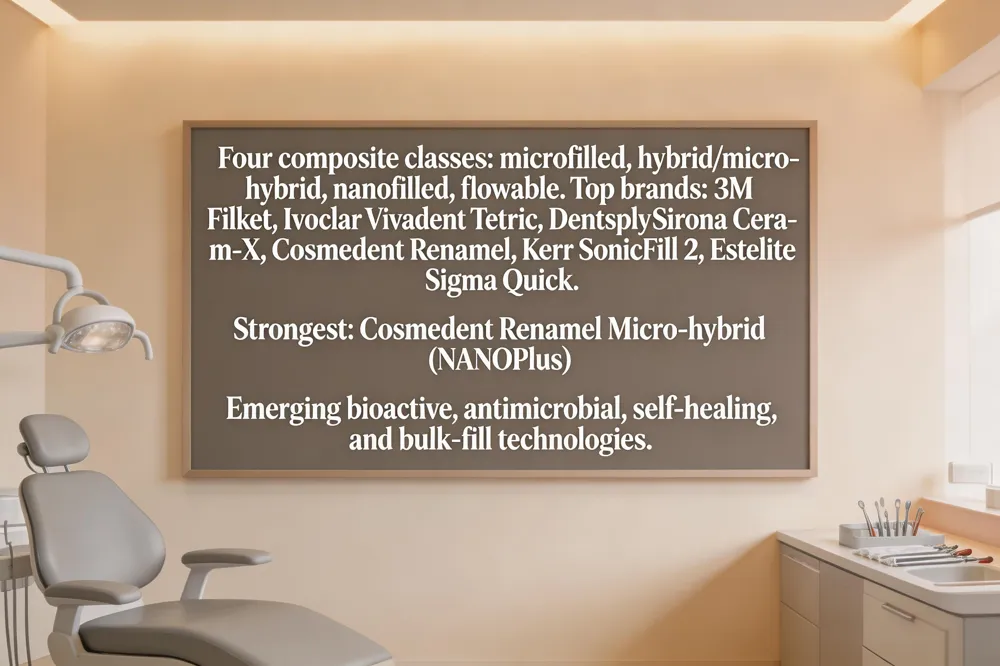 The modern composite market is organized around four primary categories: microfilled (ultra‑smooth polish, ideal for anterior work), hybrid/micro‑hybrid (balanced strength and polishability for both front and back teeth), nanofilled (nano‑sized particles give superior polish retention and high flexural strength), and flowable (low‑viscosity, excellent adaptation for small cavities or as a base). Among the top‑rated commercial brands, 3M Filtek (nanofilled), Ivoclar Vivadent’s Tetric line, Dentsply Sirona Ceram‑X, Cosmedent Renamel (micro‑hybrid and NANO Plus), Kerr SonicFill 2, and Estelite Sigma Quick consistently receive high marks for durability, shade matching and handling. The strongest composite currently available is Cosmedent’s Renamel Micro‑hybrid line, which delivers exceptional flexural strength and wear resistance for posterior restorations; its NANO Plus variant also ranks at the top of strength benchmarks. The newest materials push beyond aesthetics: bioactive glass‑filled and fluoride‑releasing composites promote remineralization; antimicrobial fillers (silver, zinc‑oxide nanoparticles, quaternary ammonium monomers) reduce secondary caries; self‑healing microcapsule systems restore fracture toughness; and bulk‑fill nanohybrids, high‑translucency zirconia, and hybrid ceramic‑polymer networks enable same‑day, minimally invasive restorations.
Tech‑Driven Filling Techniques in 2026
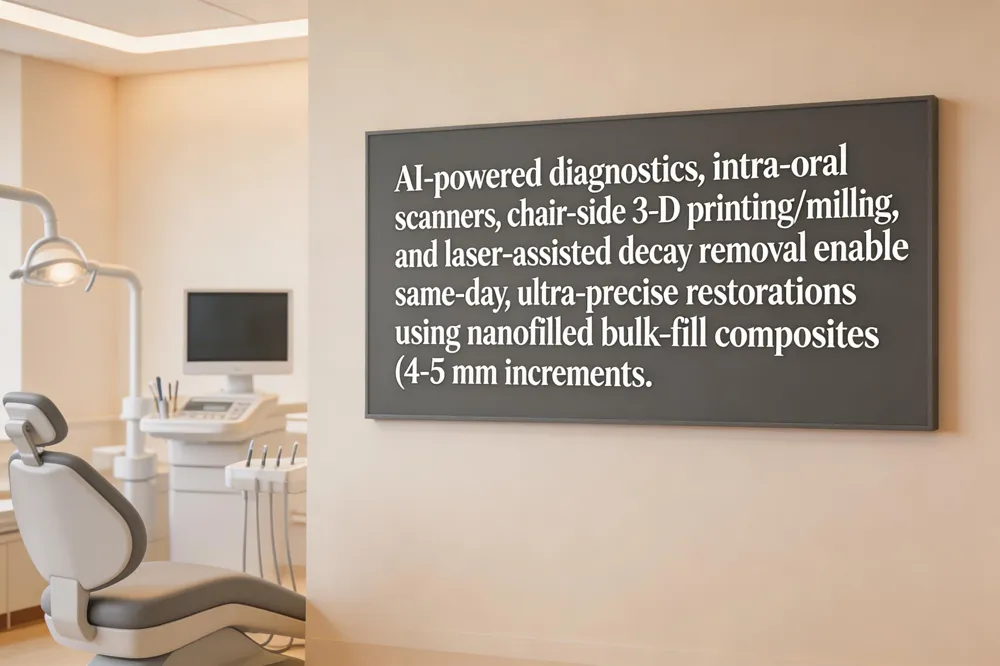 In 2026 the most influential dental technologies are artificial‑intelligence‑driven diagnostics that detect cavities and periodontal disease on X‑rays and CT scans with unprecedented speed and accuracy. Intra‑oral scanners paired with digital impression workflows have replaced traditional molds, giving ultra‑precise 3‑D models for restorations. Chair‑side 3‑D printing and milling now enable same‑day crowns, bridges, surgical guides and custom aligners, dramatically cutting appointment times and lab costs. Laser‑assisted decay removal (e.g., Solea) eliminates caries without heat, vibration or anesthesia, preserving healthy tooth structure. The latest tooth‑filling procedures combine this laser technique with high‑performance, nanofilled bulk‑fill composites that can be placed in a single appointment; nanofillers provide enamel‑like strength, superior polishability and excellent shade‑matching, while bulk‑fill formulations allow increments up to 4‑5 mm, reducing layering steps. Cosmetic dentists are fully qualified to perform these restorations, using shade‑matched composites to blend seamlessly with the smile while delivering the same durability and safety as any general practice.
Clinical Insights, Maintenance, and Future Horizons
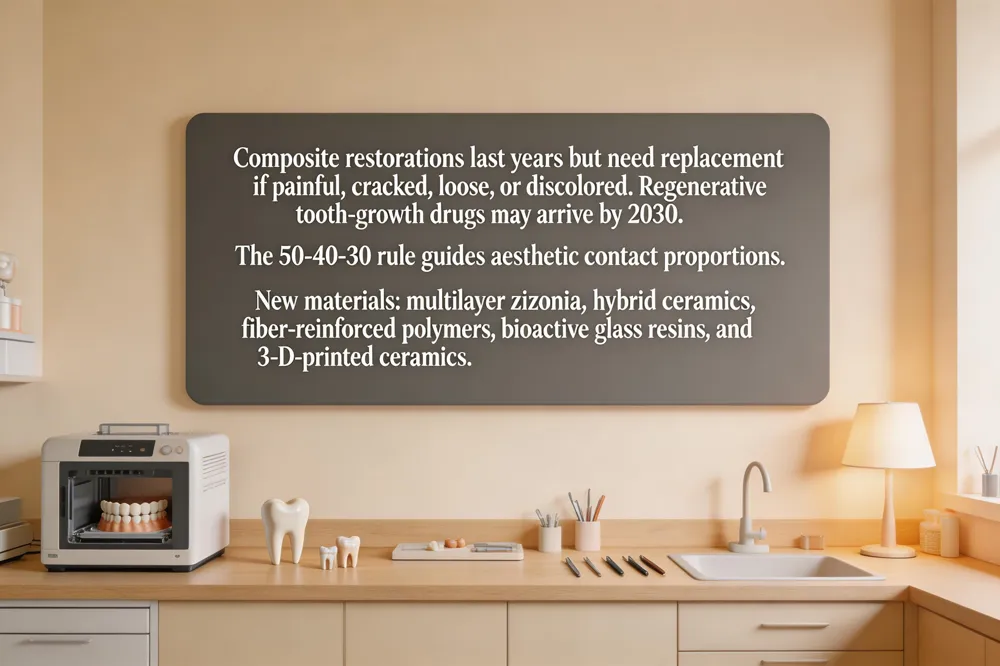 Do tooth‑colored fillings need to be replaced? They last many years, but replacement is required if you feel pain, sensitivity, see cracks or chips, or if the restoration loosens or discolors. Visits catch problems early.
Is it true that a new regrowing teeth medicine can be available by 2030? A regenerative drug in Japanese trials may enable human teeth to regrow by 2030, offering a natural alternative to implants. Stem‑cell activation shows dentin formation in animal studies, though clinical use remains experimental.
What does the 50‑40‑30 rule refer to in dental aesthetics? It defines ideal apparent contact dimensions: 50 % between central incisors, 40 % between central and lateral incisors, and 30 % between lateral incisor and canine, guiding harmonious smiles.
What are the newest materials being used in dentistry? Composites blend aesthetics strength. Multilayer zirconia mimics enamel while bearing load. Hybrid ceramics such as lithium‑silicate networks provide milling tooth‑like color without sintering. Fiber‑reinforced polymers and bioactive glass resins release ions for remineralization and antibacterial protection. 3‑D‑printed zirconia and other additive‑manufactured ceramics enable restorations comparable performance.
Putting the Advances to Work for Your Smile
Empowering patients with informed choices means explaining the benefits of modern, mercury‑free composites—nanohybrid, bulk‑fill, bioactive and antibacterial formulations—and their shade‑matching, minimal‑drill techniques. At Empower Your Smile we use LED curing, shade‑matching spectrophotometers, 3‑D intra‑oral scanning and CAD/CAM‑designed restorations, while offering resin infiltration for early lesions and fluoride‑releasing fillers for remineralization. Looking ahead, we expect wider use of stem‑cell‑stimulating scaffolds, smart self‑healing composites and single‑shade universal resins that further simplify treatment and enhance long‑term tooth health.