Why Your Smile Deserves Both Health and Aesthetic Expertise
A beautiful smile is built on a healthy foundation. General dentistry prevents disease, treats decay, and ensures proper bite, while cosmetic dentistry enhances color, shape, and symmetry for confidence. Modern offices—such as Empower Your Smile in Tribeca, NYC—blend these goals by offering routine cleanings, X‑rays, and gum‑ disease therapy alongside porcelain veneers, Invisalign®, and whitening. Their patient‑centered philosophy starts with a comprehensive oral exam, then uses digital imaging and 3‑D scans to design a smile that matches facial harmony and lifestyle. By coordinating preventive care with artistic restoration, the practice delivers long‑lasting, natural‑looking results that protect teeth, simplify hygiene, and boost self‑esteem.
Understanding the Core Differences Between General and Cosmetic Dentistry
General vs. Cosmetic Dentistry
| Aspect | General Dentistry | Cosmetic Dentistry |
|---|---|---|
| Primary Focus | Disease prevention, oral health maintenance | Visual appearance of the smile |
| Typical Procedures | Cleanings, exams, fluoride, sealants, fillings, crowns, root canals, extractions | Whitening, porcelain/composite veneers, bonding, gum contouring, clear‑aligner therapy (Invisalign®), smile‑makeover planning |
| Insurance Coverage | Mostly covered (medically necessary) | Often elective & not covered; some functional procedures (e.g., implants) may receive partial coverage |
| Training | DDS/DMD + state licensure | DDS/DMD + additional postgraduate education, AACD certification, CE in aesthetic design, digital smile‑design software, advanced materials |
| Goal | Healthy, functional mouth | Confident, natural‑looking smile that aligns with facial symmetry and lifestyle |
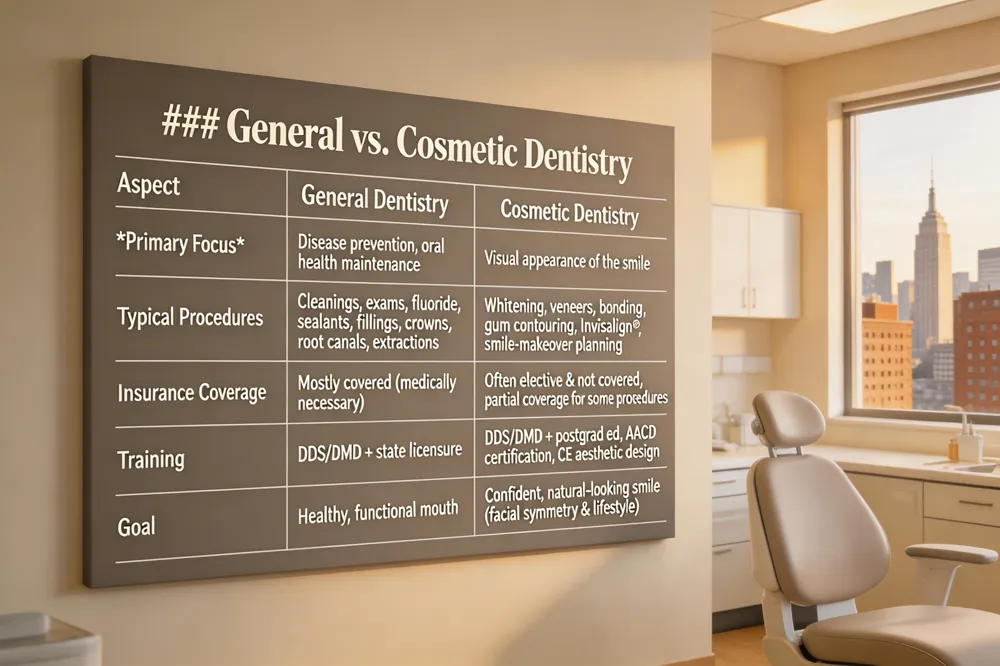 General dentistry is the foundation of oral health. It emphasizes disease prevention, routine cleanings, exams, fluoride treatments, sealants, and restorative work such as fillings, crowns, root canals, and extractions. These services are considered medically necessary and are usually covered by dental insurance. Cosmetic dentistry, by contrast, is focused on the visual appearance of the smile. It employs whitening, porcelain or composite veneers, bonding, gum contouring, clear‑aligner therapy (e.g., Invisalign®), and comprehensive smile‑makeover planning. While many cosmetic procedures are elective and often not reimbursed, some—like implants that also restore function—may receive partial coverage.
Training distinguishes the two roles. Both general and cosmetic dentists hold DDS or DMD degrees and pass state licensure exams. Cosmetic dentists typically pursue additional postgraduate education, certifications (e.g., AACD accreditation), and continuing‑education courses in aesthetic design, digital smile‑design software, and advanced materials such as ultra‑thin porcelain. This extra training equips them to balance shade matching, facial symmetry, and patient lifestyle.
Empower Your Smile (Dr. Moezinia, Tribeca, NYC) blends both approaches under one roof. The practice provides preventive check‑ups and restorative care while offering a dedicated aesthetic team that uses 3D scanning, digital mock‑ups, and in‑house labs to create personalized smile designs. This collaboration ensures patients receive a healthy mouth and a confident, natural‑looking smile.
The Four Pillars of Dental Care
The Four Pillars of Dental Care
| Pillar | Key Services | Purpose |
|---|---|---|
| Diagnostic | Exams, X‑rays, oral cancer screening, digital imaging (3‑D scans, intra‑oral cameras) | Early identification of decay, disease, or structural issues |
| Preventive | Routine cleanings, fluoride treatments, sealants, mouthguards, patient education | Stop cavities, strengthen enamel, reduce periodontal risk |
| Restorative | Fillings, crowns, bridges, root canal therapy, implants, dentures | Repair damage, restore function, protect remaining tooth structure |
| Cosmetic | Professional whitening, veneers, bonding, Invisalign® clear aligners, gum contouring | Enhance aesthetics, boost confidence, sometimes improve function |
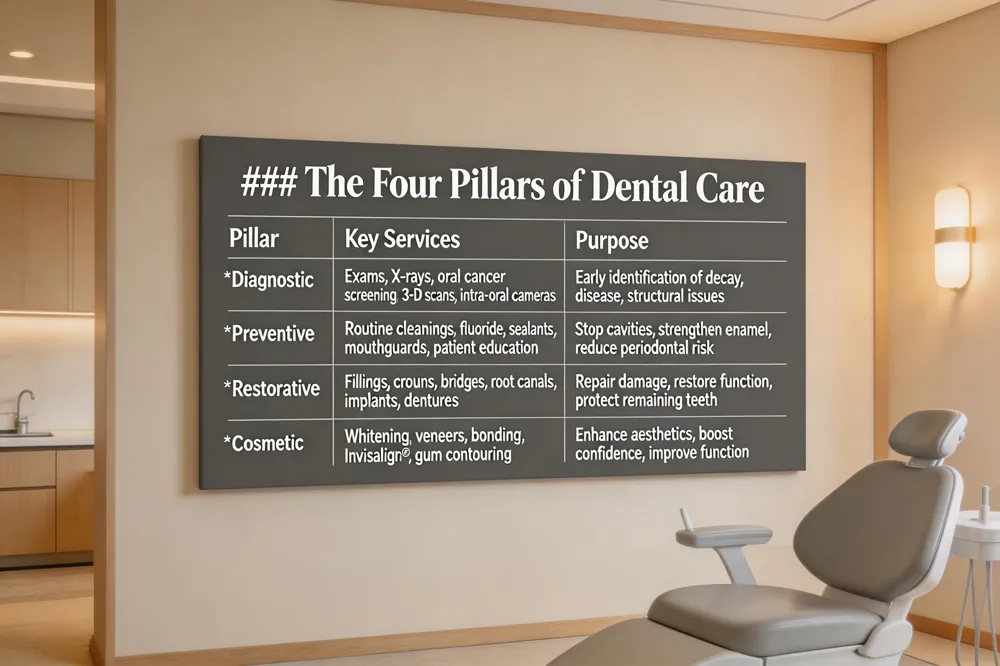 Dental care can be organized into four primary pillars—diagnostic, preventive, restorative, and cosmetic.
Diagnostic dentistry uses exams, X‑rays, oral cancer screening, and digital imaging (3‑D scans, intra‑oral cameras) to identify problems early. Detecting decay, gum disease, or structural issues before they progress saves time, money, and preserves healthy tooth structure.
Preventive care focuses on routine cleanings, fluoride treatments, sealants, mouthguards, and patient education. Regular cleanings and sealants stop cavities, while fluoride strengthens enamel, reducing the risk of future decay and periodontal disease.
Restorative dentistry repairs damage and restores function. Typical procedures include fillings (amalgam or tooth‑colored composite), crowns, bridges, root canal therapy, and tooth replacement options such as dental implants or dentures. Restorative work returns chewing efficiency, protects remaining tooth structure, and prevents disease from spreading.
Cosmetic dentistry enhances the visual appearance of the smile. Common services are professional whitening, porcelain or composite veneers, dental bonding, Invisalign® clear aligners, and gum contouring. Cosmetic procedures improve confidence and can also provide functional benefits—veneers protect chipped teeth, and proper alignment eases oral hygiene.
Why each pillar matters: Diagnostic and preventive pillars create a healthy foundation; restorative care rebuilds lost tissue and function; cosmetic care refines aesthetics while often supporting oral health. Together they ensure a durable, natural‑looking smile that lasts for years.
Answer to the key question: The four primary types of dentistry are diagnostic, preventive, restorative, and cosmetic. Diagnostic dentistry involves exams, X‑rays, and screenings to identify oral health issues before treatment. Preventive dentistry focuses on routine cleanings, fluoride applications, sealants, and patient education to stop problems before they start. Restorative dentistry repairs damage through fillings, crowns, bridges, root canals, and tooth replacements such as implants or dentures. Cosmetic dentistry enhances the smile’s appearance with whitening, veneers, bonding, and other aesthetic procedures.
Practical Oral‑Health Rules: 3‑3‑3 and 50‑40‑30
Practical Oral‑Health Rules
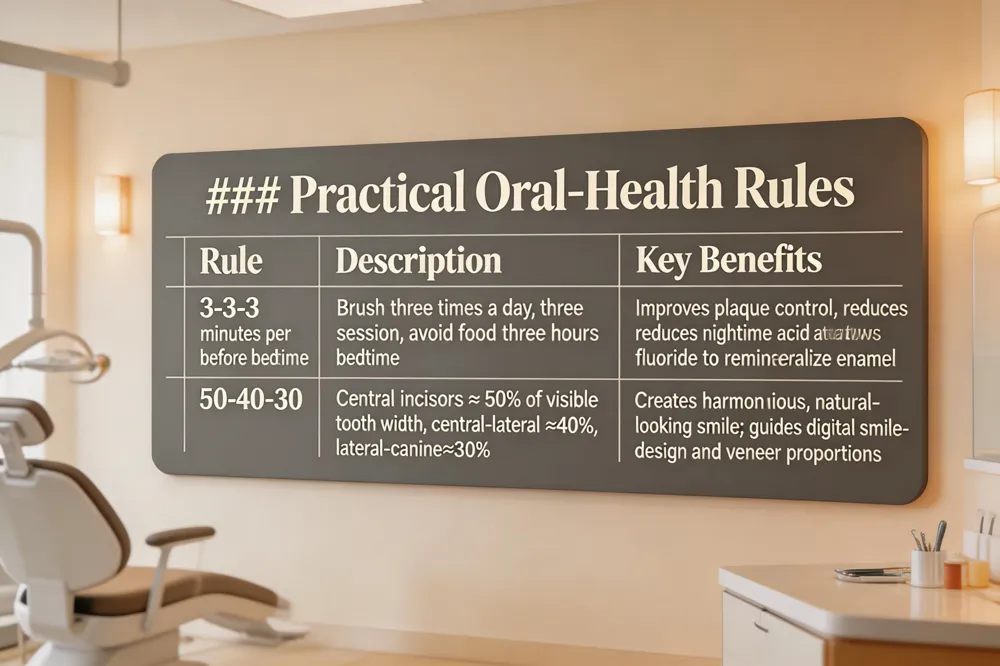
| Rule | Description | Key Benefits |
|---|---|---|
| 3‑3‑3 | Brush three times a day, three minutes per session, avoid food three hours before bedtime | Improves plaque control, reduces nighttime acid attacks, allows fluoride to remineralize enamel |
| 50‑40‑30 | Central incisors ≈ 50 % of visible tooth width, central‑lateral contact ≈ 40 %, lateral‑canine contact ≈ 30 % | Creates harmonious, natural‑looking smile; guides digital smile‑design and veneer proportions |
 3 Simple daily habits for plaque control
The 3‑3‑3 rule is a memorable cue: brush three times a day, spend roughly three minutes each session, and keep food away for at least three hours before bedtime. While professional guidelines still recommend brushing twice daily for two minutes, flossing once, and regular check‑ups, the 3‑3‑3 approach helps many patients stay disciplined, reduce nighttime acid attacks, and give fluoride more time to remineralize enamel.
Visual proportion rule for aesthetic balance
The 50‑40‑30 rule guides smile design: central incisors should occupy about 50 % of the visible tooth width, the contact between central and lateral incisors about 40 %, and the lateral‑to‑canine contact about 30 %. This proportion creates a harmonious, natural‑looking smile.
How these rules complement professional care
Both rules are adjuncts, not substitutes, for professional treatment. A solid home‑care routine supports the health of teeth and gums, while the 50‑40‑30 proportion helps cosmetic dentists plan restorations that blend with facial symmetry, using tools like digital imaging and 3D scans. Together, they promote lasting oral health and a balanced, confident smile.
Choosing the Right Provider for Your Smile Design
Choosing the Right Smile‑Design Provider
| Qualification / Feature | Why It Matters |
|---|---|
| DDS/DMD degree | Baseline dental education and licensure |
| Post‑graduation training in aesthetics | Specialized knowledge in veneers, smile design, digital workflows |
| AACD (or similar) certification | Demonstrates mastery of cosmetic techniques and standards |
| Advanced technology (3‑D intra‑oral scanner, CAD/CAM, digital imaging) | Precise shade matching, accurate tooth proportion analysis, realistic treatment previews |
| Strong before‑and‑after portfolio | Shows real‑world results and artistic skill |
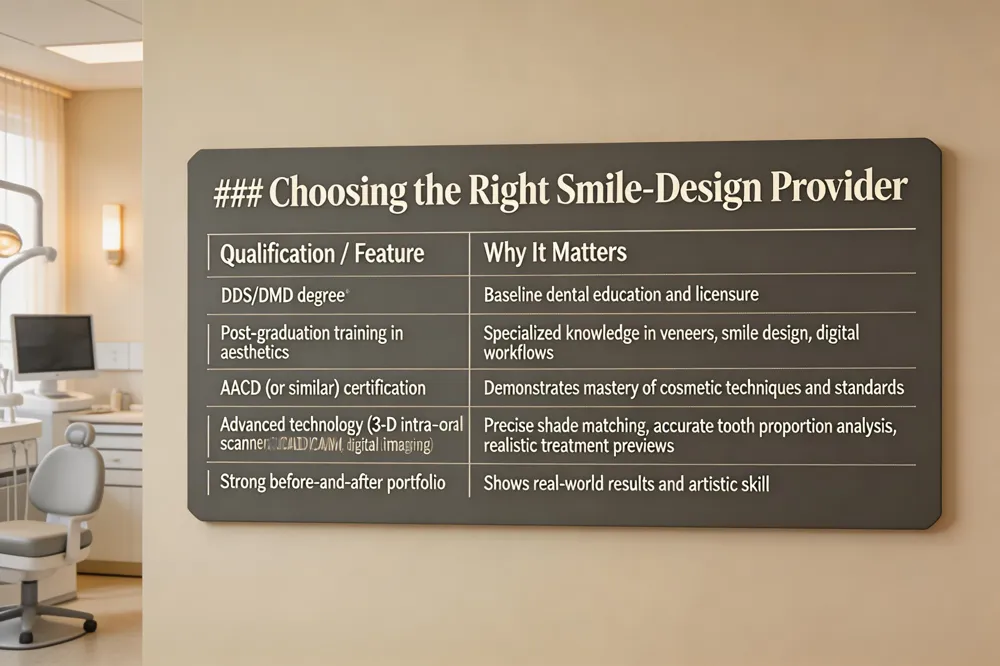 When selecting a smile‑design dentist, look for a practitioner who combines artistic vision with rigorous scientific training. Key qualifications include a DDS or DMD degree, additional postgraduate coursework in aesthetic dentistry, and certifications such as AACD Fellowship that demonstrate mastery of porcelain veneers, digital smile design, and implant aesthetics. Advanced technology—3D intra‑oral scanners, CAD/CAM milling, and high‑resolution digital imaging—ensures precise shade matching, tooth proportion analysis, and realistic treatment previews.
How can I become a cosmetic dentist? Earn a bachelor’s degree, complete a four‑year dental program (DDS/DMD), pass state licensure, then pursue specialized postgraduate training (residency, fellowship, or intensive CE courses) focused on veneers, smile design, and digital dentistry. Joining the AACD and building a robust before‑and‑after portfolio further validates expertise.
What is the average salary of a cosmetic dentist in the United States? Nationally, the median annual salary is about $180,245, with a range from $164,773 (10th percentile) to $230,767 (90th percentile). Practitioners in high‑cost markets like New York City often earn 10 %+ above the median.
Where can I find a cosmetic dentist near me in New York City? Empower Your Smile, 125 West Broadway, Tribeca, offers porcelain veneers, Invisalign®, professional whitening, and digital smile design, with easy online scheduling and financing options.
What is the most feared dental procedure? Root canal therapy tops patient anxiety lists, despite modern anesthesia making it comparable in discomfort to a routine filling. Understanding its safety and high success rates helps alleviate fear and promotes essential oral‑health care.
Patient‑Centric Care at Empower Your Smile: Services, Technology, and Accessibility
Patient‑Centric Care at Empower Your Smile
| Service / Technology | Description |
|---|---|
| Comprehensive Services | Preventive cleanings, exams, restorative work, porcelain veneers, Invisalign®, implants |
| Digital Imaging & 3‑D Scanners | Capture precise intra‑oral anatomy for planning and mock‑ups |
| In‑House Laboratory | Fast turnaround for custom restorations, ensuring perfect fit and shade |
| Multiple Office Locations | Medical Center (5837 Babcock Rd.), Alamo Ranch (11720 Alamo Ranch Pkwy., Suite 200), Stone Oak (18415 Blanco Rd., Suite 103) – convenient access for San Antonio patients |
| Convenient Scheduling & Financing | Online booking, flexible payment plans, insurance assistance |
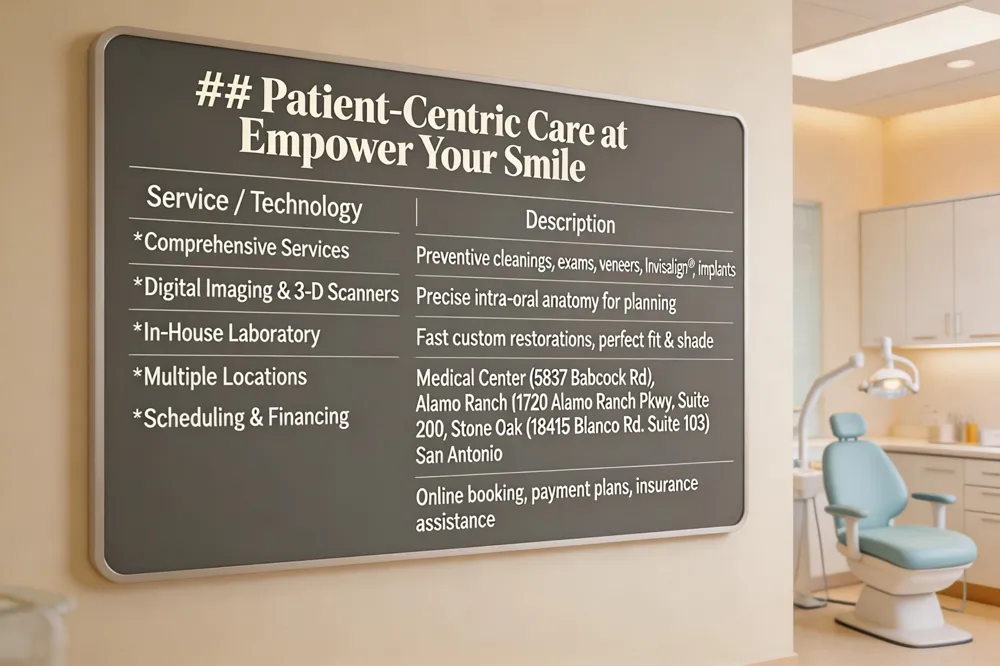 Empower Your Smile in Tribeca offers a full spectrum of dental care, from routine cleanings and preventive exams to advanced restorative solutions such as porcelain veneers, Invisalign®, and dental implants. The practice’s three conveniently located offices—Medical Center (5837 Babcock Rd.), Alamo Ranch (11720 Alamo Ranch Pkwy., Suite 200), and Stone Oak (18415 Blanco Rd., Suite 103)—provide easy access for patients throughout San Antonio and the practice can be reached at (210) 337‑6453 or via online scheduling. Each visit begins with a comprehensive, personalized consultation that evaluates facial symmetry, shade matching, and the patient’s lifestyle goals. Using state‑of‑the‑art digital imaging, 3D intra‑oral scanners, and an in‑house laboratory, the team creates precise digital mock‑ups and streamlines the smile‑design process, ensuring natural‑looking, long‑lasting results. This patient‑centric approach combines artistic expertise with cutting‑edge technology, delivering customized treatment plans that fit individual budgets and schedules while maintaining optimal oral health.
Your Path to a Confident, Healthy Smile
A truly beautiful smile starts with solid oral health and expert aesthetic design. While preventive cleanings, exams, and disease treatment safeguard your teeth and gums, advanced cosmetic techniques—such as porcelain veneers, Invisalign®, and digital smile design—refine shape, color, and harmony for lasting confidence. Empower Your Smile blends these two worlds, offering personalized consultations that assess facial symmetry, shade matching, and lifestyle needs before any artistry begins. Take the first step toward your dream smile by scheduling a one‑on‑one consultation today. Our welcoming offices are conveniently located in Manhattan, Brooklyn, and Queens, making it easy for New York City residents to access top‑tier, patient‑focused care. Call (212) 555‑0198 or book online to start your transformation.