Why Timing Is the Cornerstone of Success
Successful gum grafting hinges on aligning the graft with the extraction’s healing phases. After extraction, a stable clot forms within 24‑48 hours, followed by granulation tissue and early bone fill during weeks 2‑4; placing the graft during this window supplies optimal blood supply and prevents ridge collapse. Clinical studies show grafts placed 2‑4 weeks post‑extraction achieve the highest root‑coverage rates and the best aesthetic outcomes. At Empower Your Smile, we evaluate each patient’s socket healing, systemic health, and lifestyle to schedule the graft at the precise moment that maximizes integration and long‑term gum health.
The Golden Window: When to Place a Graft After Extraction
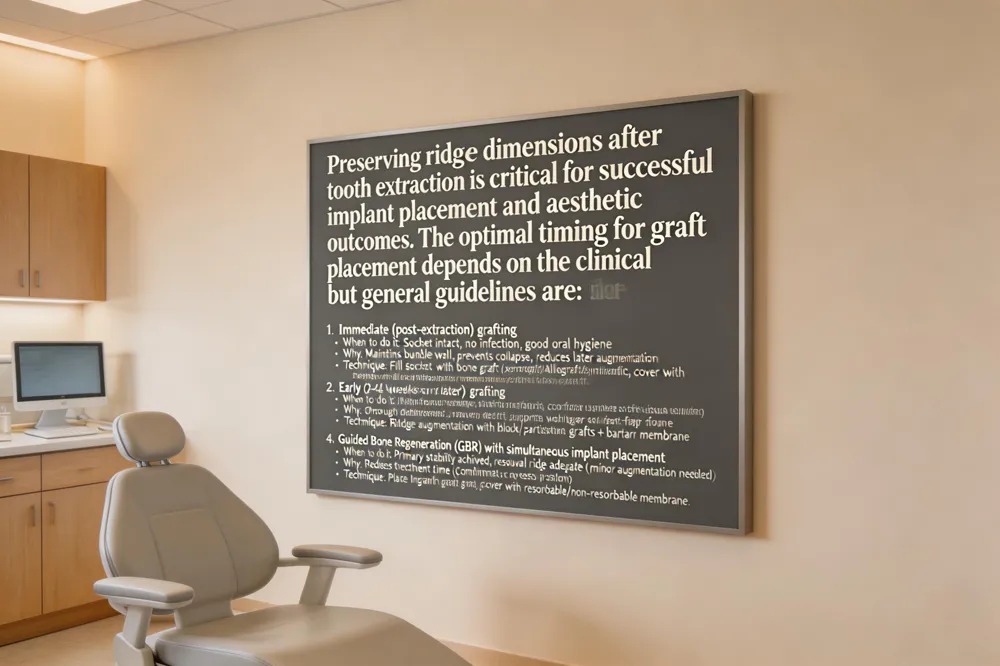 Immediately after extraction (within the first 0‑48 hours) the socket is still fresh, the blood clot is stable and the tissue is highly vascularized, making it an ideal window for a soft‑tissue graft. This timing preserves ridge dimensions and reduces early bone remodeling. If the graft is delayed 2‑4 weeks, the socket has filled with granulation tissue and initial bone fill, providing a solid, well‑vascularized base while still allowing excellent graft integration. Clinical studies consistently show the highest success rates—over 90 %—when grafts are placed within this 2‑4 week window, with a 30 % reduction in ridge loss compared with later placement.
Typical healing timeline after one week: Swelling and mild discomfort have markedly decreased; the graft appears whitish‑yellowish as it adheres, and patients can resume a soft‑food diet and gentle oral hygiene.
Healing stages (pictures): Day 1‑3 – protective scab formation; Week 1‑2 – re‑epithelialization and swelling reduction; Week 3‑4 – tissue maturation and color blending; Month 2‑3 – final contour and stability.
Day‑by‑day healing: 0‑48 hrs – clot formation, swelling, light bleeding; Days 3‑5 – swelling peaks then subsides, graft looks whitish; Days 7‑10 – scab loosens, tissue stabilizes, soft foods introduced; 2 weeks – graft firmly attached, minimal swelling, brushing resumes on opposite side; 4‑6 weeks – full tissue integration; up to 6 months – final maturation.
Pain, Stitches, and the Palatal Donor Site
 Gum grafting itself is painless because local anesthesia (often with nitrous‑oxide, oral or IV sedation) numbs the area during surgery. After the anesthetic wears off, patients usually feel mild‑to‑moderate soreness at the graft and at the palate where tissue was harvested. Over‑the‑counter ibuprofen or acetaminophen, a soft‑food diet and avoiding hot drinks keep the discomfort brief; most return to normal activities within a few days. Most grafts are secured with resorbable sutures that dissolve in 4‑10 days; if non‑resorbable stitches are used, they are removed at a 1‑2‑week follow‑up. The palate donor site feels like a “pizza‑burn” or hot‑coffee sensation for the first 1‑2 weeks. A soft dressing or plastic shield protects the wound for 48 hours, then a thin layer of Orabase can be applied. Gentle warm salt‑water rinses, soft foods, and no straws or vigorous rinsing promote healing. Contact the dentist if bleeding becomes heavy, the dressing detaches early, or pain is uncontrolled.
When It’s Too Late: Advanced Recession and Treatment Options
 Gum grafting works best when performed early, before the supporting bone and tissue deteriorate. It is considered “too late” when recession has progressed to Miller Class III or IV – indicating moderate‑to‑severe bone loss, furcation defects, or loose teeth that can no longer provide a stable foundation for a graft. Other red flags include heavily worn or decayed exposed roots and persistent sensitivity lasting months. At this stage, dentists often turn to alternative pathways such as tooth extraction followed by implant placement, sometimes preceded by bone‑building grafts. Less‑invasive soft‑tissue options include allografts, xenografts, enamel‑matrix protein derivatives, guided‑tissue‑regeneration membranes, the Pinhole Surgical Technique, and laser‑assisted procedures like LANAP. Early‑stage recession may also be managed with scaling, root planing, or laser contour‑ without a graft A periodontist can assess candidacy and recommend the most appropriate restorative plan.
Financial Considerations and What You’ll See in the Clinic
 Gum‑grafting fees vary, but the national average sits around $2,700‑$3,000 per site. In New York City, where Empower Your Smile operates, prices reflect the expertise of board‑certified periodontists and advanced technology, ranging from $500 for a simple connective‑tissue graft to $4,000‑$5,000 for extensive multi‑tooth cases or sedation. Most dental insurance plans cover a portion when the procedure is medically necessary; our team works to maximize benefits and offers flexible financing.
Before‑and‑after photos of successful grafts are available in the Empower Your Smile website gallery, showcasing added tissue thickness, root coverage, and improved smile aesthetics.
For clinical examples of graft failures, consult peer‑reviewed journals such as the Journal of Periodontology, university dental school case libraries, or professional association databases (AAP, ADA). These sources provide vetted images for educational purposes.
Beyond the Graft: Success Factors and Long‑Term Maintenance
 Gum graft failure typically stems from inadequate blood supply, poor surgical technique, or aggressive oral habits that disturb the graft during the first 1‑2 weeks. Smoking, uncontrolled diabetes, and neglecting prescribed antibiotics further raise infection risk, while severe recession or insufficient healthy tissue limits stable coverage. Maximizing outcomes hinges on meticulous post‑operative care: a soft, cool‑food diet for the first week, gentle antimicrobial rinses, avoiding brushing or flossing the graft until cleared, and refraining from straws, smoking, and heavy exercise for at least 7‑10 days. Regular follow‑up visits at 1 week, 1 month, and 3 months allow early detection of complications and suture removal. Compared with alternatives such as deep cleaning, orthodontic repositioning, or implant placement, grafting offers a high (>90 %) success rate, preserves natural tooth structure, and improves aesthetics with minimal invasiveness—making it a worthwhile, long‑term solution for most patients.
Additional Insights: Bonding, Tissue Regeneration, and Frequently Asked Queries
 Bonding versus grafting: Dental bonding is a non‑invasive, tooth‑colored composite applied to the visible tooth surface to mask imperfections and reduce sensitivity. It simply "covers" the problem in a single visit and is best for mild recession. Gum grafting, by contrast, is a minor surgical procedure that transplants tissue (autograft, allograft, or synthetic) to rebuild the lost gum line, protect the root, and provide a permanent, biologic solution.
Why gums don’t naturally grow back: The oral epithelium lacks the regenerative capacity to replace receded gingiva on its own. A graft supplies healthy, vascularized tissue that integrates with surrounding gums, creating a new, stable margin that can last a lifetime when proper oral hygiene is maintained.
Quick reference to common questions:
- How does bonding differ from gum grafting? Bonding crowns exposed roots with resin; grafting surgically restores gum tissue.
- Will my gums grow back after a gum graft? The graft does not make original gum regrow, but it replaces it with new tissue that integrates and remains healthy.
- What types of gum surgery are available? Options include scaling & root planing, flap surgery, pocket reduction, bone grafting, crown lengthening, and soft‑tissue grafts (connective tissue, free‑gingival, or palatal).
- Can I see before‑and‑after photos? Yes—visit the Empower Your Smile gallery or schedule a consultation for personalized case examples.
Your Path to a Healthy, Confident Smile
At Empower Your Smile, we begin every gum‑grafting case with a comprehensive early evaluation. Using intra‑oral scanning, CBCT imaging and a detailed periodontal exam, we identify the exact stage of recession and any underlying bone loss. From that data we design a personalized timing plan—whether an immediate graft at extraction, a 2‑to‑4‑week soft‑tissue placement, or a delayed approach—optimizing tissue integration and aesthetic results. Our commitment extends beyond surgery; we provide customized home‑care protocols, nutritional guidance and scheduled follow‑ups to ensure lasting oral health and a confident, radiant smile for you.