Understanding Gum Recession and Its Impact
Gum recession occurs when the gingival tissue pulls away from the tooth surface, exposing the root. The most common causes are aggressive brushing, periodontal disease, genetics, tobacco use, orthodontic movement, and trauma. When untreated, the exposed root becomes vulnerable to temperature‑sensitive hypersensitivity, cavity formation, and bone loss, which can progress to tooth mobility and eventual loss. Because the gum tissue cannot naturally regenerate, professional intervention is required. Gum grafting—typically performed by a periodontist—has become the gold‑standard treatment. The procedure transplants healthy tissue from the palate, a donor bank, or a synthetic material to cover the exposed root, restore gum thickness, and re‑establish a protective seal. With success rates exceeding 90 %, grafting not only reduces sensitivity and halts further recession but also improves smile aesthetics and long‑term periodontal health.
The Basics of Gum Grafting: Procedure, Duration, and What It Looks Like
Procedure Overview
| Step | Description | Typical Duration |
|---|---|---|
| 1. Anesthesia | Local anesthetic administered to numb the area. | < 5 min |
| 2. Incision & Flap | Small incision made, flap created to expose tooth roots. | 5‑10 min |
| 3. Tissue Harvest | Palate connective‑tissue graft, donor bank tissue, or pedicle flap mobilized. | 5‑15 min |
| 4. Graft Placement | Graft positioned over recession site, sutured or secured with dressing. | 5‑10 min |
| 5. Flap Reposition | Flap repositioned and secured. | < 5 min |
Overall Surgery Time: 30 min – 1 hr for a single tooth; 1‑2 hrs for multiple sites/complex techniques.
Before vs. After Visual:
- Before: Uneven gum line, exposed root, dark/inflamed tissue.
- After (healed): Thick, pink band covering root, smooth uniform margin, restored aesthetics.
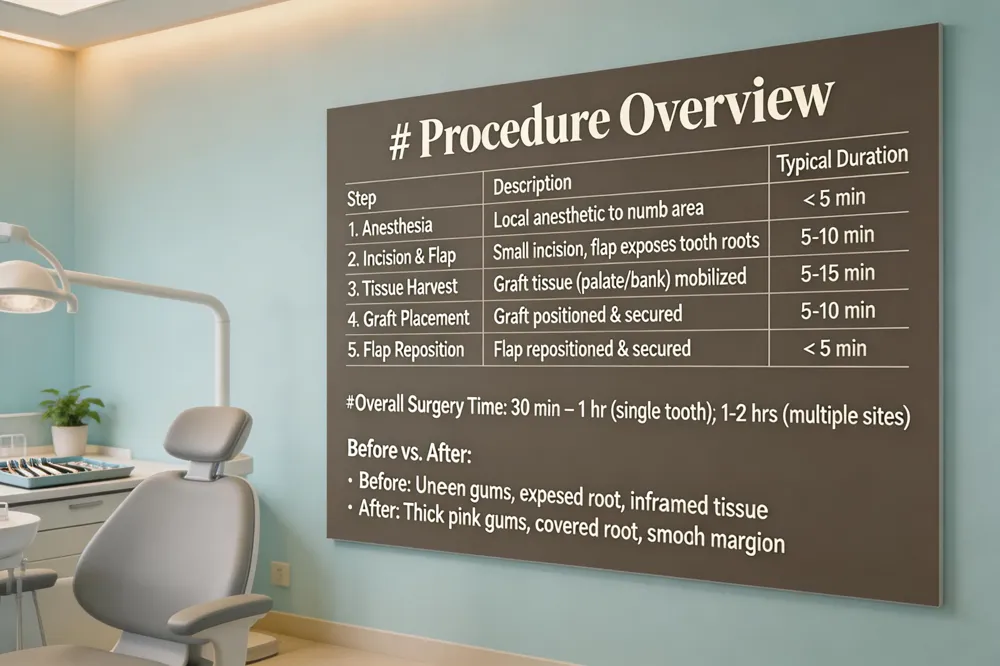 A periodontist begins a gum‑graft by administering local anesthesia, then makes a small incision to create a flap and clean the exposed tooth roots. Depending on the case, tissue is harvested from the palate (connective‑tissue graft), taken from a donor bank, or a pedicle flap is mobilized. The graft is placed over the recession site, sutured or secured with a periodontal dressing, and the flap is repositioned.
How long does a gum graft surgery take? A single‑tooth graft usually lasts 30 minutes to one hour; multiple sites or more complex techniques can extend the appointment to one or two hours. Patients remain awake but pain‑free and can leave the office the same day.
What does a gum graft look like before and after? Before treatment the gum line is uneven, the root is exposed, and the area may appear dark or inflamed. After healing, a thick, pink band of tissue covers the root, creating a smooth, uniform gum margin that restores both function and a balanced, attractive smile.
Recovery Journey: Healing Stages, Pain Management, and Timeline
Healing Timeline
| Time Frame | Healing Stage | Typical Symptoms & Pain Management |
|---|---|---|
| 0‑24 hrs | Blood clot forms on donor site; acts as scaffold. | Mild soreness; keep head elevated, ice packs. |
| 1‑3 days | Swelling peaks, inflammation resolves. | Swelling, bruising; soft foods, analgesics. |
| 4‑5 days | Graft adheres, color still whitish‑yellow. | Mild discomfort; monitor for worsening pain. |
| End of Week 1‑2 | Color shifts to pink, tissue firming. | Slight tenderness; continue soft diet. |
| 4‑6 weeks | Maturation, increasing stability. | Normal oral hygiene resumes. |
| Up to 6 months | Full remodeling. | Long‑term maintenance. |
Warning Signs: Severe pain, increasing swelling, pus, fever, or graft loosening → contact dentist immediately.
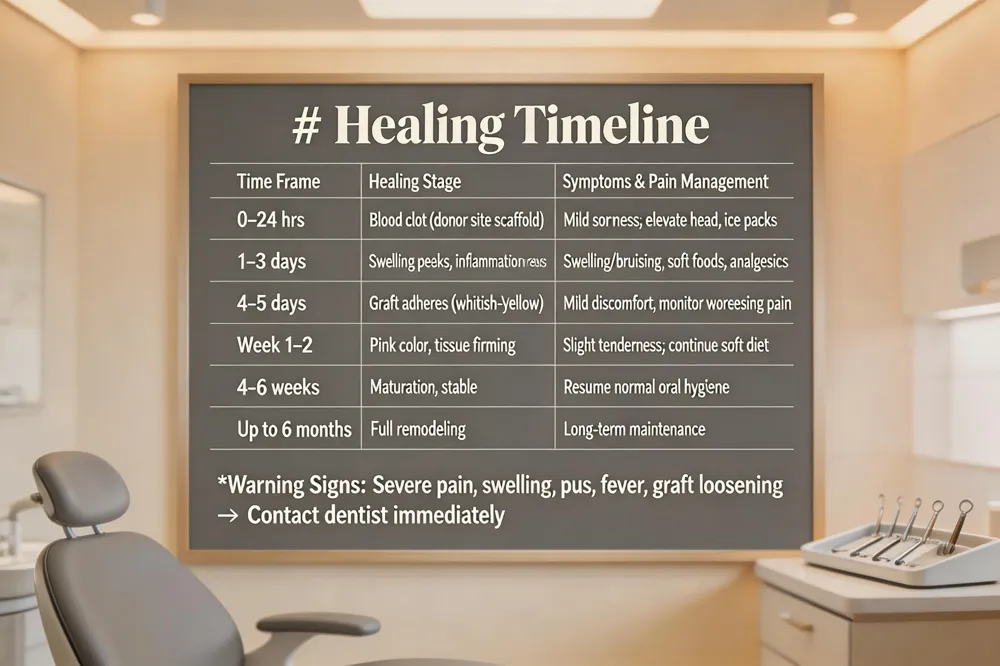 Immediately after gum‑graft surgery a blood clot forms on the palate donor site, protecting the wound and acting as a scaffold for new cells during the first 24‑48 hours. In the next three to five days swelling peaks and mild inflammation resolves as the graft begins to adhere. By the end of week 1 and into week 2 the graft’s color shifts from a whitish‑yellow hue to a healthier pink and the tissue becomes noticeably firmer, marking early integration. Between weeks 4‑6 the graft continues to mature, achieving full stability; complete remodeling may extend to six months, though most patients resume normal oral hygiene and diet after two weeks.
Typical discomfort includes mild soreness, swelling, and bruising that lessen after the first few days. Pain persisting beyond five days should be mild; severe, worsening pain, swelling, pus, or fever signals infection and warrants prompt dentist contact. Use soft foods, ice packs, and keep the head elevated to manage normal.
Summary of Q&A:
- Healing stages start with clot formation, progress through inflammation, color change to pink, firmness increase, and long‑term maturation.
- Pain on day 5 is normal if mild; severe or worsening pain is a warning sign.
Success Factors, Risks, and Common Concerns
Key Factors & Risks
| Factor | Details | Mitigation / Warning Sign |
|---|---|---|
| Surgical Precision | Accurate incision, secure sutures, adequate blood supply. | Off‑angle cuts or premature disturbance → graft failure. |
| Post‑Op Care | Strict oral hygiene, no smoking, follow diet/activity instructions. | Neglect → infection, delayed healing. |
| Donor Site Discomfort | Sensitivity, swelling, bruising (especially palate harvest). | Manage with analgesics, soft diet. |
| Infection | Low‑risk but possible (pain, pus, foul odor). | Prompt professional evaluation. |
| Graft Failure | Pale/gray patch, detachment, necrotic tissue. | Early detection → re‑treatment. |
| Patient Factors | Smoking, uncontrolled diabetes slow healing. | Smoking cessation, medical control before surgery. |
Success Rate: >90 % when protocol followed.
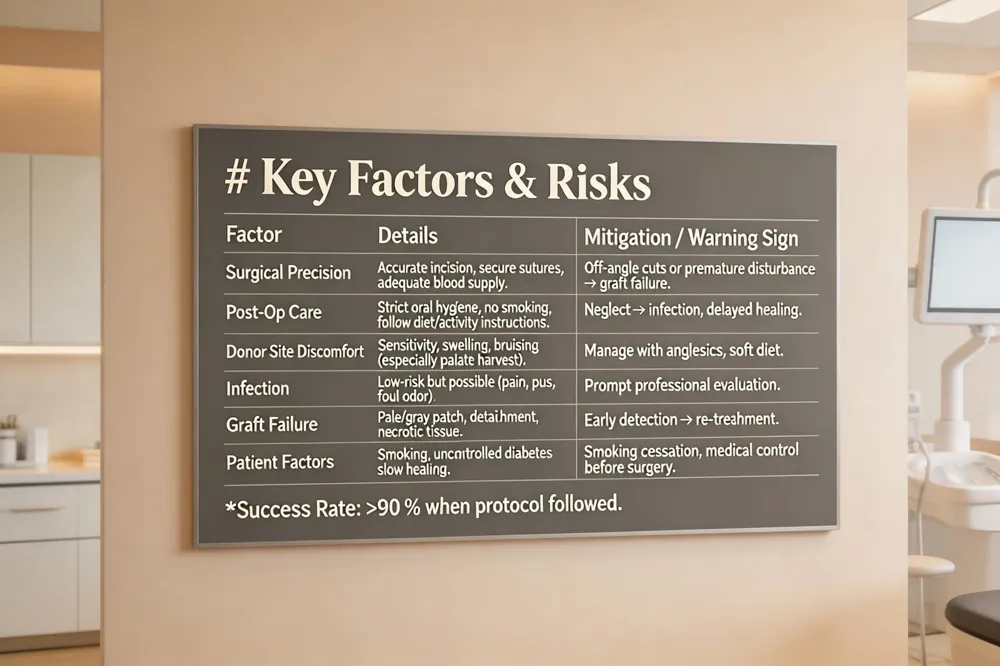 Gum grafting is a technique‑sensitive procedure that demands precise incision placement, secure suturing, and a reliable blood supply; even a minor error—like an off‑angle cut or premature disturbance—can jeopardize healing. Post‑operative care is equally crucial: neglecting oral hygiene, smoking, or ignoring diet and activity instructions can easily undo a well‑executed surgery.
Downsides include temporary discomfort (sensitivity, swelling, bruising) at both donor and recipient sites, possible bleeding—especially with palate harvests—and a low‑risk chance of infection or graft failure, which may present as persistent pain, pus, or loss of the tissue. Allergic reactions to graft materials are rare, and healing may be slower for smokers or uncontrolled diabetics.
When performed correctly and maintained with diligent oral hygiene, regular cleanings, and healthy habits, a gum graft can remain stable for many years—often a lifetime. Failure signs include a pale, white‑gray patch that detaches, dark or necrotic tissue, loose or shifting graft, persistent bleeding, swelling, pus, or foul odor. Prompt professional evaluation is essential if any of these appear.
Cost, Value, and Practical Considerations
Cost Overview
| Item | Typical Cost (USD) | Notes |
|---|---|---|
| Single‑tooth graft | $500 – $1,200 | Minimal invasive, local anesthesia. |
| Multiple‑site/extensive graft | $2,000 – $4,000 | More tissue, longer chair time. |
| National average (any graft) | ≈ $2,750 | Range $2,100 – $5,000 depending on complexity, graft type, region. |
| Insurance | Variable coverage if medically necessary. | Verify benefits, pre‑authorization, co‑pays. |
Value Proposition: Restores tissue, protects roots, reduces sensitivity, improves aesthetics, long‑term oral‑health benefit outweighs modest fees.
 Financial range for single and multiple grafts:
A gum graft in the United States typically runs between $500 and $1,200 for a single‑tooth procedure, while grafts that treat multiple sites or more extensive recession often cost $2,000 – $4,000. The national average for a gum‑grafting surgery is about $2,750, with a broader range of $2,100 – $5,000 depending on case complexity, graft type (pedicle, connective‑tissue, free gingival), anesthesia, and regional cost differences.
Insurance coverage possibilities:
Dental insurance may cover part of the cost if the graft is deemed medically necessary. Coverage varies by plan, so patients should verify benefits, any required pre‑authorization, and potential co‑pays before treatment.
Assessing whether grafting is worth it:
Yes—gum grafting is generally worth it for anyone with receding gums, exposed roots, or bone loss. The procedure restores lost tissue, protects roots from decay, reduces sensitivity, and prevents further periodontal damage while improving smile aesthetics. With a >90 % success rate, a short recovery of one to two weeks, and modest fees, the long‑term oral‑health benefits outweigh the cost.
Timing, Follow‑Up, and Long‑Term Maintenance
Timing & Maintenance
| Timing | Recommendation | Long‑Term Maintenance |
|---|---|---|
| Ideal candidacy | Moderate recession, sufficient bone, Miller Class I/II. | Regular cleanings, excellent oral hygiene. |
| Contraindications | Extensive bone loss, tooth mobility, Miller Class III/IV defects. | May need bone grafts, orthodontics, or implants. |
| First week post‑op | Swelling/bruising subsides, graft feels firm, mild tenderness. | Soft‑food diet, avoid brushing site, antimicrobial rinse. |
| 2‑week mark | Resume normal oral hygiene (gentle brushing). | Continue avoiding tobacco, aggressive brushing. |
| Long‑term | Annual dental visits, professional cleanings, maintain healthy habits. | Graft can remain stable for decades, often lifetime. |
Follow‑Up Visits: Typically 1‑week and 2‑week check‑ins; thereafter routine periodontal maintenance.
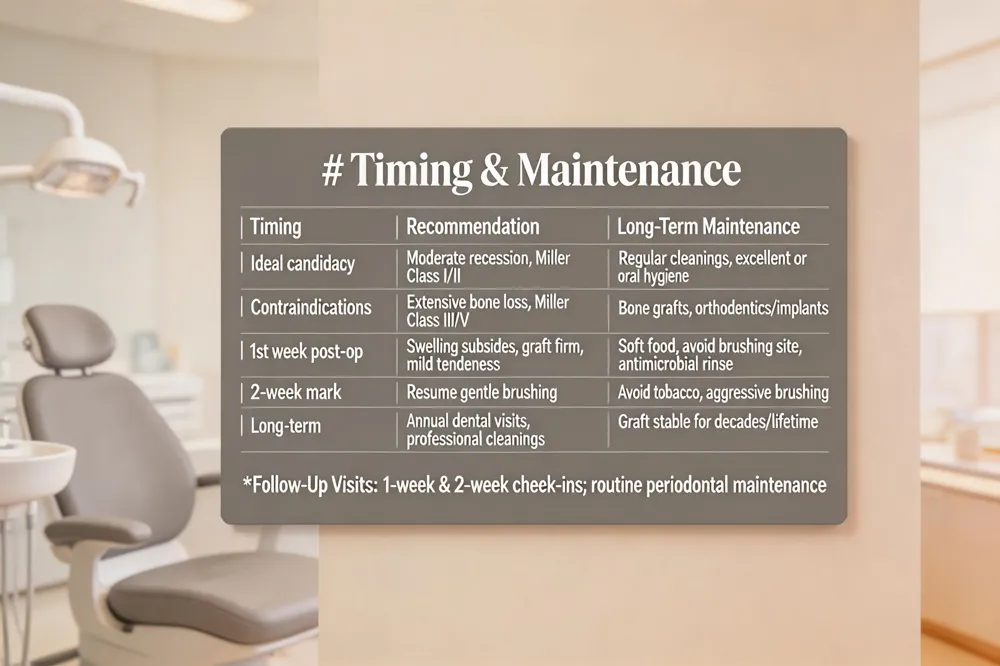 Gum grafting works best for moderate recession; it becomes too late when there is extensive bone loss, tooth mobility, or Miller Class III/IV defects, because the graft cannot achieve a stable blood supply and may fail. In such cases dentists often turn to bone grafts, orthodontic correction, or extraction with implants. By the end of the first week after surgery swelling and bruising should have subsided, the graft feels firm, and only mild tenderness or a faint throbbing may remain, especially when chewing. The graft will look pink with some white‑opaque patches—normal early integration. Continue a soft‑food diet, avoid brushing the site, and use the prescribed antimicrobial rinse. For long‑term success, maintain excellent oral hygiene, attend regular cleanings, and avoid tobacco and aggressive brushing. With diligent care a well‑placed graft can remain healthy for decades, often lasting the rest of the patient’s life.
Your Path to a Healthier, More Confident Smile
Recap of gum graft benefits and success rates
Gum grafting restores lost tissue, covers exposed roots, reduces sensitivity, protects against decay, and improves smile aesthetics. Studies show success rates above 90 % and root‑coverage outcomes of 70‑95 % when performed by an experienced periodontist. Early evaluation is crucial; untreated recession can lead to cavities, bone loss, and tooth loss. A personalized assessment lets the clinician choose the optimal graft type—connective tissue, free gingival, or pedicle—and address underlying causes such as aggressive brushing or periodontal disease.
How Empower Your Smile can guide you
Empower Your Smile provides periodontal exams, 3‑D imaging, and a treatment plan tailored to your anatomy and health history. Their board‑certified periodontists perform grafts under anesthesia with optional sedation, and give after‑care instructions, including diet, oral‑hygiene tips, and follow‑ups. From the initial consultation through recovery, the team monitors healing, manages complications, and ensures the graft integrates for protection, a brighter smile.