The Vital Role of Early Detection in Oral Health
Early detection of oral cancer is the cornerstone of effective care. When lesions are identified at an initial stage, treatment can be less invasive, often limited to a simple excision or localized therapy, which dramatically raises cure rates. Studies show five‑year survival exceeds 80 percent for stage I disease but drops below 40 percent once cancer spreads to lymph nodes or beyond. Empowering patients through education—teaching self‑examination, recognizing persistent red or white patches, and promptly reporting changes—creates a proactive partnership with the dentist. Informed individuals are more likely to attend regular screenings, ensuring timely intervention and better outcomes. This collaborative effort saves lives.
Guidelines, Frequency, and Risk Assessment
Guidelines, Frequency, and Risk Assessment
| Guideline | Recommendation | Frequency | Key Notes | |||----------------|-----------|-----------| | ADA | Visual‑tactile exam at every dental visit for all adults; biopsy or referral for suspicious lesions | Every visit (typically 6‑12 mo) | Adjunctive tools optional, not definitive | | American Cancer Society | Annual exam for adults ≥ 40 yr; every 3 yr for ages 20‑39 | Annual (≥ 40) / Every 3 yr (20‑39) | Emphasizes age‑based intervals | | Oral Cancer Foundation | At least yearly screening for everyone ≥ 18 yr | Annual | Broad recommendation | | USPSTF | “I” statement – insufficient evidence for universal screening of asymptomatic adults | Individualized | No firm interval recommendation | | High‑risk individuals (tobacco, heavy alcohol, HPV, prior lesions) | More frequent exams | Every 6‑12 mo | Tailor to risk profile | | U.S. incidence | ~11 per 100,000 people yearly (≈0.011 %) | — | Lifetime odds ~1 in 9,000; higher in smokers, heavy drinkers, older men | | Gold‑standard diagnostic | Tissue biopsy with histopathology | — | Required for definitive diagnosis |
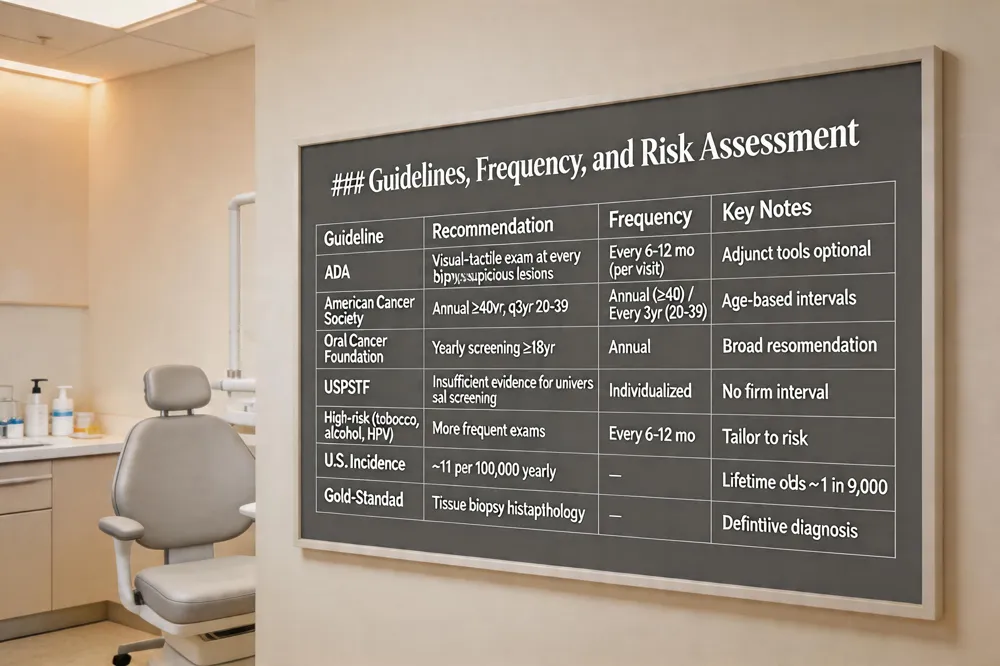 Professional bodies differ on routine oral cancer screening. The American Dental Association (ADA) recommends a visual‑tactile exam at every dental visit for all adults, with immediate biopsy or specialist referral for suspicious lesions; adjunctive tools are optional but not definitive. The American Cancer Society advises annual exams for patients ≥ 40 years and every three years for ages 20‑39, while the Oral Cancer Foundation advocates at least yearly screening for everyone ≥ 18. The USPSTF assigns an "I" statement, noting insufficient evidence for universal screening of asymptomatic adults. Screening intervals should be individualized: low‑risk adults can be examined annually, high‑risk individuals (tobacco, heavy alcohol, HPV, prior lesions) often every 6‑12 months. In the United States the incidence is ~11 per 100,000 people yearly (≈0.011 %); lifetime odds rise to ~1 in 9,000, with markedly higher rates in smokers, heavy drinkers, and older men. The gold‑standard diagnostic test is a tissue biopsy with histopathology.
What Happens During a Professional Screening?
What Happens During a Professional Screening?
| Step | Description | Who Performs | Billing Code |
|---|---|---|---|
| Visual & tactile exam | Bright white‑light inspection + mirror; palpation of lips, tongue, floor, cheeks, gums, palate, jaw, neck, lymph nodes | Dentist (or hygienist for initial) | D0120 / D0150 (routine evaluation) |
| Adjunctive light‑based tools | Fluorescence (e.g., VELscope) or polarized white light to highlight abnormal tissue | Dentist | D0431 (adjunctive visual‑diagnostic screening) |
| Topical dyes | Toluidine‑blue or acetic‑acid rinse brushed on suspicious patches | Dentist | — |
| Dental hygienist interview & palpation | Questions about lumps, voice changes, swallowing, tobacco/vaping; neck palpation | Dental hygienist | — |
| 3‑finger test | Checks mouth opening; inability to fit three fingers may indicate trismus/lesion | Dentist or hygienist | — |
| Biopsy (if needed) | Tissue sample taken for histopathology | Oral surgeon or specialist | — |
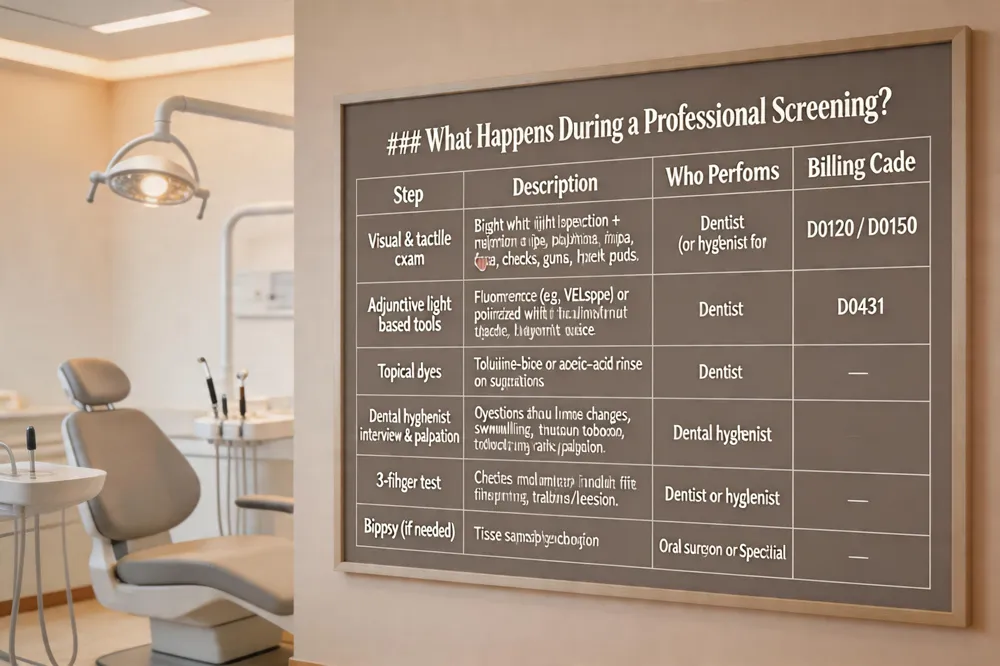 During a routine oral‑cancer exam the clinician first performs a visual and tactile examination using a bright white‑light source and a mirror to inspect the lips, tongue, floor of the mouth, cheeks, gums and palate, while gently palpating the jaw, neck and lymph nodes for lumps. Many practices augment this with light‑based adjuncts and dyes: a blue‑light fluorescence device (e.g., VELscope) or polarized white light highlights abnormal tissue, and topical agents such as toluidine‑blue or acetic‑acid rinses may be brushed on suspicious patches. The dental hygienist often leads the initial screening, asking about lumps, voice changes, swallowing difficulties and tobacco or vaping use, and performing the neck palpation before the dentist evaluates any findings. Billing uses CDT code D0431 for adjunctive visual‑diagnostic screening, with D0120/D0150 for the routine evaluation. A quick 3‑finger test checks mouth opening and possible trismus; inability to fit three fingers may signal a lesion that needs further investigation. The overall test is a visual oral exam, sometimes called a VELscope or Identafi fluorescence screening, with biopsy reserved for definitive diagnosis.
Recognizing Signs and Performing Self‑Exams
Recognizing Signs and Performing Self‑Exams
| Sign | Description | Self‑Exam Tip |
|---|---|---|
| Persistent ulcer | Non‑healing sore > 2 weeks, may bleed or hurt | Look for any sore that hasn’t healed in two weeks |
| Red (erythroplakia) or white (leukoplakia) patches | Discolored lesions on tongue, gums, inner cheeks, palate | Examine under bright light; note any red/white patches lasting > 2 weeks |
| Unexplained lump or swelling | Thickened area in mouth or neck, swollen lymph nodes | Palpate jawline, neck, and oral tissues for any firm bumps |
| Numbness/tingling | Sensation loss in lips, tongue, jaw | Test feeling by gently touching these areas |
| Difficulty swallowing or hoarseness | Early sign of lesion affecting throat | Note any new trouble swallowing or voice changes |
| Change in denture fit | Sudden looseness or pressure from dentures | Check if dentures fit differently than usual |
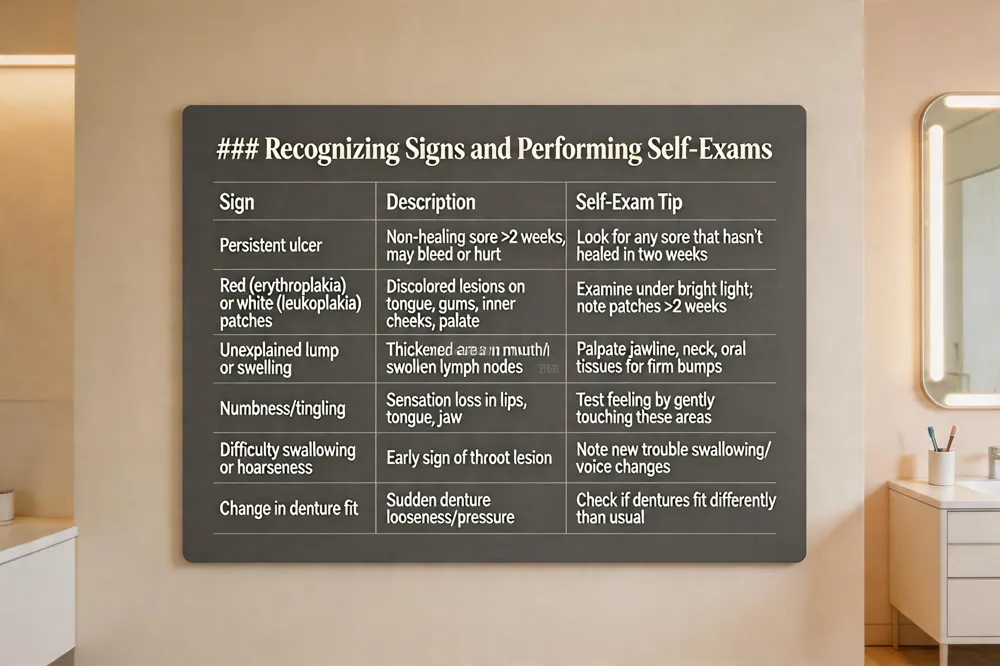 Oral‑cancer screening symptoms include persistent ulcers that don’t heal within two weeks, especially if they bleed or hurt, and red (erythroplakia) or white (leukoplakia) patches on the tongue, gums, inner cheeks, or palate that persist. Unexplained lumps, thickened areas, or swollen lymph nodes in the neck or jaw, numbness or tingling in the lips, tongue, or jaw, difficulty swallowing, hoarseness, or a change in denture fit are also red flags. To detect oral cancer at home, perform a monthly self‑exam under a bright light with a clean mirror and clean hands. Inspect the lips, cheeks, gums, tongue (including the underside), floor of the mouth, palate, and the skin of the face and neck for any sores, patches, or bumps. Gently palpate the same areas and the jawline lymph nodes. If you notice any of these changes, experience persistent pain, or have difficulty swallowing, schedule a prompt dental appointment. Early detection dramatically improves treatment success and survival.
Practical Matters: Cost, Coverage, and Access
Practical Matters: Cost, Coverage, and Access
| Topic | Details | Typical Cost / Coverage |
|---|---|---|
| Insurance coverage | Most private dental plans cover visual oral‑cancer exam as preventive; Medicare Part A/B usually does not; Medicaid varies by state | Varies – often $0‑$30 copay if covered |
| Out‑of‑pocket cost | $30‑$100 fee for screening; often $0 when insurance applies | $30‑$100 (reduced or waived with coverage) |
| Value of screening | Quick, painless; detects precancerous/early cancers; improves survival especially for high‑risk patients | High clinical value despite limited mortality evidence |
| Necessity | Not proven to lower overall mortality but identifies suspicious tissue early; professional guidelines recommend at least annual screening for all adults | Recommended for all adults; more frequent for high‑risk |
| Location | Empower Your Smile, Tribeca, NYC – screenings included with routine visit | Same as routine visit cost range |
 Is oral cancer screening covered by insurance? Most private dental plans treat a visual oral‑cancer exam as a preventive service and will cover it, though copays and deductibles vary. Traditional Medicare (Part A/B) does not include routine dental screenings, so the exam is usually not covered unless tied to a medically necessary procedure. Medicaid coverage differs by state; some reimburse preventive exams, others do not. Check your specific policy for any required referrals or documentation.
Oral cancer screening cost Out‑of‑pocket fees typically range $30‑$100, often reduced to $0 when insurance applies. At Empower Your Smile the screening is bundled with a routine check‑up, so patients usually pay within this range.
Are oral cancer screenings worth it? The exam is quick, painless, and can detect precancerous lesions or early‑stage cancers when treatment is most successful. Even without proven mortality benefit, early detection markedly improves survival, especially for high‑risk individuals.
Is oral cancer screening necessary? While not proven to lower overall mortality, it identifies suspicious tissue before symptoms appear, allowing less invasive treatment. Professional guidelines recommend at least annual screening for all adults, with more frequent exams for those over 40 or with risk factors.
Oral cancer screening near me Empower Your Smile in Tribeca, NYC offers professional screenings as part of every routine visit. Schedule online or call Dr. Moezinia’s team today.
Take Charge of Your Oral Health Today
Regular oral‑cancer screenings save lives. Early detection dramatically raises five‑year survival rates, reduces the need for aggressive treatment, and preserves speech, chewing, and appearance. Because most cancers develop without pain or obvious signs, a quick visual and tactile exam at every dental visit is essential—especially for those over 40 or with tobacco, alcohol, or HPV risk factors. Schedule your next routine check‑up, ask your dentist about a dedicated oral‑cancer exam, and perform a monthly self‑check at home. Knowledge of risk factors, warning signs, and the simple steps to catch disease early empowers you to protect your mouth and overall health.