Welcome to Your Deep‑Cleaning Journey
Scaling and root planing (SRP) is a deep‑cleaning procedure that removes plaque, tartar and bacterial toxins from both above and below the gumline, then smooths the exposed tooth roots so bacteria cannot re‑attach. It is typically performed by a dentist, periodontist or dental hygienist using hand scalers, ultrasonic instruments, or a combination of both, and local anesthesia is administered to numb the gums and keep the patient comfortable.
SRP is regarded as the first‑line, nonsurgical treatment for mild to moderate gum disease because it directly targets the source of infection in periodontal pockets, halting disease progression before bone loss or tooth mobility occurs. By eliminating sub‑gingival calculus and smoothing root surfaces, SRP creates a healthier environment for the gums to re‑attach, often reducing pocket depths and preventing the need for more invasive surgery.
Key benefits extend beyond the mouth: patients experience fresher breath, reduced gum bleeding and swelling, and a lower risk of tooth loss. Moreover, decreasing the oral bacterial load can positively influence systemic conditions such as cardiovascular disease and diabetes, making SRP an important step toward overall health.
Understanding Scaling and Root Planing
Clinical signs that trigger a deep cleaning (SRP)
| Sign | Typical clinical description |
|---|---|
| Periodontal pockets ≥ 4 mm | Measured with a probe; indicates deep sub‑gingival space where plaque can accumulate |
| Bleeding on probing (BOP) | Bleeding when gentle pressure is applied with a periodontal probe |
| Persistent gum swelling or redness | Visible inflammation that does not resolve with routine hygiene |
| Radiographic bone loss | X‑ray evidence of loss of alveolar bone around teeth |
| Chronic halitosis | Bad breath that persists despite regular brushing and flossing |
| Gum recession exposing longer crowns | Tissue loss that makes more of the tooth surface visible |
| Loose or mobile teeth | Increased tooth mobility due to loss of supporting bone |
| Inadequate response to routine prophylaxis | Periodontal parameters remain unchanged after regular cleanings |
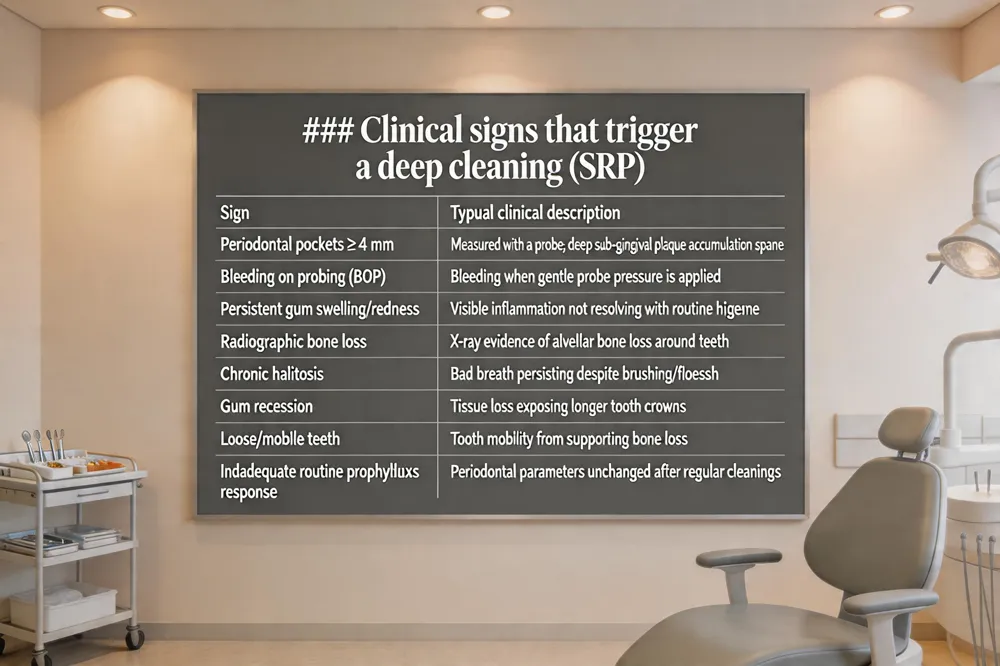 Clinical signs that trigger a deep cleaning include periodontal pockets 4 mm or deeper, bleeding on probing, persistent gum swelling or redness, radiographic bone loss, chronic halitosis, gum recession that lengthens tooth crowns, and loose or mobile teeth. When routine prophylaxis cannot control these symptoms, a therapeutic deep cleaning is indicated.
Step‑by‑step of Scaling and root planing:
- Assessment – Oral exam, periodontal probing, and x‑rays determine pocket depths and bone loss.
- Anesthesia – Local anesthetic numbs the gums for comfort.
- Scaling – Hand scalers or ultrasonic instruments remove plaque and tartar above and below the gum line.
- Root Planing – Curettes smooth the exposed root surfaces within the pockets, eliminating rough spots where bacteria can re‑attach.
- Adjunctive Therapy – Local or oral antibiotics may be placed to reduce bacterial load.
- Post‑procedure care – Gentle brushing, warm salt‑water rinses, soft foods, and OTC pain relievers aid healing.
How SRP differs from routine prophylaxis: Scaling and root planing removes sub‑gingival deposits and smooths root surfaces, targeting periodontal pockets and disease progression. Routine prophylaxis cleans only the visible tooth surfaces above the gum line and does not address deep pockets. SRP is a non‑surgical, first‑line treatment for moderate to severe periodontitis, whereas prophylaxis is a preventive maintenance measure.
What is the difference between scaling and root planing? Scaling and root planing removes plaque, tartar, and bacterial buildup from the visible surfaces of the teeth, both above the gum line and, when needed, just below it, using hand or ultrasonic scalers. Root planing goes a step deeper: it smooths the exposed root surfaces beneath the gum line with curettes or similar instruments so the gums can re‑attach more securely and future plaque can’t easily accumulate. While scaling primarily addresses the outer tooth surfaces, root planing targets the root structure within periodontal pockets created by gum disease. Because it removes and planar the root, root planing is typically reserved for patients with moderate to severe periodontitis, whereas scaling is part of routine or deep cleaning. Together they form a "deep cleaning" that helps eliminate infection, reduce inflammation, and protect both oral and overall health.
When is a deep cleaning (periodontal cleaning) truly necessary? A deep cleaning—also called scaling and root planing—is truly necessary when clinical signs of periodontal disease are present, such as periodontal pockets that are 4 mm or deeper or bleeding on probing. Radiographic evidence of bone loss, persistent gum swelling or redness, and gum recession that reveals longer tooth crowns also indicate the need for a therapeutic cleaning. Other warning signs include chronic bad breath that doesn’t improve with routine hygiene, loose or mobile teeth, and persistent gum bleeding during brushing or flossing. When these conditions cannot be controlled with a standard prophylactic cleaning, the dentist or hygienist will recommend a deep cleaning to remove sub‑gingival plaque and calculus and halt disease progression. After the initial treatment, regular periodontal maintenance every 3–4 months is often advised to keep the condition stable.
Cost and Insurance Landscape
Typical cost ranges for scaling and root planing (SRP)
| Pricing source | Per‑quadrant cost (USD) | Full‑mouth cost (4 quadrants) | Patient out‑of‑pocket range |
|---|---|---|---|
| General market average | $240 – $285 | $960 – $1,140 | $600 – $1,600 |
| National survey (average) | $242 (average) | ≈ $970 | $150 – $400 per quadrant |
| Humana pricing tool | $198 – $272 | $792 – $1,088 | — |
| Aspen Dental (average) | $289 | $1,156 | — |
| Out‑of‑pocket (low‑end) | $150 | $600 | — |
| Out‑of‑pocket (high‑end) | $400 | $1,600 | — |
Insurance coverage: Most plans cover SRP as medically necessary, paying 50 %–80 % after deductible; patient pays remaining co‑pay and any non‑covered items.
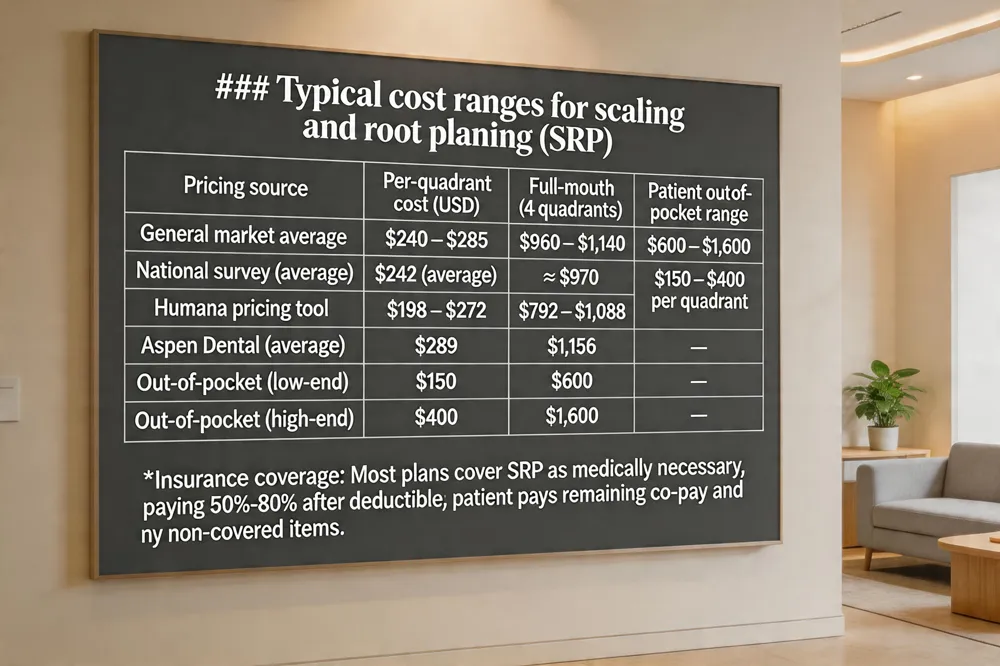 Scaling and root planing (SRP) typically costs $240 – $285 per quadrant in the United States, which works out to roughly $1,000 – $1,600 for a full‑mouth deep cleaning. National surveys show an average per‑quadrant price of $242, with a broader range of $185 – $444 depending on the practice and region. Humana’s pricing tool lists $198 – $272 per quadrant, while Aspen Dental averages $289 per quadrant. When patients pay out‑of‑pocket, the per‑quadrant range is usually $150 – $400, so a complete mouth can total $600 – $1,600; some offices quote $250 – $400 per quadrant, pushing the full‑mouth cost to $1,200 – $2,000. Factors that influence cost include geographic location, whether a periodontist or general dentist performs the procedure, the severity of disease, and any adjunctive services such as X‑rays, local antibiotics, or anesthesia. Most dental insurance plans cover SRP as a medically necessary treatment for periodontitis, typically paying 50 %–80 % of the fee after the deductible is met; patients are responsible for the remaining co‑pay and any non‑covered items. Understanding these variables helps patients anticipate out‑of‑pocket expenses and plan for any supplemental coverage or payment options.
Appointment Logistics and Duration
Typical appointment structures
| Visit plan | Approx. chair‑time | Number of quadrants treated | Notes |
|---|---|---|---|
| One‑visit full‑mouth | 90 – 120 min | All 4 quadrants | May be broken into two 60‑minute sessions for comfort |
| Two‑visit split | 60 – 90 min each | 2 quadrants per visit | Reduces fatigue; convenient for anxious patients |
| Single‑quadrant (rare) | 30 – 45 min | 1 quadrant | Often used for maintenance after initial deep cleaning |
Anesthesia: Local anesthetic used in all visits to keep patient comfortable.
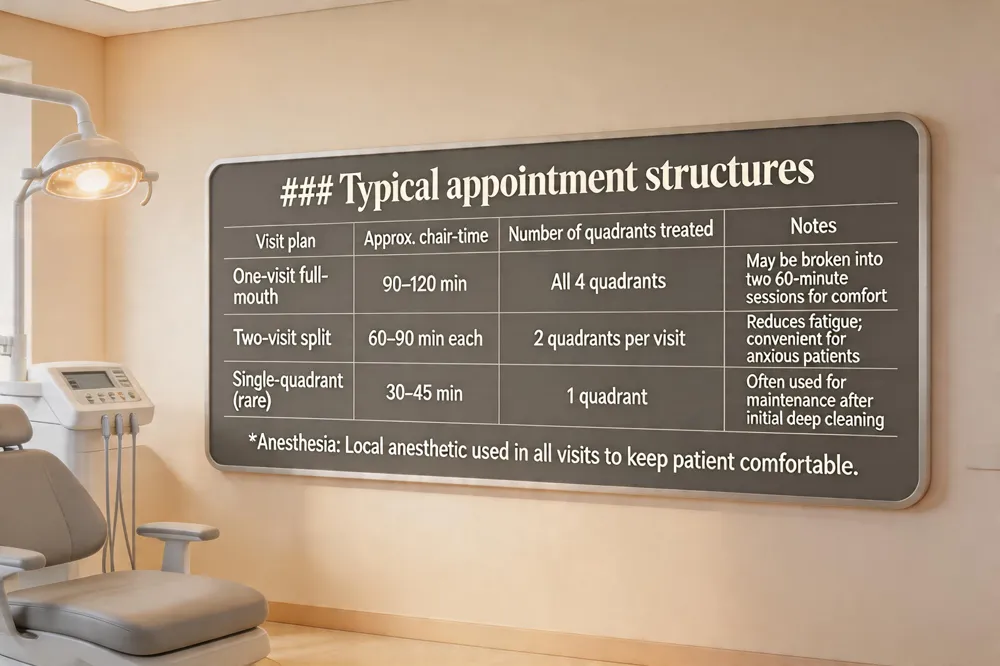 Scaling and root planing (SRP) is a deep‑cleaning procedure that typically requires one to two hours of chair‑time. Most clinicians treat one side of the mouth at a time, so a full‑mouth cleaning is often split into two appointments, each lasting about 60–90 minutes. When the entire mouth is addressed in a single visit, the session can extend toward the two‑hour mark, but local anesthesia keeps the experience comfortable throughout.
One‑visit vs. two‑visit plans – The decision depends on the extent of periodontal disease, the patient’s comfort level, and insurance coverage. A two‑visit approach reduces fatigue and allows the dentist to focus on each quadrant, while a one‑visit schedule is convenient for patients who prefer fewer office trips. Both strategies aim to remove plaque and tartar above and below the gumline and to smooth the root surfaces.
Patient rights – You have the right to decline any recommended procedure, including SRP. The dentist must explain why the deep cleaning is advised, outline the risks of untreated gum disease (bone loss, tooth mobility, systemic health impacts), and discuss alternatives. If you choose to refuse, you may be asked to sign an informed‑refusal form to document that the risks were explained. While refusal is permitted, postponing treatment can allow disease progression, potentially leading to more invasive and costly interventions later.
Post‑Procedure Care and Pain Management
Post‑procedure care timeline & pain statistics
| Time after SRP | Recommended actions |
|---|---|
| 0–2 h (while anesthetic wears off) | Wait before eating; keep soft, cool foods |
| 0–24 h | Avoid hard, crunchy, spicy, very hot/cold, acidic foods; no smoking or alcohol‑based mouthwashes |
| 24–72 h | Warm salt‑water rinse 3‑5 times/day (½ tsp salt per cup water); soft‑bristled brushing, desensitizing toothpaste |
| 72 h onward | Resume normal diet; continue gentle oral hygiene; schedule follow‑up in 4‑6 weeks |
Pain level distribution (survey):
- Faint‑to‑weak: 28 %
- Weak‑to‑mild: 18 %
- Mild‑to‑moderate: 28 %
- Moderate‑to‑strong: 8 %
- Strong‑to‑intense: 8 %
Pain control: Ibuprofen 200 mg (3 × every 3 h) or acetaminophen; do not exceed 3 days without dental advice.
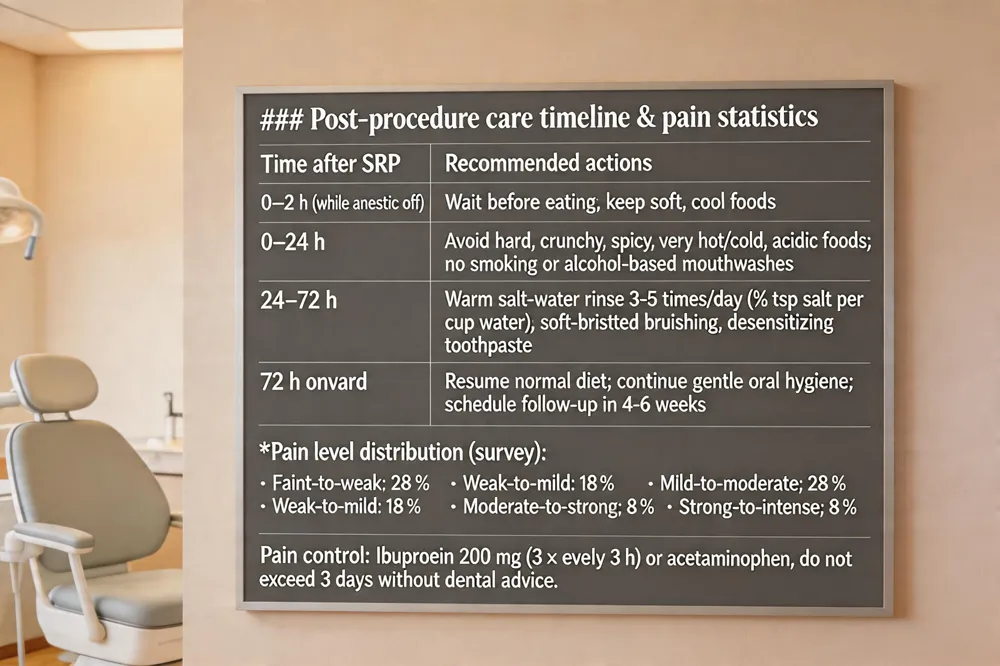 After scaling and root planing, start with gentle care. Wait until the local anesthetic wears off before eating, then stick to soft, cool foods—yogurt, mashed potatoes, scrambled eggs—for the first 48‑72 hours. Avoid hard, crunchy, spicy, very hot or cold, and acidic items, and refrain from smoking or alcohol‑based mouthwashes because they impair healing. Rinse the mouth 3‑5 times daily with warm salt water (½ tsp salt per cup of water) to reduce irritation and swelling. Use a soft‑bristled toothbrush and a desensitizing toothpaste, brushing lightly around the treated sites; postpone flossing for the first 24 hours.
Post‑procedure discomfort is usually mild to moderate. Over‑the‑counter ibuprofen (200 mg) or acetaminophen can control pain; the 3‑3‑3 dental rule recommends three 200 mg ibuprofen tablets taken every three hours, not exceeding three days. Most patients report only faint‑to‑weak or mild pain; surveys show about 28 % feel faint‑to‑weak, 18 % weak‑to‑mild, 28 % mild‑to‑moderate, and only 8 % each moderate‑to‑strong or strong‑to‑intense pain. If pain persists beyond a few days, swelling worsens, or bleeding does not stop, contact your dentist promptly. Schedule the follow‑up visit, usually 4‑6 weeks later, and take any prescribed antibiotics or antimicrobial rinses as directed to ensure complete healing.
Risks, Disadvantages, and Patient Rights
Common side effects & patient‑rights checklist
| Side effect | Typical frequency | Management |
|---|---|---|
| Mild gum tenderness & swelling | Very common | Soft diet, salt‑water rinses |
| Increased tooth sensitivity | Common | Desensitizing toothpaste, avoid extreme temperatures |
| Minor bleeding while brushing | Common | Gentle brushing, monitor for prolonged bleeding |
| Slight gum recession | Occasional | Discuss with dentist; monitor attachment levels |
| Root surface infection (rare) | Uncommon | Antibiotics if prescribed, contact dentist promptly |
| Nerve irritation / temporary loose feeling | Rare | Follow‑up visit, possible additional evaluation |
Patient rights:
- Right to informed consent – dentist must explain why SRP is needed, risks of untreated disease, and alternatives.
- Right to decline – can sign an informed‑refusal form.
- Right to ask for a second opinion or different treatment plan.
- Right to receive a clear cost estimate before treatment.
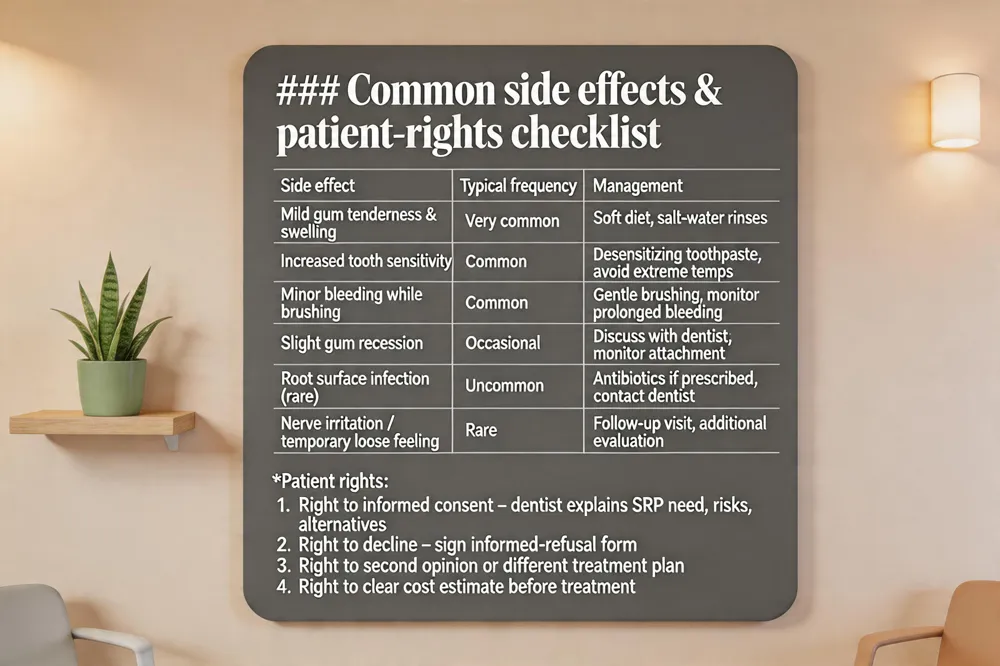 Scaling and root planing (SRP) is a safe, nonsurgical deep cleaning, but it does carry short‑term side effects and, rarely, more serious complications. Most patients experience mild gum tenderness, swelling, and increased tooth sensitivity for a few days to a week after the procedure. Minor bleeding while brushing and a slight gum recession are common as inflamed tissue heals. In uncommon cases, the exposed root surface can become infected, and nerve irritation or temporary loose feeling of teeth may occur. Because SRP often requires two or more appointments, it can be more costly and time‑consuming than a routine prophylaxis.
A deep cleaning is unnecessary when clinical signs of periodontal disease are absent. Healthy gums with no pockets deeper than 3 mm, no bleeding, recession, or bone loss can be maintained with regular cleanings and diligent at‑home oral hygiene. Early inflammation that resolves with improved brushing or interdental cleaning also does not require SRP. Decision‑making should be based on a thorough examination and individualized risk assessment.
Before the appointment, avoid aggressive brushing, heavy meals, coffee, tea, alcohol, nicotine, and any whitening products. Do not smoke, and stay well‑hydrated with water. If you feel ill, anxious, or are running late, notify the office so accommodations can be made.
Oral Hygiene Rules and Long‑Term Maintenance
3‑3‑3 oral‑hygiene rule & maintenance schedule
| Rule component | Action | Frequency |
|---|---|---|
| Brush | Use soft‑bristled brush (or electric head) | 3 × daily (after meals and before bed) |
| Brush duration | Full 3 minutes per session | Every brushing |
| Floss / interdental cleaner | Clean between teeth | After each brushing (or at least once daily) |
| Replace brush | New brush or head when bristles fray | Every 3 months (or sooner) |
Professional maintenance:
- Prophylaxis (routine cleaning) every 6 months for healthy gums.
- Deep‑cleaning follow‑up (SRP) every 3‑6 months initially, then based on periodontal stability.
- Periodic pocket‑depth checks and X‑rays as advised by dentist.
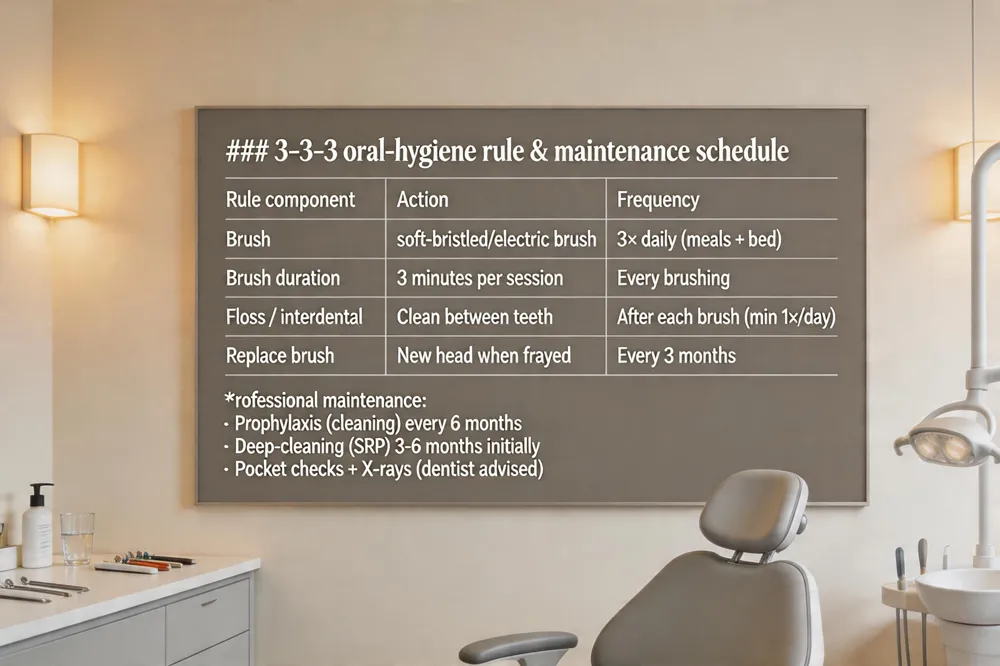 The 3‑3‑3 rule for oral hygiene is a simple, memorable guideline: brush three times a day—after breakfast, after lunch, and before bedtime—for a full three minutes each session, then floss or use an interdental cleaner to clean between teeth, and replace your toothbrush (or electric brush head) every three months or sooner if the bristles fray. This routine removes plaque, reduces cavities and gum disease, and supports a brighter smile.
Routine teeth scaling (prophylaxis) removes plaque and tartar from the visible surfaces of the teeth and just above the gum line and is usually performed every six months for preventive care. A deep cleaning, known as scaling and root planing, goes beneath the gum line to eliminate deposits from tooth roots and smooth those roots, targeting periodontal pockets caused by gum disease. Deep cleaning often requires local anesthesia, may be split into one or two visits, and is reserved for patients with mild to moderate periodontitis. While scaling maintains healthy gums, root planing actively treats disease and helps gum tissue re‑attach.
Maintaining SRP results hinges on diligent at‑home care and regular professional check‑ups. After a deep cleaning, patients should continue brushing twice daily with a soft brush, floss gently, use antimicrobial mouthwash as directed, and schedule follow‑up cleanings every three to six months. These periodic visits allow the dentist to monitor pocket depths, reinforce oral‑hygiene habits, and intervene early if signs of disease return, ensuring long‑term gum health and tooth preservation.
Your Path to a Healthier, Confident Smile
Scaling and root planing (SRP) is a non‑surgical, deep‑cleaning treatment that removes plaque and tartar above and below the gumline and smooths tooth roots to prevent bacterial re‑attachment. It is the first‑line therapy for mild to moderate gum disease, helping to reduce bad breath, gum bleeding, swelling, and the risk of tooth loss while supporting overall systemic health. The procedure is typically performed by a dentist, periodontist, or trained hygienist under local anesthesia, takes 45‑120 minutes per quadrant, and may be completed in one or two visits depending on disease severity. Post‑procedure discomfort is usually mild—temporary gum tenderness, slight bleeding, and increased tooth sensitivity that resolve within a few days with OTC pain relievers, soft foods, and gentle oral‑hygiene practices such as soft‑bristle brushing, flossing after 24‑hours, and antimicrobial rinses.
If you notice swollen, bleeding gums, persistent bad breath, or deeper pockets during a routine check‑up, discuss SRP options with Dr. Moezinia and the Empower Your Smile team. They will evaluate your periodontal health, tailor a treatment plan, and may incorporate adjunctive antibiotics or local drug delivery when needed.
Take the next step toward a healthier, more confident smile—schedule a personalized consultation today. The team will walk you through what to expect, answer any questions, and set up a follow‑up schedule to keep your gums strong and your smile bright.